
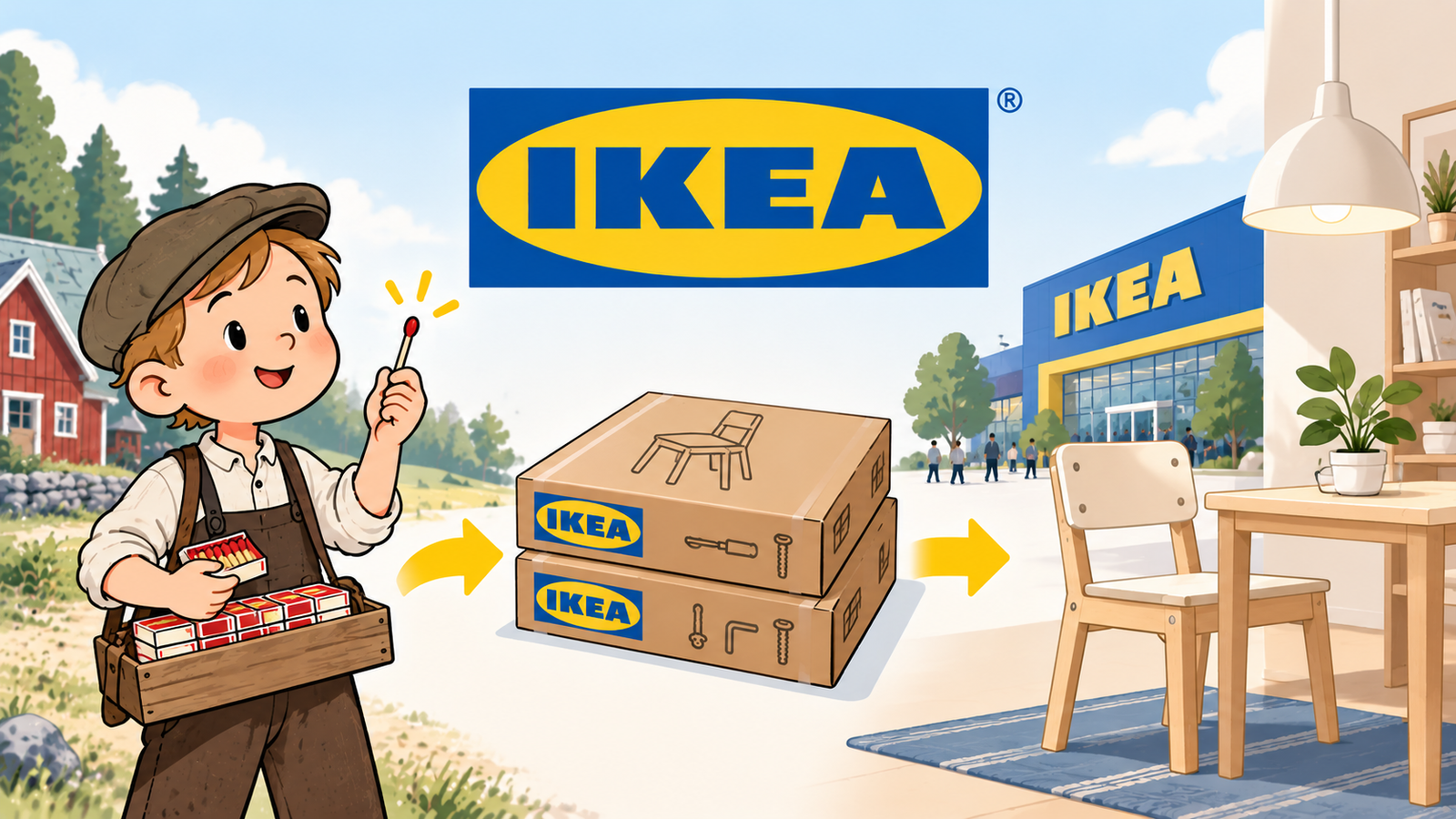
The Economics of Low Prices Began with Small Savings
In a small rural village in Sweden, there once lived a boy who loved selling things.
The first thing he sold was nothing grand. It was matches.
He bought matches cheaply in bulk and sold them individually to his neighbours. The profit from each box was tiny, but the young boy discovered something important:
The lesson was simple: buy cheaply, keep the price affordable, and small profits can grow when enough people buy.
His name was Ingvar Kamprad.
He would later become the founder of IKEA, one of the world’s best-known furniture companies.
A Business That Began with Matches
Kamprad was born in 1926 in Småland, a rural region in southern Sweden.
The land was relatively poor, and life was not easy. People learned to make the most of limited resources, placing a high value on thrift, practicality, and avoiding waste.
From an early age, Kamprad was fascinated by buying and selling things.
He started with matches, then moved on to seeds, Christmas cards, pencils, pens, and other small items that he could sell to neighbours.
What is interesting is that Kamprad did not simply ask, “How much can I charge?”
He thought about the opposite question:
How could he keep prices low while still building a sustainable business?
This idea would later become one of the keys to understanding IKEA.
Most companies make a product first and then decide what price to charge.
But IKEA approached the problem differently.
First, think about a price that ordinary people can afford. Then design the product and the way it is made to fit that price.
IKEA Founded by a 17-Year-Old
In 1943, when Kamprad was 17, his father gave him a small sum of money as a reward for doing well in school.
Kamprad used that money to start a business.
That business was IKEA.
The name IKEA itself reflects Kamprad’s roots:
I — Ingvar
K — Kamprad
E — Elmtaryd
A — Agunnaryd
The first two letters come from his name, while the last two come from the farm and village where he grew up.
IKEA did not begin as a furniture company.
It initially sold various household items such as pens, wallets, and picture frames. Furniture was added to IKEA’s range in 1948.
As the furniture business grew, Kamprad began focusing on an important problem.
Why Should Good Furniture Be Expensive?
At the time, well-designed furniture was often too expensive for ordinary families.
Furniture was large and heavy.
Manufacturing cost money, of course, but so did storing finished furniture in warehouses and transporting it over long distances.
Kamprad began asking a simple question:
“Why shouldn’t ordinary people be able to buy well-designed furniture at an affordable price?”
Lowering prices required more than simply using cheaper materials.
IKEA had to rethink the entire process — design, production, packaging, transportation, storage, and retailing.
From this thinking came one of the ideas that would eventually define IKEA.
“Why Transport Furniture Fully Assembled?”
Imagine a large table.
A fully assembled table with its legs attached takes up a lot of space in a truck.
But what if the legs were removed and the tabletop and other parts were packed into a flat box?
Suddenly, many more tables could fit into the same truck.
They would also take up less warehouse space and could be easier to handle during transportation.
During the 1950s, IKEA increasingly developed the flat-pack model and customer self-assembly that would become central to its business.
This was more than a new way of packaging furniture.
It changed the economics of furniture.
Why Does Assembling It Yourself Make It Cheaper?
There is an interesting economic principle behind this.
In a traditional furniture business, the company performs many of the tasks.
It assembles the product, stores it, provides sales assistance, and transports the finished furniture.
Every one of these activities costs money.
Ultimately, those costs are reflected in the price paid by the customer.
IKEA shifted some of that work to the customer.
Customers pick up flat-packed products, take them home, and assemble the furniture themselves using instructions.
It requires a little more effort.
But in return, there is more room to keep prices down.
In economic terms, some of the work once performed by the company is transferred to the consumer, and the consumer receives a lower price in return.
We can see similar arrangements in everyday life.
At a self-service petrol station, we fill the tank ourselves. When we book a flight or hotel online, we perform tasks that were once handled by travel agents or other staff.
We do a little more of the work ourselves, and in return we can save money.
IKEA Sells More Than Furniture
There is something else interesting about visiting an IKEA store.
Imagine that you walk in intending to buy just one desk.
As you make your way through the store, however, you pass a living room, a bedroom, and a kitchen.
Then you begin to think:
“That lamp looks nice.”
“Actually, I could use one of those storage boxes too.”
By the time you reach the checkout, you may have more items than you originally planned to buy.
There is economics behind this too.
Consumers do not always make purchasing decisions by carefully calculating prices alone.
We buy by seeing, touching, and imagining.
Rather than displaying only a desk, IKEA shows us a room with the desk in it.
Instead of showing only a sofa, it shows us a complete living room.
Looking at that space, a customer may begin to imagine:
“Maybe my home could look like this too.”
So IKEA is not simply selling wood, screws, tables, and chairs.
In a sense, it is also selling the possibility that “at this price, I might be able to create a home like this.”
How Saving $1 Can Become $10 Million
Another important part of IKEA-style thinking is attention to small costs.
Suppose a company finds a way to save just $1 on a single product.
That may not sound significant.
But if it sells 10 million units, the calculation changes dramatically:
$1 × 10 million units = $10 million
Make the box slightly smaller.
Use a little less transportation space.
Simplify one step in production.
Each change may seem tiny.
But when repeated across millions of products, small savings can become enormous.
This is where economies of scale become important.
If a company can produce and distribute large quantities while reducing the cost per unit, it can offer lower prices.
Lower prices can attract more customers.
Higher sales volumes can then create further opportunities to make production and distribution more efficient.
This kind of cycle became an important part of IKEA’s growth.
Does a Low Price Have to Mean Low Quality?
We often assume that a cheaper product must also be a lower-quality product.
But Kamprad’s question was somewhat different:
The challenge was to reduce unnecessary costs without simply sacrificing quality.
Flat-packing furniture,
using less transportation space,
making better use of warehouse space,
and asking customers to assemble products themselves are different from simply using inferior materials.
Economists might look at these changes in terms of productivity.
If we can produce more with the same resources, or provide the same product at a lower cost, productivity has improved.
And when productivity improves, products that were once affordable only to a relatively small group can become accessible to many more people.
Cars followed this path.
So did refrigerators.
Computers and smartphones went through similar transformations.
Products that were once expensive and unusual gradually became part of everyday life through mass production, innovation, and greater efficiency.
Frugality Became a Business Philosophy
Kamprad grew up in Småland, a region where people had a strong tradition of making careful use of limited resources.
That background later influenced IKEA’s corporate culture.
The basic idea was simple:
Reduce unnecessary costs, and you can offer customers lower prices.
Packaging designed for efficient transportation rather than elaborate presentation.
Products designed to be easier to manufacture rather than unnecessarily complicated.
Flat packs that take up less space rather than expensive ways of transporting fully assembled furniture.
Seen this way, IKEA’s innovation did not necessarily come from one spectacular technological invention.
Much of it came from repeatedly asking a small question:
“Is this cost really necessary?”
An Economic Story That Began with a Box of Matches
If we see Kamprad’s life only as the success story of a young salesman who became a global entrepreneur, we may miss the most interesting part.
What makes his story especially useful is the way he thought about price.
A price is not simply a number printed on a product.
Behind that number are material costs,
labour costs,
warehouse costs,
transportation costs,
and the way the product is sold.
Change one of those elements, and the price may change too.
And when the price falls far enough, people who previously could not afford the product can become new customers.
Lower prices can create new markets.
As a boy selling matches, Kamprad encountered this principle on a very small scale.
Buy in larger quantities and the purchase price may fall.
Sell at an affordable price and more people may buy.
Repeat a small profit many times and it can eventually become substantial.
That simple idea later developed into an important part of the philosophy behind one of the world’s best-known furniture companies.
One Economic Thought for Today
Economics does not always begin with enormous numbers or complicated theories.
It can begin with something as simple as thinking about the price of a box of matches.
How can we make something a little cheaper?
How can we make a good product affordable to ordinary people?
Where are money, time, and space being wasted?
IKEA grew in part by asking questions like these again and again.
The economic lesson in Kamprad’s story is surprisingly simple:
Big changes sometimes begin with small savings.
And a good business does not always begin by finding the most expensive thing to sell.
Sometimes it begins by finding a way for more people to afford something useful.
Sources
- IKEA — From Humble Origins to Global Brand: A Brief History of IKEA
- IKEA Museum — The Birth of IKEA
- IKEA Museum — Flatpacks: A Flatter Furniture Future
☕ A Moment to Pause
As we come to the end of today’s story from Sweden, take a moment to slow down and enjoy a warm, familiar song.