
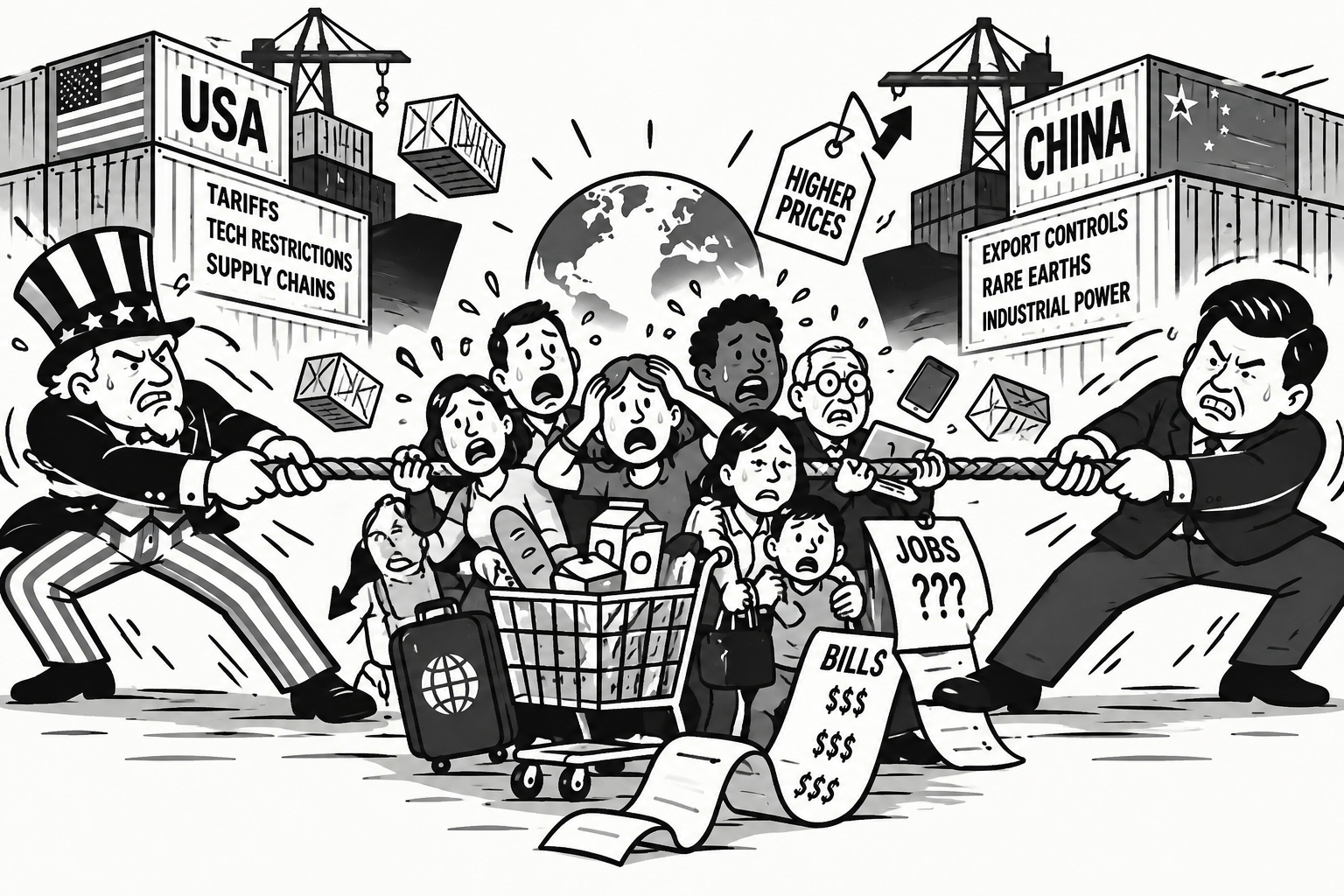
How Global Trade Conflicts Reach Ordinary Families — and What We Can Do
When we hear about a trade conflict between the United States and China, it can seem very far away.
Tariffs. Semiconductors. Export controls. Supply chains.
These sound like problems for presidents, economists and multinational companies.
But eventually, they can arrive somewhere much closer to home:
our kitchen table.
The price of a laptop may rise. A household appliance may become more expensive. Businesses may face higher costs. Interest rates and exchange rates may move. Some jobs may become less secure while new opportunities appear elsewhere.
So today, instead of asking who is winning the trade conflict, let’s ask a more practical question:
What does it mean for ordinary people?
The World Is More Connected Than We Think
Imagine buying a smartphone.
It may be designed in one country, use chips made in another, contain components from several Asian economies, be assembled somewhere else, and finally be sold in New Zealand, Europe or America.
Modern trade works through enormous international networks.
This has helped companies lower costs and given consumers access to affordable products from around the world.
But there is another side.
The more connected economies become, the more a disruption in one place can travel to another.
A tariff in Washington or an export restriction in Beijing may therefore eventually affect a family thousands of kilometres away.
What Happens When a Tariff Is Introduced?
Suppose an imported product costs $100.
A government imposes a tariff on that product.
The importer now has an additional cost.
What happens next?
The company has several choices.
It can absorb the cost and accept lower profits. It can ask its suppliers for lower prices. It can find another supplier. Or it can increase the price paid by customers.
Usually, some combination occurs.
Recent Federal Reserve research found clear evidence that the 2025 U.S. tariffs gradually pushed up consumer goods prices. The effect did not necessarily appear overnight. Some of it travelled slowly through inventories, wholesalers and supply chains.
That is an important point.
A trade conflict may begin at the border, but part of the cost can eventually reach the checkout counter.
The Effect Does Not Stop at Imported Goods
Suppose a local manufacturer does not import the finished product at all.
Does that mean it is protected?
Not necessarily.
Perhaps it imports machinery, electronic components, packaging, chemicals or raw materials.
If those inputs become more expensive, the local producer’s costs can rise too.
This is why trade barriers can sometimes affect the prices of domestically produced goods as well as imports.
The economic chain can look something like this:
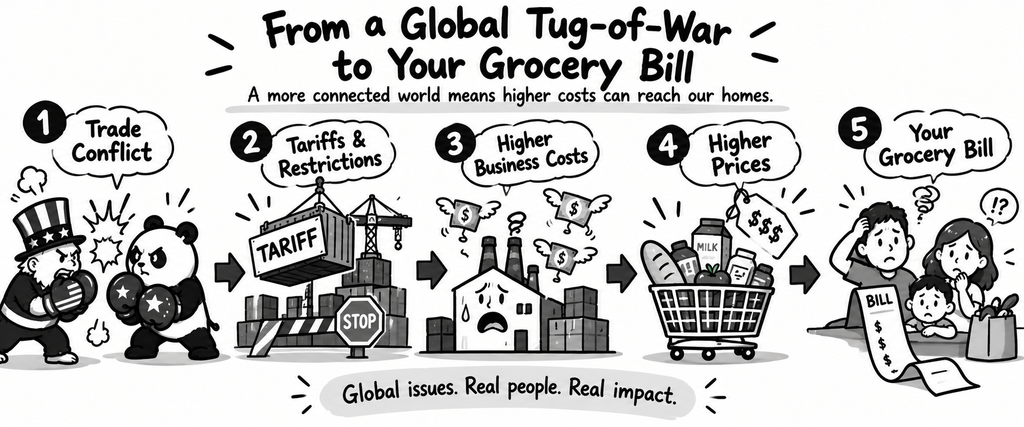
And sometimes the chain continues:
Inflation → Interest rates → Mortgages and borrowing costs
Higher inflation can influence interest-rate decisions, although central banks consider many other economic factors as well.
Suddenly, an international dispute does not feel quite so distant.
Companies Start Moving Their Supply Chains
Businesses do not simply sit still when tariffs rise.
They adapt.
A company that once relied heavily on factories in China may look for suppliers in Vietnam, India, Mexico or elsewhere.
Another company may decide to produce more goods closer to its customers.
This is often called supply-chain diversification.
But changing a supply chain is not like changing supermarkets.
Companies must find suppliers, negotiate contracts, test quality, arrange transportation and sometimes build entirely new factories.
An IMF analysis illustrates how slow this adjustment can be. Under an extreme hypothetical tariff shock between the United States and China, its model suggests that fully reorganising supply chains could take around four to five years.
So the world economy can adapt.
But adaptation takes time — and time costs money.
Does This Mean Globalisation Is Ending?
Probably not.
The story is more complicated.
The World Trade Organization expects world merchandise trade to continue growing in 2026, although more slowly than in 2025.
Despite the headlines about trade wars and economic nationalism, much of global trade continues through established international trading networks.
So we should be careful about dramatic predictions that the world economy is simply breaking into two completely separate camps.
A better description may be:
Globalisation is not disappearing. It is changing.
Companies increasingly think not only about the cheapest supplier, but also about reliability, political risk and security.
Efficiency is still important.
But resilience is becoming important too.
What Does All This Mean for an Ordinary Family?
This is where economics becomes personal.
Imagine a family planning to replace its refrigerator.
At the same time, mortgage payments are taking a large part of household income.
Petrol and food prices have risen.
The family also has retirement savings invested in financial markets.
Now consider what international economic tensions can potentially influence:
Prices.
Interest rates.
Exchange rates.
Investment markets.
Business confidence.
Employment.
No family can control all these forces.
But families can control something else:
how prepared they are for uncertainty.
Five Sensible Responses for Ordinary People
Keep Some Financial Breathing Room
When the world becomes uncertain, flexibility becomes valuable.
A household with some emergency savings has more choices when prices rise, income falls temporarily or an unexpected bill arrives.
The objective is not to predict the next crisis.
It is simply to avoid being financially trapped when something unexpected happens.
Be Patient With Large Purchases
During periods of volatile prices, comparing alternatives becomes more valuable.
Do we need to replace the car immediately?
Can the appliance last another year?
Is there a locally produced or differently sourced alternative?
Sometimes the best economic decision is simply not to rush.
Avoid Putting Everything in One Basket
The same principle businesses use for supply chains can also be useful in personal finance: diversification.
Depending too heavily on one company, one industry, one investment or one economic scenario can create unnecessary vulnerability.
Diversification cannot eliminate risk.
But it can reduce the damage when one particular part of the economy suffers.
Don’t Try to Predict Every Political Headline
Markets can move dramatically after announcements about tariffs, wars or international negotiations.
That can tempt people to make quick financial decisions.
But today’s frightening headline can be followed by tomorrow’s agreement — and tomorrow’s optimism can disappear just as quickly.
For most households, building resilience is more realistic than trying to predict geopolitics.
Invest in Your Own Ability to Adapt
Perhaps the most overlooked investment is ourselves.
Trade patterns will change.
AI will change industries.
Some jobs will disappear and new ones will appear.
Learning new technology, improving professional skills and remaining willing to adapt may ultimately provide more protection than trying to guess which country or market will win the next economic battle.
A Lesson From the Global Economy
For decades, globalisation was largely built around one powerful idea:
efficiency.
Produce each product where it can be made most cheaply, connect the world through trade, and everyone can benefit from lower costs and larger markets.
That idea has not disappeared.
But another word is becoming increasingly important:
resilience.
Businesses are learning that the cheapest supply chain is not always the safest supply chain.
Countries are learning that dependence can create vulnerability.
And perhaps households can learn something similar.
The cheapest lifestyle is not necessarily the strongest financial position.
Having some savings, manageable debt, diversified investments and adaptable skills may look less exciting than trying to predict the next economic boom.
But in an uncertain world, those things provide something valuable:
room to move.
The Bottom Line
We cannot control relations between Washington and Beijing.
We cannot know where the next trade dispute will begin.
And we certainly cannot predict every movement in prices, currencies or financial markets.
But we don’t need to.
Perhaps the wisest response to an uncertain global economy is surprisingly simple:
Don’t try to predict every storm.
Build a stronger umbrella.
That may be one of the most useful economic lessons ordinary families can take from today’s changing world.
A Moment to Relax
Economics is important — but sometimes it is also good to stop looking at charts, prices and headlines for a few minutes.
Make a cup of coffee, take a short break, and enjoy some music.
The world economy will still be there when the song ends.
Sources
- Federal Reserve Board — The Slow Climb: How Tariffs Gradually Raised Retail Prices in 2025
- International Monetary Fund — United States: 2026 Article IV Consultation
- World Trade Organization — Global Trade Outlook and Statistics — March 2026