
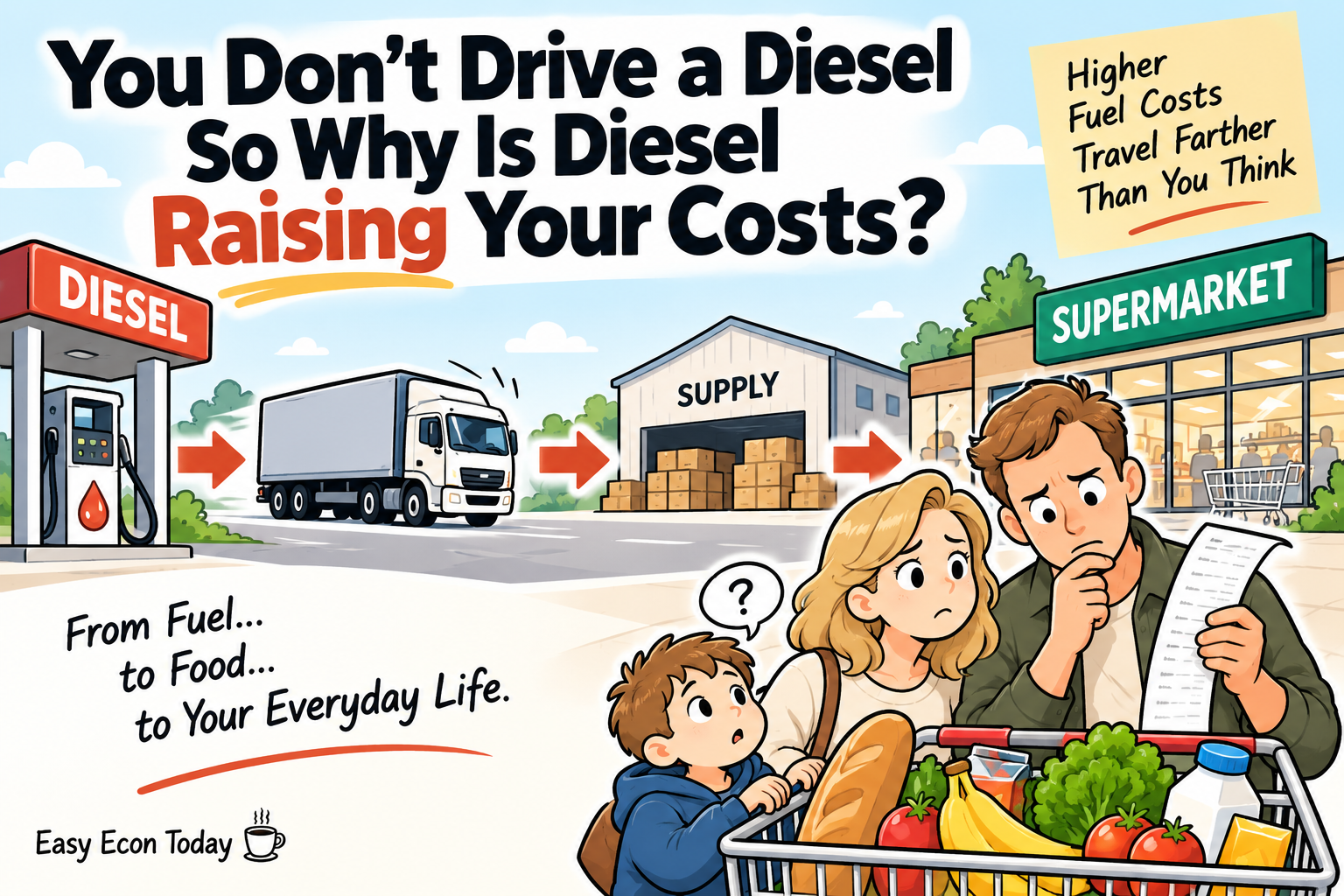
The fuel you may never buy can still reach your wallet
You stop at the supermarket on the way home.
A carton of milk costs a little more.
Fruit seems more expensive.
The price of bread has moved up again.
You may wonder: Why does everything keep getting more expensive?
And then you hear on the news that diesel prices are rising.
Perhaps you drive an electric car. Maybe your car runs on petrol. Or perhaps you hardly drive at all.
So you might reasonably ask:
What does the price of diesel have to do with me?
Quite a lot, as it turns out.
Diesel is one of those prices we rarely notice until something goes wrong. Yet it sits quietly behind much of the modern economy.
The food in your supermarket, the package delivered to your door, the materials used to build your house and even some of the machinery used to produce your food may all depend on diesel somewhere along the way.
And right now, that hidden cost is becoming harder to ignore.
Diesel Is the Fuel Behind the Things We Buy
Think about a simple bag of potatoes.
Before it reaches your kitchen, the potatoes have to be planted, harvested, sorted, packaged and transported.
Farm machinery may use diesel.
A truck carries the potatoes from the farm.
Another truck may take them to a distribution centre.
And another vehicle eventually delivers them to your supermarket.
The customer buying the potatoes may never purchase a litre of diesel.
But diesel has been travelling with those potatoes almost the entire way.
The same principle applies to thousands of products.
Clothing, furniture, electronics, construction materials and groceries all have to move.
And much of that movement still depends on trucks, ships, trains and heavy machinery.
This is why diesel is different from many other prices.
When diesel becomes expensive, the cost can travel through the economy.
Why Is Diesel So Expensive Now?
The current problem isn’t simply that crude oil has become more expensive.
A barrel of crude oil cannot be poured directly into a truck. It first has to be processed by a refinery into products such as petrol, diesel and jet fuel.
And refining has become an important bottleneck.
Recent disruptions in the Middle East and damage to refining capacity connected with conflicts elsewhere have reduced the amount of diesel reaching international markets. Inventories are also unusually tight in several major markets.
That combination has pushed diesel prices sharply higher.
In the United States, the average retail diesel price reached $6.29 a gallon in mid-September, according to the U.S. Energy Information Administration.
That matters far beyond the fuel station.
Because when the trucker’s bill rises, somebody eventually has to pay it.
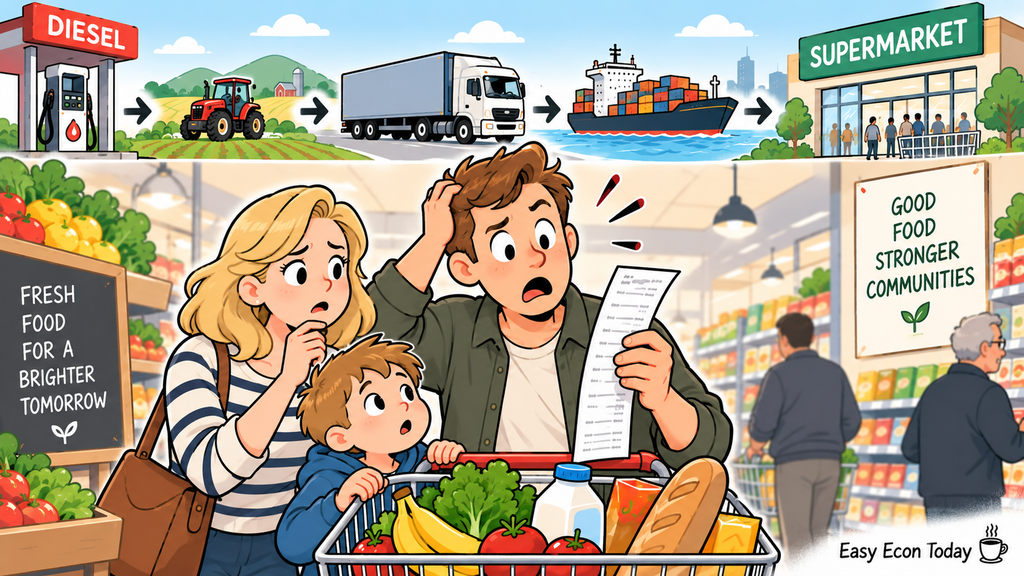
The price of fuel rarely stays at the pump.
From the Truck to the Supermarket Shelf
Imagine that transporting a truckload of groceries used to cost $1,000.
Now suppose higher diesel prices push that cost to $1,150.
The trucking company cannot absorb higher fuel bills forever. It may eventually charge the distributor more.
The distributor may charge the supermarket more.
And the supermarket may eventually charge you more.
Not every increase is passed through immediately or completely. Businesses sometimes absorb part of the cost through lower profit margins.
But when fuel prices remain high for long enough, the pressure becomes harder to absorb.
That is how an energy problem gradually becomes a cost-of-living problem.
And transportation is only one part of the story.
Farmers use fuel.
Construction companies operate heavy machinery.
Mining companies move enormous quantities of material.
Airlines buy jet fuel.
Businesses pay more to receive supplies and send products to customers.
One expensive input can therefore appear in many different places.
New Zealand Shows How the Chain Works
New Zealand provides a particularly clear example.
The Reserve Bank of New Zealand said in September that conflict in the Middle East had pushed petrol and diesel prices higher.
Inflation had risen to 4.1% in the June quarter, with higher fuel prices playing an important role. The Bank also noted that higher fuel costs were making other goods and services, including food and flights, more expensive.
Living in New Zealand makes this connection particularly easy to see. We are a small economy far from many of the world’s major markets, so changes in global fuel and transport costs can eventually become very local — appearing in food prices, airfares and household bills.
Fuel prices rise.
Then transportation and production costs rise.
Some of those costs reach consumers.
Inflation becomes harder to bring down.
And then another part of your household budget can be affected.
Interest rates.
How Can Diesel Affect Interest Rates?
This connection is less obvious.
Central banks do not normally raise interest rates simply because diesel becomes expensive for a few weeks.
They are more concerned about what happens next.
Suppose higher fuel prices spread into food, transportation, airfares and other services.
Workers may then seek higher wages to compensate for the increased cost of living.
Businesses facing higher wages and energy costs may raise prices again.
If this process continues, a temporary energy shock can contribute to broader and more persistent inflation.
Central banks then face a difficult decision.
They cannot produce more diesel.
They cannot repair a refinery.
And they cannot make an oil tanker move faster.
What they can do is influence demand by changing interest rates.
Higher interest rates make borrowing more expensive. Households and businesses may spend and invest less, reducing some of the pressure on prices.
That is one reason an energy shock can eventually reach people who never buy diesel at all.
A higher fuel bill can become higher inflation.
And persistent inflation can contribute to higher interest rates.
One Price, Many Wallets
This is what makes diesel such an interesting economic story.
At first glance, it looks like a problem for truck drivers.
Look a little closer and you see farmers.
Then supermarkets.
Then manufacturers.
Then households.
And eventually, possibly, mortgages and other borrowing costs.
The journey might look something like this:
Diesel ↑ → Transport costs ↑ → Business costs ↑ → Consumer prices ↑ → Inflation pressure ↑ → Interest-rate pressure ↑
Of course, the real economy is more complicated than one simple chain.
Companies can change suppliers. Consumers can buy less. Governments can change fuel taxes. Oil prices can fall. Refineries can increase production.
But the basic lesson remains useful:
Prices are connected.
What Does This Mean for You?
There is no reason to panic every time diesel prices rise.
Energy markets can change quickly, and today’s record price does not tell us exactly where prices will be several months from now.
But sustained high diesel prices are worth watching because they can tell us something about the direction of transportation costs, food prices and inflation.
For households, that means looking beyond the petrol station.
Watch grocery bills.
Watch delivery costs.
Watch airfares.
And watch what central banks say about inflation.
Those seemingly separate stories may actually be connected.
The next time you see a headline saying diesel prices have reached another record, you might think:
“I don’t drive a diesel.”
But somewhere between a farm, a factory, a truck and your local supermarket, diesel may already be travelling toward your wallet.
Sources
Reserve Bank of New Zealand (RBNZ) — Monetary Policy Statement, September 2026
International Road Transport Union (IRU) — Diesel Prices Surpass Previous 2026 Records, September 2026
U.S. Energy Information Administration (EIA) — Gasoline and Diesel Fuel Update