
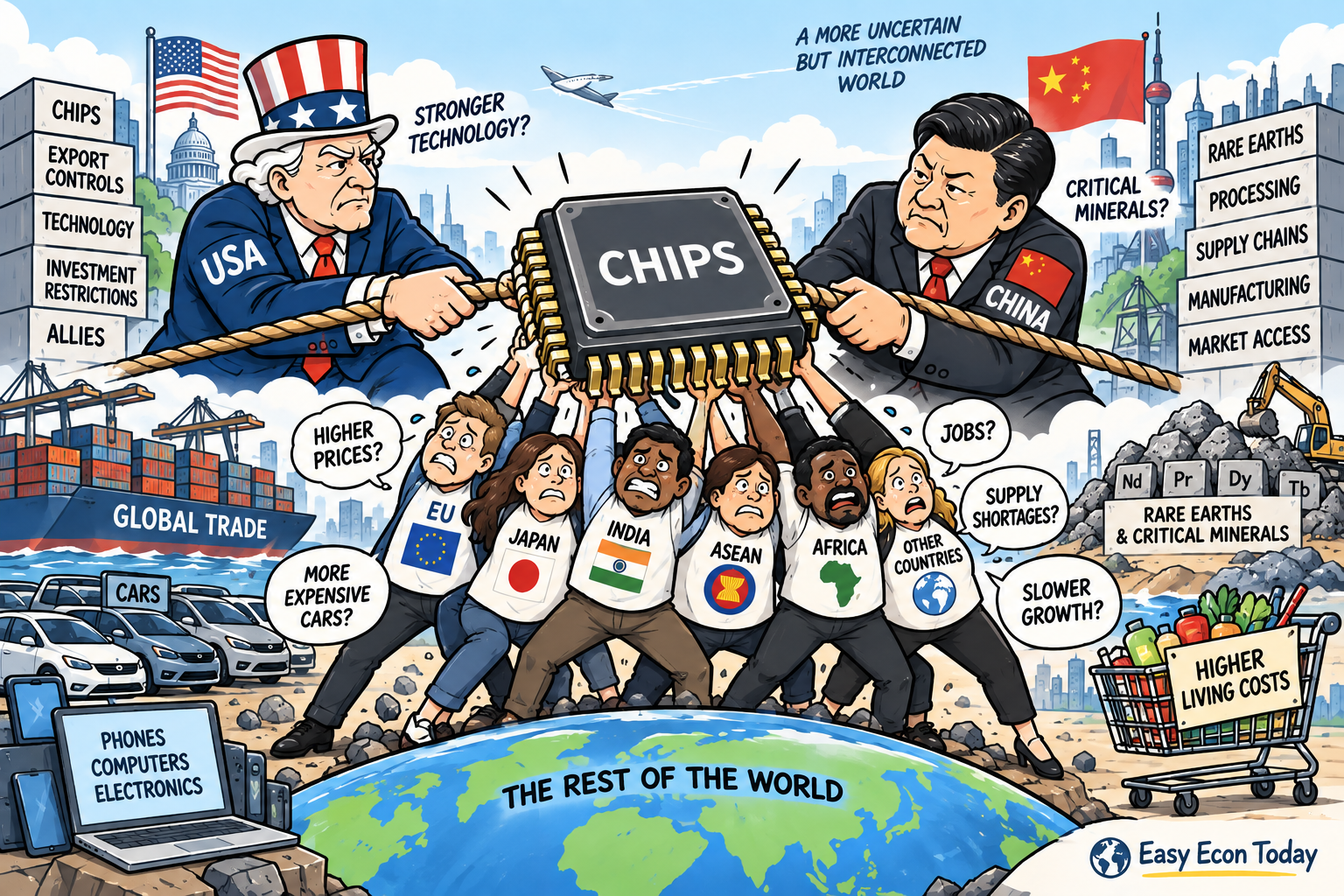
Geoeconomics Explained: How Money, Technology and Trade Became Tools of Global Power
For decades, we were told a simple story about the global economy.
Countries trade because trade makes everyone richer. A smartphone might be designed in one country, use chips made in another, contain minerals processed somewhere else, and finally be assembled thousands of miles away.
Efficiency mattered. Cost mattered. Politics often seemed secondary.
That world is changing.
Today, semiconductors, rare earths, tariffs, investment restrictions and even payment systems are becoming instruments of national power.
There is a word for this: geoeconomics.
It may sound academic, but its effects can eventually reach the price of a car, the cost of electronics, the security of a job and even the value of our investments.
And nowhere is this transformation easier to see than in the economic relationship between the United States and China.
What Is Geoeconomics?
Geoeconomics is actually a fairly simple idea.
Countries can use economic power to pursue strategic goals.
Instead of thinking only about soldiers, warships and military alliances, think about:
- tariffs,
- sanctions,
- semiconductor export controls,
- access to financial markets,
- critical minerals,
- government subsidies,
- supply chains.
The IMF describes modern geoeconomics as the use of financial and trade relationships to pursue geopolitical and economic objectives.
This does not mean economic competition has replaced military power. It means economic relationships themselves have become part of national strategy.
A country that controls something the rest of the world desperately needs may possess considerable leverage.
That brings us to one of the most important products in the modern economy.
Chips: Tiny Products With Enormous Power
Semiconductors are inside almost everything.
Phones.
Cars.
Data centers.
Medical equipment.
Industrial machinery.
And increasingly, artificial intelligence.
The most advanced AI systems require enormous computing power, which makes advanced chips strategically important.
The United States has therefore used export controls to restrict China’s access to some advanced semiconductor technology.
The rules themselves continue to evolve. In January 2026, for example, the U.S. Commerce Department revised its policy so that exports of certain advanced chips, including Nvidia H200 and AMD MI325X products, could be reviewed case by case under specified conditions.
The important point is bigger than any individual chip.
Technology that was once viewed mainly as a commercial product is now also treated as a strategic asset.
For China, this creates a strong incentive to develop its own semiconductor capabilities and reduce dependence on foreign technology.
For the United States, maintaining leadership in advanced technology is increasingly connected to economic and national security.
This is geoeconomics in action.
China Has a Powerful Card Too: Rare Earths
The economic leverage does not run in only one direction.
China occupies an extraordinarily important position in rare earth supply chains.
Rare earth elements are used in products including electric vehicles, electronics, wind turbines, industrial equipment and advanced technologies.
According to the U.S. Geological Survey, China accounts for more than 70% of global rare-earth extraction and about 87% of processing.
That distinction matters.
Mining minerals is one thing. Processing them into usable materials at scale is another.
A country does not necessarily need to control every resource. Sometimes controlling a critical bottleneck is enough.
China has already demonstrated the importance of this position through export licensing requirements affecting rare earths and permanent magnets.
An IMF study published in 2026 found that a severe rare-earth supply disruption could have meaningful economic effects on import-dependent economies, particularly over the short term when substitutes are difficult to find.
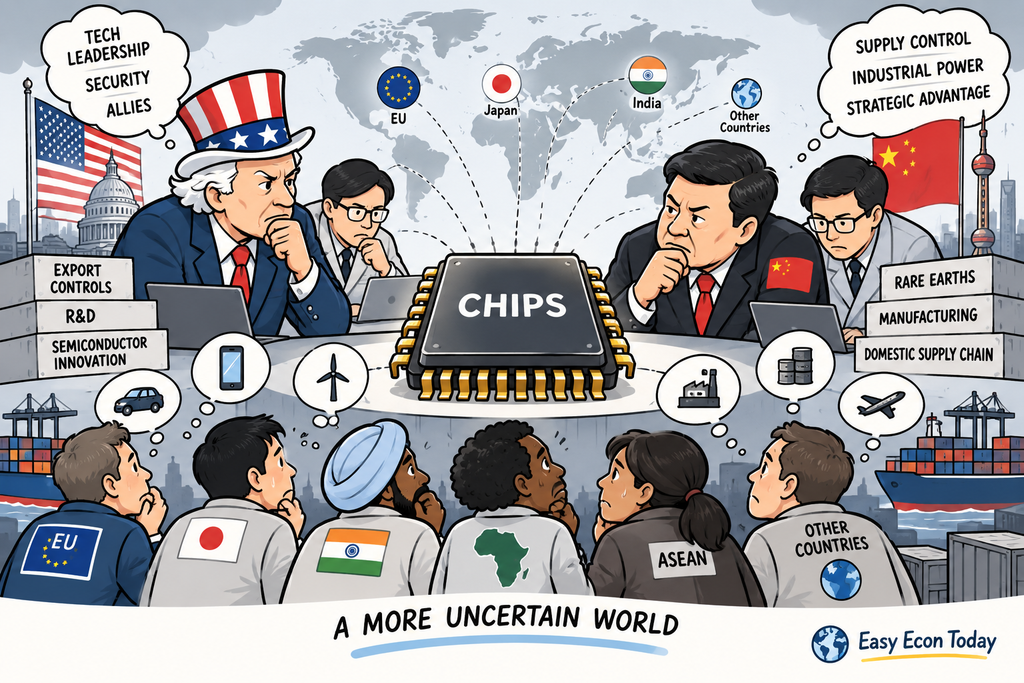
So the economic contest has an interesting symmetry.
The United States has leverage in important areas of advanced technology.
China has leverage in important parts of manufacturing and critical-mineral supply chains.
Neither side is completely independent of the other.
The New Battlefield Is the Supply Chain
This is why today’s US-China rivalry is about much more than tariffs.
Governments increasingly ask questions that businesses once rarely had to consider:
Where are our chips made?
Who processes our critical minerals?
Where do our batteries come from?
What happens if a supplier suddenly disappears?
Can an economic rival shut down an important part of our production system?
For decades, companies built supply chains primarily around efficiency.
If a component could be produced more cheaply somewhere else, production moved there.
But governments and businesses are now placing greater value on resilience.
That can mean building factories at home, sourcing from friendly countries, maintaining multiple suppliers or subsidizing strategically important industries.
The WTO has found evidence of increasing fragmentation in world trade, including renewed decoupling between the United States and China.
In other words, globalization is not simply disappearing.
It is being reorganized.
Why Doesn’t Everyone Just Become Self-Sufficient?
Because independence is expensive.
Imagine deciding that your household will never again depend on a supermarket.
You could grow vegetables, raise animals, bake bread, make clothes and perhaps generate your own electricity.
You would certainly become more self-reliant.
But you would also lose many of the advantages that come from specialization and trade.
Countries face a similar problem.
Globalization allowed companies to specialize, produce at enormous scale and reduce costs.
But specialization also created dependence.
The IMF describes this as a fundamental trade-off between the gains from trade and economic security.
If every country tries to produce everything itself, resilience may improve in some areas—but efficiency can fall and costs can rise.
That is the dilemma at the heart of geoeconomics.
How much efficiency should a country sacrifice for security?
There is no simple answer.
And Eventually, It Reaches Us
It is easy to look at Washington and Beijing and think this is a struggle between governments thousands of miles away.
But supply chains eventually lead to ordinary households.
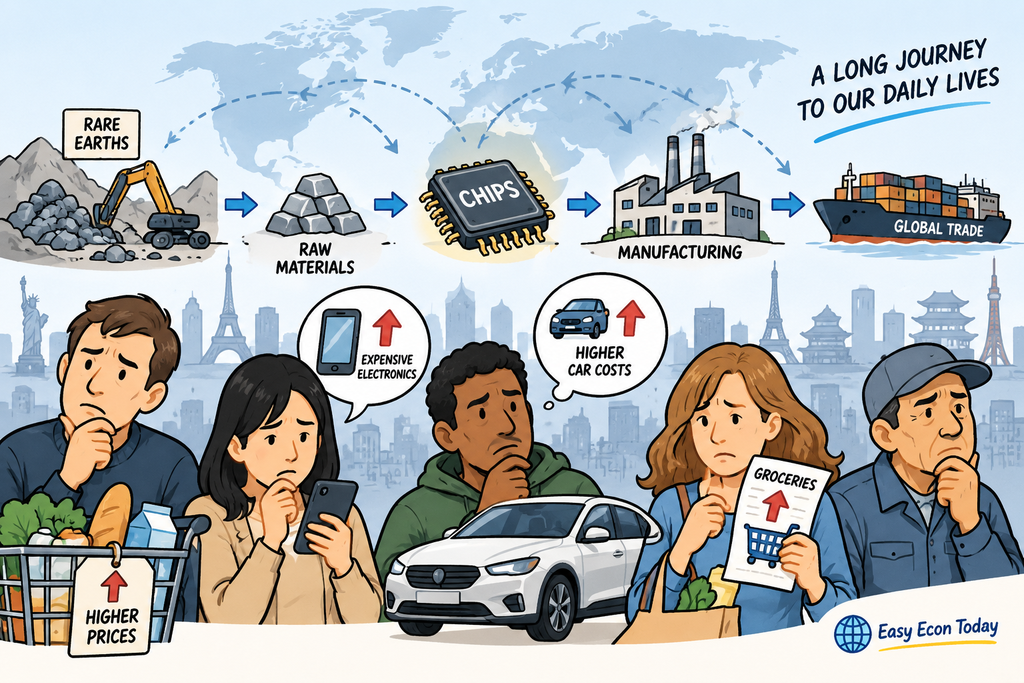
Consider a modern car.
It may contain semiconductors designed in one country, manufactured in another, rare-earth magnets using materials processed in China and thousands of other components crossing multiple borders.
If one critical component becomes scarce, the problem can travel through the entire production chain.
The same principle applies to smartphones, computers, appliances and renewable-energy equipment.
For ordinary consumers, geoeconomic competition can therefore appear in surprisingly familiar forms:
higher prices, longer waiting times, fewer choices or sudden shortages.
For workers, the effects can go both ways.
New factories and supply-chain investment can create jobs in countries trying to bring strategic industries home.
At the same time, companies dependent on imported components may face higher costs.
Investors also need to pay attention.
Industries that once competed mainly on price and technology are increasingly affected by government subsidies, tariffs, export controls and national-security rules.
A World Divided Into Economic Blocs?
One of the biggest questions is how far this process will go.
Will the United States and China eventually operate largely separate technology systems?
Will countries have to choose sides?
Or will economic interests prevent complete separation?
There are reasons to be cautious about predicting a clean split.
Even amid strategic rivalry, the world’s major economies remain deeply connected through trade, finance and investment.
But fragmentation has costs.
The WTO’s 2026 World Trade Report modeled an extreme scenario in which the world economy splits into geopolitically aligned blocs. In that scenario, global GDP would be 5.1% lower and global exports 18.6% lower than under the report’s baseline assumptions.
That is not a forecast.
It is a warning about what could happen under severe fragmentation.
The lesson is important:
Economic security may require diversification, but complete economic separation could make everyone poorer.
The Real Power May Lie in the Choke Points
Perhaps the most useful way to understand geoeconomics is not to ask:
“Which country is stronger?”
A better question is:
“Who controls something that others cannot easily replace?”
It might be advanced semiconductor technology.
It might be rare-earth processing.
It might be energy.
It might be a payment network.
It might even be a crucial piece of software.
Economists sometimes describe these strategic bottlenecks as choke points.
Countries that control them can gain influence far beyond the dollar value of the product itself.
And countries that depend on them have a powerful incentive to find alternatives.
That is why governments around the world are now talking about “de-risking,” “friend-shoring,” “economic security” and “strategic autonomy.”
Different words, but they reflect the same concern:
Dependence can create vulnerability.
What Should Ordinary People Watch?
Most of us cannot influence semiconductor export rules or rare-earth policy.
But understanding geoeconomics can help us make sense of economic news that otherwise appears disconnected.
A new tariff may affect consumer prices.
A restriction on critical minerals may affect car production.
A semiconductor rule may affect AI investment.
A government subsidy may determine where a new factory is built.
And a supply-chain dispute thousands of miles away may eventually reach a household budget.
This is why geoeconomics is not merely a subject for diplomats and economists.
It is increasingly part of everyday economics.
A New Chapter in the Global Economy
For much of the past generation, the central question in global business was:
Where can we produce this most efficiently?
The new question is becoming:
Where can we produce this safely—and who can we depend on?
That is a profound change.
The United States and China are at the center of it, but they are not the only participants. Europe, Japan, India and many smaller economies are also reconsidering their dependencies and supply chains.
The world is unlikely to stop trading.
But the era in which economics and geopolitics could be treated as separate subjects appears to be fading.
Chips, minerals, money and trade are no longer just parts of the economy.
They are also instruments of power.
And understanding that may be one of the keys to understanding the global economy of the years ahead.
Sources
International Monetary Fund — Understanding Geoeconomics in a Volatile World (2026)
International Monetary Fund — Macroeconomic Effects of Rare Earths Supply Chain Disruptions (2026)
World Trade Organization — World Trade Report 2026 and Global Trade Outlook and Statistics 2026
U.S. Geological Survey — China / Rare Earths data
U.S. Department of Commerce, Bureau of Industry and Security — Semiconductor Export Policy (2026)