
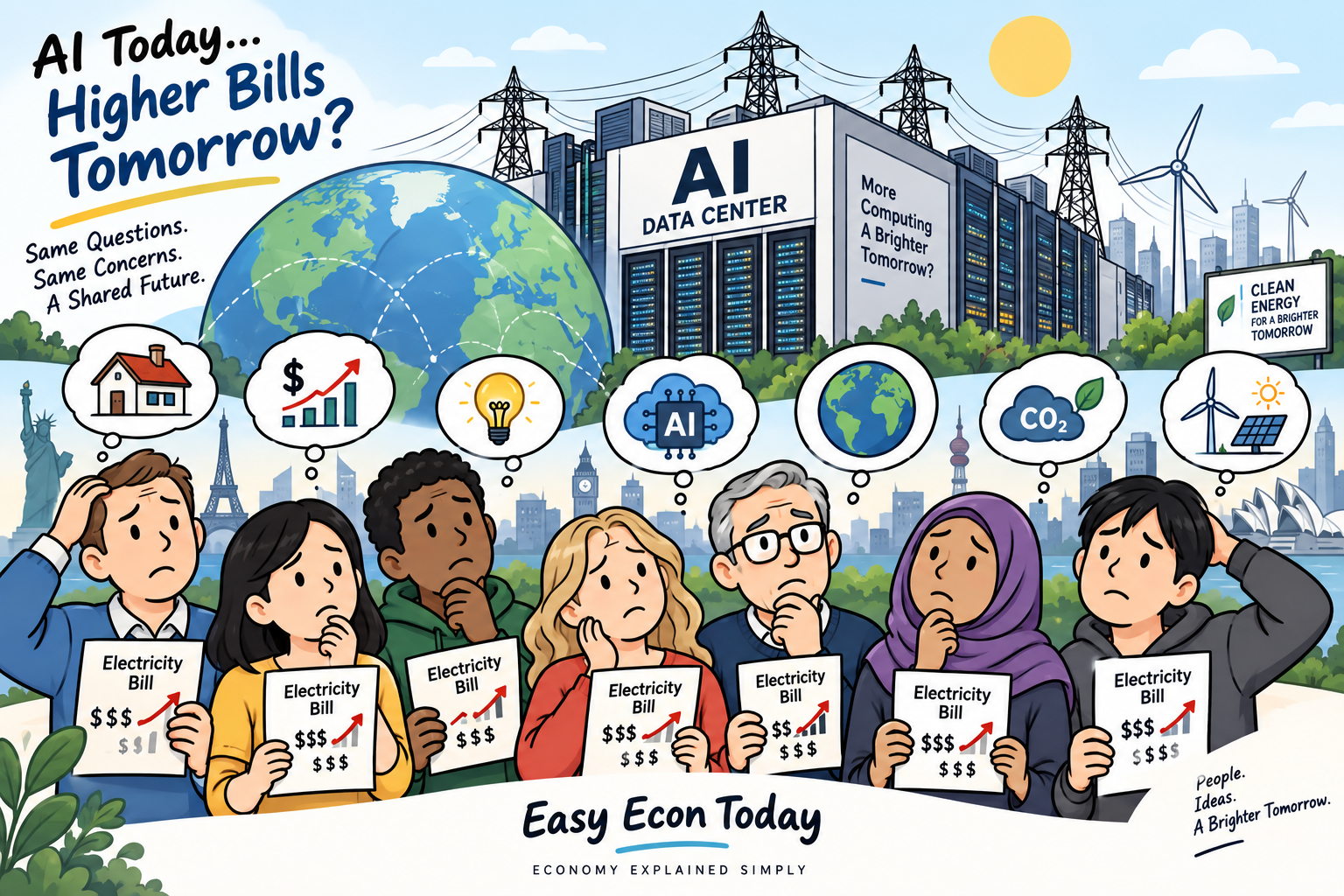
You ask an AI chatbot a simple question.
A few seconds later, the answer appears on your screen.
It feels almost effortless.
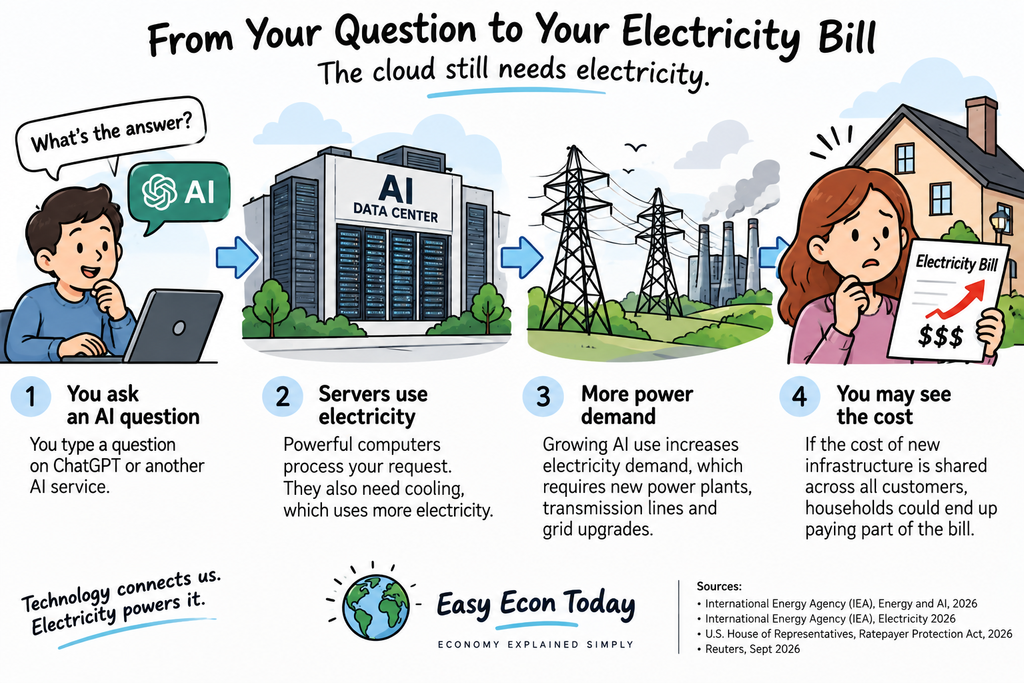
But somewhere, computers inside a large data center have been working to produce that answer. Those computers need electricity. They also generate heat, which means more electricity may be needed to keep them cool.
Multiply that by millions of people using AI every day, and a surprisingly simple question appears:
Could the AI boom eventually show up on our electricity bills?
The answer is not simply yes or no.
What caught my attention is that this is no longer just a technology story. The more electricity AI uses, the more questions arise about power grids, new infrastructure, and ultimately who pays for it. For ordinary households, that is where the AI boom starts to become a personal finance story.
AI Lives in the Real World
We sometimes think of AI as something floating invisibly in “the cloud.”
The cloud, however, is very physical.
It consists of enormous data centers filled with servers, networking equipment and cooling systems.
And they consume electricity.
According to the International Energy Agency (IEA), data centers worldwide used about 485 terawatt-hours (TWh) of electricity in 2025.
By 2030, that could rise to around 950 TWh — roughly double today’s level.
AI-focused data centers are growing even faster. The IEA expects their electricity consumption to roughly triple between 2025 and 2030.
That does not mean data centers will consume most of the world’s electricity. Even in 2030, their share is expected to be around 3% globally.
But there is an important catch.
Data centers are not spread evenly around the world.
They tend to cluster in particular places.
And that is where things get interesting.
Imagine a Small Town
Suppose a large AI company decides to build a huge data center near a town.
That sounds like good news.
There may be construction jobs, investment and new business activity.
But the local electricity system suddenly has a very large new customer.
The existing grid may not have enough capacity.
So the area might need:
- new power generation,
- new transmission lines,
- larger substations,
- transformers, and
- other grid upgrades.
All of this costs money.
And that leads to the most important question in this story:
Who pays?
This is the part I find easy to overlook. A data center may be built by a private company, but the electricity infrastructure around it is part of a much larger system shared with homes and businesses. That makes the question of who pays more important than it might first appear.
This Is Where Your Electricity Bill Comes In
Electric utilities normally recover the cost of building and maintaining electricity infrastructure through the rates paid by their customers.
Imagine that a utility needs to spend $1 billion upgrading its network partly because several enormous data centers are arriving.
If the data centers pay for the additional infrastructure they require, households may be largely protected from those costs.
But if some of those costs are spread across all electricity customers, ordinary households could end up paying part of the bill.
So the real issue isn’t simply:
“Does AI use a lot of electricity?”
A better question is:
“Who pays for the electricity infrastructure AI requires?”
That distinction is important.
Why This Has Become a Political Issue
The issue has become serious enough that U.S. lawmakers are debating how the costs of large data centers should be allocated.
In September 2026, the U.S. House of Representatives passed the Ratepayer Protection Act by 417 votes to 3.
The idea is straightforward: regulators should consider requiring very large electricity users, including data centers, to bear the additional infrastructure costs created by their demand rather than shifting those costs onto existing customers.
The legislation still faces further steps, and exactly how such rules would work can vary by state.
But the debate itself tells us something important.
AI is no longer only a technology story.
It is becoming an energy and household-cost story as well.
But Don’t Blame Every Electricity Increase on AI
There is another side to this story.
Electricity bills can rise for many reasons.
Fuel prices can increase.
Old electricity grids need replacing.
Extreme weather can require expensive upgrades.
Interest rates can increase the cost of financing new infrastructure.
Demand can rise because of electric vehicles, air conditioning, heat pumps and manufacturing — not just AI.
So if your electricity bill rises next year, it would be misleading to simply say:
“AI caused it.”
In fact, data centers could sometimes bring benefits to an electricity system.
A very large customer can provide utilities with predictable demand and revenue. If the new customer pays appropriately for the infrastructure it requires, those revenues could help spread some existing grid costs over a larger customer base.
The outcome depends heavily on how electricity markets and utility rates are designed.
AI Could Also Help the Energy System
There is an interesting irony here.
AI consumes electricity, but AI may also help us use electricity more efficiently.
AI systems can potentially help utilities:
- forecast electricity demand,
- predict equipment failures,
- balance renewable energy,
- optimize power networks, and
- reduce wasted electricity.
So AI could simultaneously become a major new electricity consumer and a tool for improving the electricity system.
Technology often works this way.
It creates a new problem while also helping us find new solutions.
The Bigger Picture
For most of us, the AI revolution feels digital.
We see ChatGPT, AI-generated images, automated customer service and new software tools.
But behind the digital world is a very physical economy.
AI needs computer chips.
Those chips need data centers.
Data centers need electricity.
Electricity needs power plants and transmission lines.
And someone eventually has to pay for all of it.
That is why one of the biggest economic questions surrounding AI may not be about computers at all.
It may be about electricity infrastructure and who pays for it.
The Simple Takeaway
AI data centers are consuming rapidly growing amounts of electricity.
That does not automatically mean your electricity bill will rise because of AI.
The more important question is how governments, utilities and technology companies divide the cost of building the additional electricity infrastructure these enormous facilities require.
If data centers pay the costs they create, households may be better protected.
If those costs are spread widely across the electricity system, consumers could end up paying part of them.
For me, that is the most interesting part of this story. A technology that feels almost invisible on our screens is becoming connected to some of the most physical parts of the economy — electricity, infrastructure and ultimately household costs.
So the next time you ask AI a question, remember:
The answer may appear instantly on your screen.
But somewhere behind it are servers, cooling systems, power lines and power stations.
The cloud, after all, still needs electricity.
Sources
- International Energy Agency (IEA), Key Questions on Energy and AI, 2026
https://www.iea.org/reports/key-questions-on-energy-and-ai/executive-summary - International Energy Agency (IEA), Energy and AI
https://www.iea.org/reports/energy-and-ai - Reuters, U.S. House advances first bill addressing economic impacts of data center boom, September 2026
https://www.reuters.com/world/us-house-advances-first-bill-addressing-economic-impacts-data-center-boom-2026-09-16/ - Reuters, Trump is talking with Senate’s Thune about bill to cut data-center electricity costs, September 2026
https://www.reuters.com/world/trump-is-talking-with-senates-thune-about-bill-cut-data-center-electricity-costs-2026-09-18/