
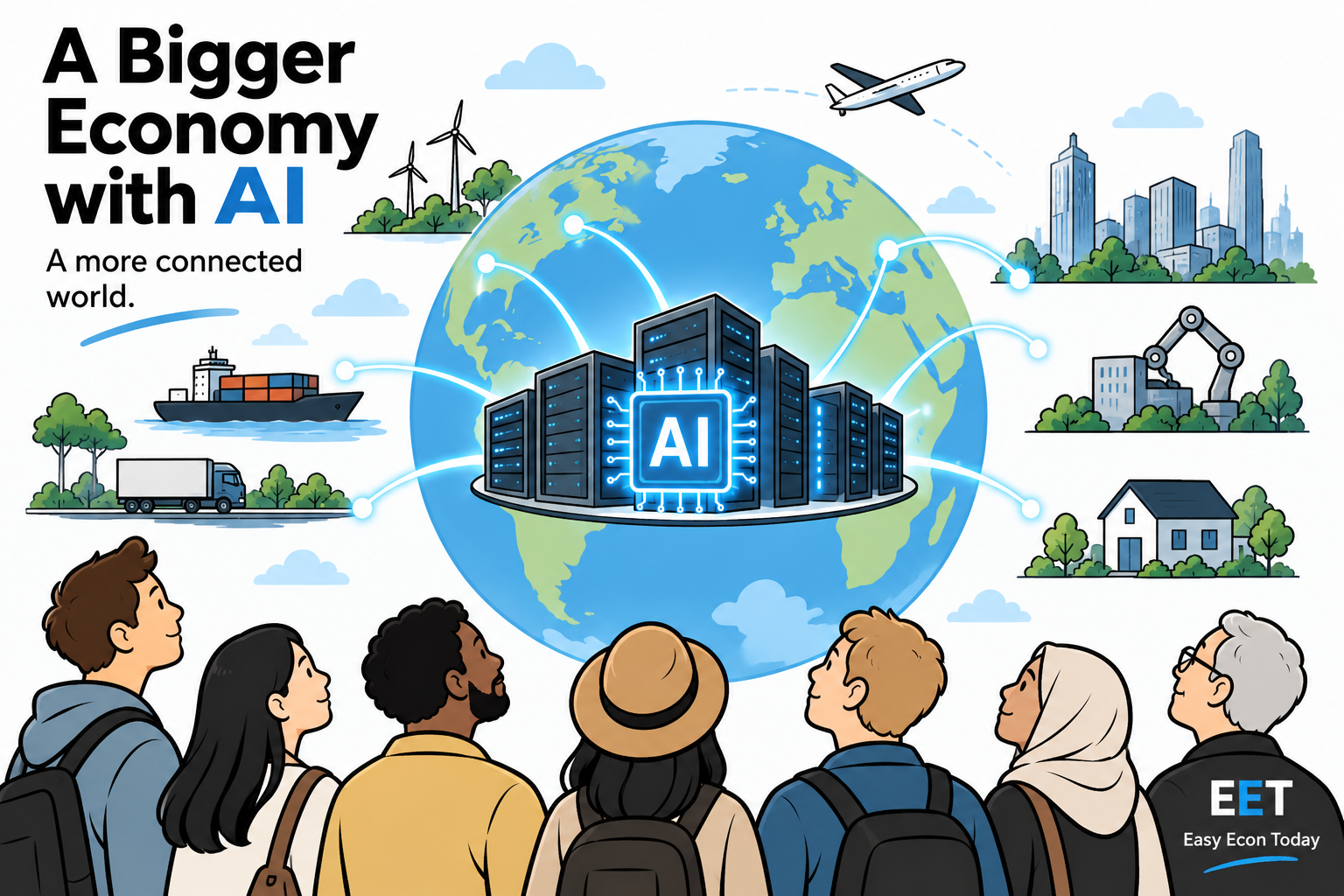
You may never buy an Nvidia chip.
You may never step inside a data center.
And you may never invest directly in an artificial intelligence company.
Yet AI may already be affecting your retirement savings, your electricity system, your workplace — and the economy growing around you.
Artificial intelligence is no longer simply a technology story.
It is becoming an investment story, an energy story, a stock-market story and, increasingly, an economic story.
And the numbers are becoming difficult to ignore.
Start With Nvidia
Consider Nvidia, whose chips have become a critical part of the AI boom.
In the quarter ending July 26, 2026, Nvidia reported revenue of $96.2 billion.
A year earlier, it was $46.7 billion.
Revenue had more than doubled in just twelve months.
Even more striking was where the money came from.
Nvidia’s Data Center business generated $89 billion in quarterly revenue — more than 90% of the company’s total.
The company that many consumers once associated mainly with graphics cards for gaming computers now sits near the center of the global AI infrastructure boom.
Its stock-market value has also climbed to around $5 trillion, making Nvidia one of the clearest symbols of how dramatically investors’ expectations have changed.
But Nvidia is only the most visible part of a much larger machine.
Follow the AI Money
AI may appear on our screens as software.
Behind the screen, however, it requires an enormous amount of physical infrastructure.
Advanced chips must be manufactured.
Servers must be assembled.
Data centers must be built.
Cooling equipment must be installed.
Power plants and electricity grids must supply them.
And companies must spend enormous sums before anyone knows exactly how profitable all this infrastructure will eventually become.
According to the International Energy Agency, capital spending by five of the world’s largest technology companies exceeded $400 billion in 2025 and is expected to increase by another 75% in 2026.
The IEA points out something remarkable:
The capital expenditure of just five major technology companies is now larger than global investment in oil and natural-gas production.
Think about that for a moment.
The AI revolution may look digital.
But behind it is one of the world’s largest physical investment booms.
Is AI Really That Much of the Economy?
Here we need to be careful.
A company worth trillions of dollars does not mean it contributes trillions of dollars to GDP every year.
Market value is not GDP.
Company revenue is not GDP either.
Investment is not the same as profit.
And stock-market value represents what investors believe a company’s future profits may be worth — not simply what that company produces today.
This distinction becomes particularly important when discussing AI.
There is not even a single official industry called “AI” in US national economic accounts.
AI activity is spread across semiconductor manufacturing, software, cloud computing, data centers, electricity, construction and many other industries.
The US Bureau of Economic Analysis is now developing experimental statistics specifically to estimate the size of the American AI economy.
In other words, AI is changing so quickly that economic statisticians are still working out the best way to measure it.
But we can already see its influence through investment.
The International Monetary Fund estimates that AI-related technology investment added about 0.5 percentage point to US GDP growth in 2025.
Some external estimates cited by the IMF suggest private-sector AI investment globally could exceed $2 trillion in 2026.
AI is not “the economy.”
But it has become large enough to influence how fast one of the world’s biggest economies grows.
The AI Economy Is Also an Electricity Economy
This is where the story begins to move much closer to everyday life.
AI requires computing power.
Computing power requires electricity.
This connection is already raising questions about how AI data centers could affect electricity demand and household power bills.
According to the IEA, global data-center electricity consumption was around 485 terawatt-hours in 2025.
By 2030, it is projected to reach roughly 950 TWh — almost double.
Electricity consumption from AI-focused data centers is expected to grow even faster, roughly tripling during that period.
But another number provides useful perspective.
Even after all that growth, data centers are projected to account for around 3% of global electricity demand in 2030.
This tells us something important about the AI economy.
AI can be enormously important without dominating everything.
Its impact can also be highly concentrated.
A giant data center built in one region can create enormous demand for local electricity even if data centers remain a relatively small share of global electricity consumption.
That can require new generation, transformers, transmission lines and storage.
And eventually a very ordinary economic question appears:
Who pays for all that infrastructure?
Technology companies?
Utilities?
Governments?
Or electricity customers?
Follow One Dollar of AI Investment
Imagine a technology company decides to spend another $10 billion on AI infrastructure.
The money does not simply disappear inside a computer.
Some goes to semiconductor companies.
Some goes to server manufacturers.
Some goes to construction companies.
Some goes to cooling systems.
Some goes to electrical equipment.
Some goes to power generation and transmission.
And eventually some becomes wages, profits, taxes and further investment.
The chain might look something like this:
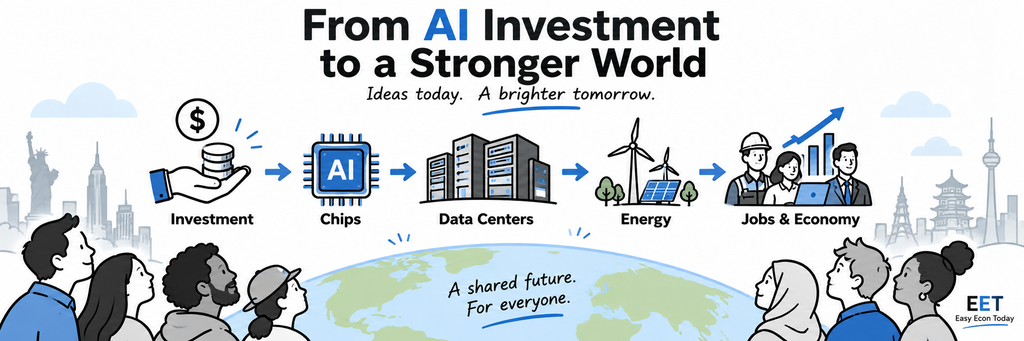
This helps explain why AI investment can contribute to economic growth even before most households fully understand how they will personally use AI.
AI Is Spreading Beyond Big Tech
There is another important part of the story.
Building AI infrastructure is one thing.
Actually using AI throughout the economy is another.
Across OECD countries where data are available, 20.2% of firms reported using AI in 2025.
That was up from 14.2% in 2024 and just 8.7% in 2023.
In only two years, business adoption had more than doubled.
Among large companies, AI use had already reached 52%.
And in Denmark, Finland and Sweden, more than 35% of businesses were using AI.
Not surprisingly, technology companies lead the way.
But AI use is spreading into industries that previously lagged behind, including construction, accommodation and food services.
This distinction matters.
Not every country needs to create the next Nvidia to participate in the AI economy.
Not every business needs to build its own AI model.
For most companies — and perhaps most countries — the bigger economic question may be:
Can they use AI to become more productive?
Your Retirement Savings May Already Be Part of the AI Story
There is another connection many people may not immediately notice.
The stock market.
Nvidia and other major technology companies connected to AI represent enormous amounts of global market value.
Millions of people therefore have indirect exposure to the AI boom without ever buying an Nvidia share themselves.
Pension funds, retirement accounts and broad index funds commonly hold major US technology companies.
When those share prices rise, investors can benefit.
But concentration works in both directions.
If expectations about future AI profits fall sharply, the effects may extend well beyond specialist technology investors.
This is one reason the AI boom has become more than a Silicon Valley story.
It has become a financial-market story as well.
The Trillion-Dollar Question
All of this leads to perhaps the biggest economic question surrounding AI:
Will this enormous investment eventually produce enormous returns?
Nvidia is already earning extraordinary revenue from supplying much of the infrastructure needed to build AI.
But the question is different for companies spending hundreds of billions of dollars buying chips and constructing data centers.
They eventually need to earn enough money from AI services, cloud computing, advertising, subscriptions, productivity improvements or entirely new businesses to justify those investments.
That is not guaranteed.
And investors are beginning to pay closer attention to the answer.
This does not mean the AI boom will fail.
Major technological transformations often require enormous investment before all their benefits become visible.
Railways required tracks.
Cars required roads and petrol stations.
Electricity required power stations and transmission networks.
The internet required fiber-optic networks and data centers.
AI may be going through its own infrastructure-building phase.
But history also teaches us something else.
A technology can transform the world — and investors can still spend too much money building it.
Both things can be true at the same time.
Then There Are Jobs
AI investment may increase economic growth while affecting workers very differently.
The IMF estimates that around 60% of jobs in advanced economies are exposed to AI.
Exposure does not mean that 60% of jobs will disappear.
That distinction is important.
In some occupations, AI may replace certain tasks.
In others, it may help workers become more productive.
But as AI becomes more capable, the value of human judgment, empathy and responsibility may become even more important.
New occupations may appear.
Workers with valuable AI-related skills may earn higher wages.
But some routine and middle-skilled occupations could face greater pressure.
This creates another economic paradox.
An economy can become more productive while some individuals feel less secure.
The benefits of AI will therefore depend not only on how powerful the technology becomes, but also on how successfully businesses and workers adapt to it.
The AI Economy Looks Different Depending on Where You Stand
So how much of the economy is AI?
There is no single number.
If we look at stock-market value, AI already appears enormous.
If we look at corporate investment, it is one of the world’s fastest-growing investment stories.
If we look at Nvidia’s revenue, the growth is extraordinary.
If we look at business adoption, AI is spreading rapidly but is still far from universal.
If we look at electricity consumption, data centers remain only a few percent of global demand.
And if we try to measure AI directly as a percentage of GDP, government statisticians are still developing the tools to do it.
AI can therefore look enormous and surprisingly small at the same time, depending on what we measure.
That apparent contradiction may tell us exactly where we are in the AI revolution.
We are spending enormous amounts building the infrastructure.
We are only beginning to discover what the economic return will be.
Why This Matters to You
You do not need to own Nvidia shares for AI to affect you.
You do not need to work for a technology company.
And you do not need a data center next door.
AI can reach your retirement savings through financial markets.
It can reach your electricity system through data centers.
It can reach your workplace through automation and new tools.
It can influence wages through productivity.
It can affect governments through economic growth and tax revenue.
And eventually it can reach consumers through the prices, products and services businesses provide.
That is why perhaps the most interesting question is no longer:
Will AI change the economy?
It already is.
The harder question is:
Who will ultimately receive the benefits — and who will pay for the enormous investment required to build it?
Sources
- NVIDIA — Second Quarter Fiscal 2027 Financial Results
Nvidia’s latest revenue, Data Center revenue and financial results. - International Energy Agency — Key Questions on Energy and AI
Data-center electricity demand, AI infrastructure investment and global energy implications. - International Monetary Fund — AI: Deployment and Disruption
AI investment, its contribution to US economic growth and the broader economic risks and opportunities. - OECD — AI Use by Individuals Surges as Adoption by Firms Continues to Expand
AI adoption rates among businesses across OECD economies. - US Bureau of Economic Analysis — Advancing Measurement and Understanding of AI’s Economic Impact
How official economic statistics are beginning to measure the size and impact of the AI economy.