
October 26, 2026 | Easy Econ Today | Cost-of-Living Crisis
The Cost of Living Crisis in Europe: Why It Matters
The cost of living crisis in Europe is no longer just about rising prices. It is becoming a source of public anger as households struggle with expensive housing, food bills, and wages that have failed to keep pace with everyday expenses.
Europe is facing a troubling economic contradiction. Its economies remain among the world’s wealthiest, yet growing numbers of citizens are questioning whether their living standards are improving.
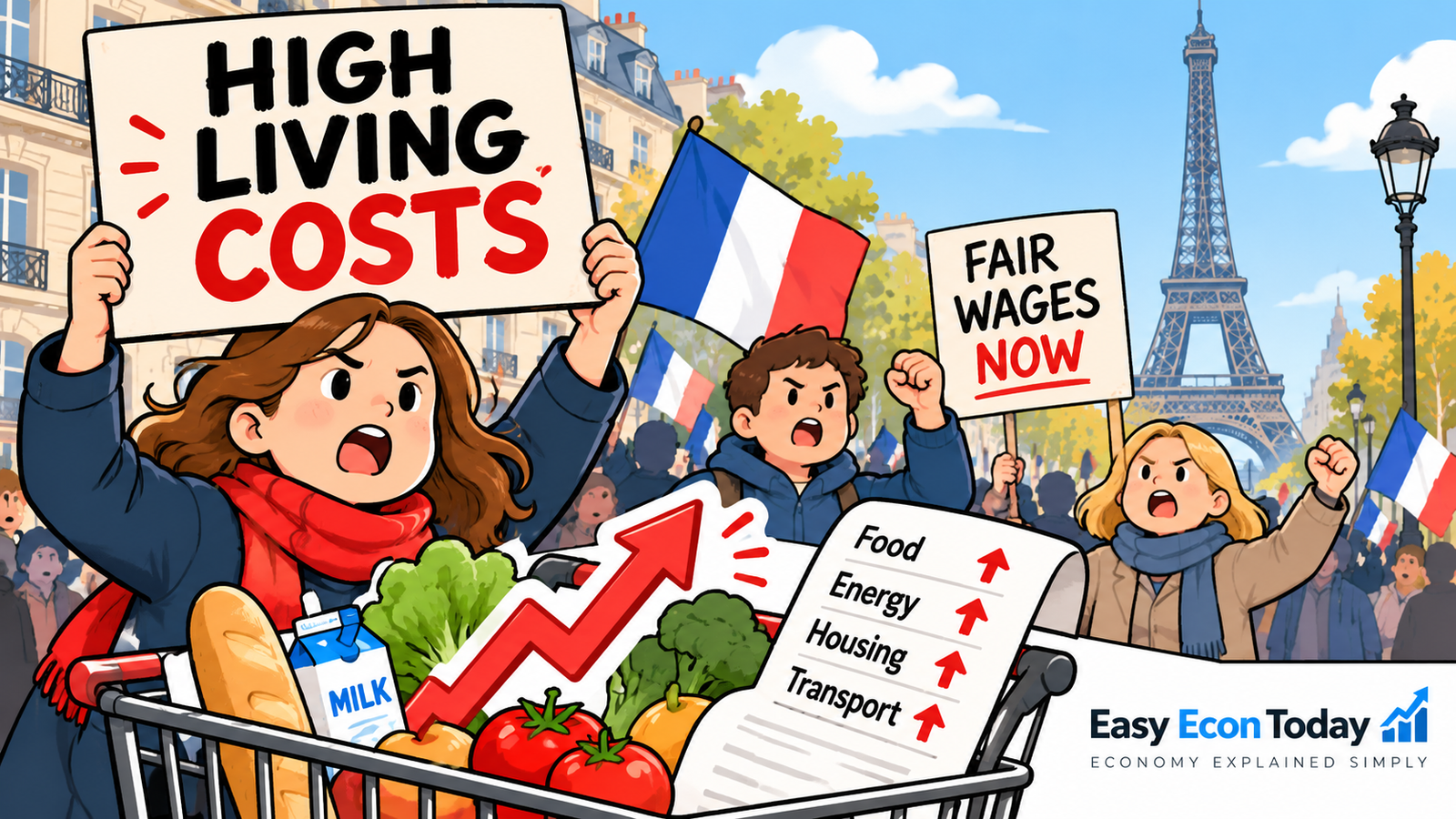
In France, hundreds of thousands of people have taken to the streets. Similar economic frustrations have appeared in other European countries, although the causes and demands vary considerably.
The demonstrations have raised a question that goes far beyond politics:
Why do people feel financially insecure even when they live in relatively prosperous countries?
The answer involves more than inflation. It includes the cumulative increase in everyday prices, housing affordability, wage growth, government debt, public services, and the distribution of economic gains.
Understanding these pressures helps explain not only Europe’s current difficulties but also the financial challenges facing households in the United States and other advanced economies.
1. What Is Happening on Europe’s Streets?
On October 24, 2026, large demonstrations took place across France. The French Interior Ministry estimated nationwide participation at 410,000 people, including approximately 110,000 in Paris.
Protesters raised concerns about living costs, wages, education funding, and deteriorating public services.
The demonstrations initially emerged from student complaints about school conditions and staffing shortages. They subsequently expanded to include workers and other groups expressing broader economic grievances.
Most participants demonstrated peacefully, although clashes between some groups and police occurred in several cities.
The unrest illustrates how dissatisfaction with specific public services can develop into a wider debate about economic opportunity and living standards.
France is not alone.
In Greece, students and teachers have protested education funding and financial pressures. Housing affordability has also generated public demonstrations in Spain and Portugal.
These movements are not identical. Each country has its own political institutions, economic conditions, and immediate causes of protest.
Nevertheless, several common economic questions emerge.
Why are essential expenses consuming so much household income? Why do younger generations struggle to afford housing? And why do governments appear increasingly constrained in their ability to respond?
2. Inflation Is More Than a Number
One of the most misunderstood economic concepts is the difference between inflation and the overall price level.
Inflation measures how quickly prices are increasing. It does not tell us whether prices have returned to their previous levels.
Consider a simple example.
Imagine a household spending €100 on a basket of groceries.
If prices increase by 10%, that basket costs €110.
If inflation subsequently slows to 3%, the same basket costs €113.30.
Inflation has fallen sharply, from 10% to 3%.
But the household is still paying 13.3% more than it did originally.
This distinction matters enormously.
People experience inflation through the amount of money leaving their bank accounts, not simply through annual percentage changes published by statistical agencies.
Higher fuel prices add another layer of pressure to household budgets, increasing both transportation expenses and the cost of everyday goods. For more on this issue, read our analysis of why petrol prices are rising.
Inflation has recently accelerated again
According to Eurostat’s preliminary estimate released on October 2, euro-area annual inflation increased from 3.2% in August 2026 to 3.8% in September.
Energy prices were an important contributor, with the energy component recording an estimated annual increase of 18.8%.
This is particularly significant because energy affects much more than household electricity bills.
Higher energy costs can increase transportation expenses, manufacturing costs, food distribution costs, and the prices businesses charge consumers.
A family may therefore experience higher energy costs both directly and indirectly.
The broader lesson is that even when headline inflation moderates, household financial pressure may persist. And when energy inflation accelerates again, that pressure can intensify.
3. Why Wage Increases Do Not Always Make People Feel Wealthier
Suppose an employee earns €3,000 per month.
The employer awards a 4% pay increase, raising monthly earnings to €3,120.
At first glance, the employee is better off.
But if consumer prices rise by 6% over the same period, the employee’s purchasing power has actually declined.
The approximate real wage change is:
4% wage growth − 6% inflation = −2%.
The exact calculation produces a decline of approximately 1.9%.
This is the difference between nominal wages and real wages.
Nominal wages describe how much money workers receive.
Real wages measure what that money can actually buy.
Why the recovery can take years
Even when real wages begin increasing again, households may still be recovering from previous losses.
For example, if prices rise faster than wages for three consecutive years, one year of modest real wage growth may not restore the original purchasing power.
Households may respond by reducing discretionary spending, postponing purchases, drawing down savings, or relying more heavily on credit.
The impact differs across income groups.
Higher-income households generally have greater flexibility to absorb unexpected expenses.
Lower-income households often spend a larger proportion of their earnings on essentials such as food, heating, transport, and rent.
Consequently, identical inflation rates can produce very different experiences across the population.
This helps explain why economic averages sometimes appear disconnected from public sentiment.
4. Housing: The Expense That Changes Everything
Housing is often the largest recurring expense in a household budget.
A relatively small increase in rent can therefore outweigh savings achieved elsewhere.
Consider two households earning the same monthly income of €3,500.
Household A pays €900 in rent.
Household B pays €1,500.
The first household spends approximately 26% of its income on rent, while the second spends nearly 43%.
That difference leaves Household B with €600 less every month for food, transport, savings, education, and other needs.
Over one year, the difference amounts to €7,200.
These are illustrative figures, but they demonstrate why housing affordability is central to discussions about living standards.
Why housing becomes increasingly expensive
Housing affordability is influenced by several interacting factors:
- Limited housing supply in economically attractive cities
- Construction costs and planning restrictions
- Population growth and changing household formation
- Interest rates and mortgage financing conditions
- Investor demand and the availability of rental accommodation
- The location of employment, education, and transport infrastructure
No single explanation applies equally to every European city.
In some locations, insufficient construction has been a major constraint. In others, rapid changes in demand, financing costs, or local regulations have played important roles.
The consequences can be especially serious for younger adults.
Even when they have stable employment, high rents may make it difficult to accumulate the savings required for a home deposit.
This can delay homeownership, family formation, and other major financial decisions.
Housing affordability is therefore not merely a property-market issue.
It can influence economic mobility, consumer spending, demographic trends, and perceptions of fairness between generations.
5. Did Years of Cheap Money Make the Problem Worse?
Following the global financial crisis and during subsequent economic disruptions, central banks used unusually low interest rates and other monetary measures to support economic activity.
These policies were intended to reduce borrowing costs, encourage investment, and prevent deeper economic weakness.
They also affected financial markets and asset prices.
When borrowing becomes cheaper, households and investors may be willing to pay more for assets that generate future income.
Property is one example.
Lower mortgage rates can increase the amount buyers are able to borrow, potentially placing upward pressure on housing prices when supply cannot respond quickly.
The same broad financial mechanism can affect equities and other investments.
The distributional question
People who already own property or financial assets may benefit when asset prices increase.
Those who have not yet accumulated assets can face a different experience.
A rising house price increases the wealth of an existing homeowner, but it also increases the amount a first-time buyer may need to save or borrow.
This creates an important distinction between income inequality and wealth inequality.
Income inequality concerns differences in earnings.
Wealth inequality concerns differences in accumulated assets and liabilities.
Monetary policy can influence both, but its distributional effects are complex.
Low interest rates can support employment and reduce debt-servicing costs, benefiting many households. At the same time, asset-price increases may disproportionately benefit existing owners.
It would therefore be misleading to claim that central-bank policy alone caused today’s affordability problems.
Housing supply, taxation, demographics, productivity, wage growth, and fiscal policy also matter.
Nevertheless, the relationship between monetary policy and asset ownership deserves attention when examining why different generations have experienced economic growth differently.
6. Government Debt and the Limits of Public Spending
When households face rising expenses, they often expect governments to respond.
Possible measures include increased social benefits, tax reductions, energy subsidies, wage support, and additional funding for public services.
However, governments face financial constraints of their own.
France provides a particularly important example.
The government has been attempting to manage a large budget deficit while responding to demands for improved schools, higher wages, and financial assistance.
According to Reuters reporting in October 2026, France was targeting a reduction in its budget deficit from approximately 5.4% of economic output in 2026 to 5.0% in 2027.
These are substantial deficits.
A government running a deficit spends more than it collects in revenue during that period.
The difference must generally be financed through borrowing or other financing arrangements.
Why debt servicing matters
When government debt increases, interest payments can become a growing budgetary obligation.
Higher market interest rates can add to this burden as debt is refinanced.
Money used for interest payments cannot simultaneously be used for additional schools, healthcare, infrastructure, or other government priorities.
This does not mean government borrowing is inherently harmful.
Borrowing can finance productive investment, stabilize an economy during recession, or respond to emergencies.
The key questions are whether debt remains sustainable and whether borrowed funds generate sufficient economic and social benefits.
The political and economic dilemma
Governments may face competing demands:
Citizens want financial relief and stronger public services.
Investors want confidence that public finances remain sustainable.
Businesses want a predictable economic environment.
Workers want wages that keep pace with living costs.
Attempting to satisfy all these demands simultaneously can be difficult, especially when economic growth is weak.
The result is a challenging trade-off between immediate financial relief and long-term fiscal sustainability.
7. Why Economic Growth Does Not Always Feel Like Progress
Gross domestic product, or GDP, measures the value of goods and services produced in an economy.
GDP growth is important because it reflects expanding economic activity.
But GDP growth alone does not reveal how the benefits are distributed.
Imagine an economy growing by 3%.
If most of the additional income flows to a relatively small group of businesses or asset owners, many households may experience little improvement in their financial position.
Similarly, GDP can increase while housing costs rise faster than wages.
In that situation, the economy is producing more, but some households may have less disposable income after paying essential bills.
Other indicators are therefore necessary to understand living standards.
These include real disposable household income, housing-cost burdens, employment security, wealth distribution, and access to public services.
The importance of disposable income
Disposable income is the amount households have available after taxes and transfers.
But even disposable income does not tell the whole story.
A household with rising disposable income may still feel worse off if rent, transport, insurance, and other unavoidable expenses increase even faster.
A useful way to understand economic pressure is to examine the money remaining after essential expenses.
This is the amount available for saving, discretionary purchases, and unexpected financial needs.
For many households, this remaining amount is more meaningful than national GDP growth.
8. How Economic Frustration Can Become Social Unrest
Economic pressure does not automatically produce protests.
Many countries experience inflation, high housing costs, or stagnant wages without large-scale demonstrations.
Social unrest usually involves several interacting factors.
These can include economic hardship, dissatisfaction with public institutions, perceptions of unfairness, political organization, and specific events that mobilize public participation.
France’s recent demonstrations illustrate this complexity.
The movement began with concerns about education funding and school conditions before expanding to include wider complaints about living costs and public services.
It would be inaccurate to describe every participant as protesting for the same reason.
It would also be inaccurate to equate peaceful demonstrations with the violence committed by some individuals.
From an economic perspective, however, the protests highlight an important issue.
When people believe that working harder no longer provides a realistic path toward financial security, confidence in economic institutions can weaken.
That perception may become particularly significant when combined with visible differences in wealth and opportunity.
The resulting frustration can affect consumer confidence, business investment, and public debate over economic policy.
9. Could Similar Pressures Affect the United States?
The United States and Europe have different economic structures, housing markets, tax systems, and public-service arrangements.
Nevertheless, households in both regions face several comparable challenges.
These include housing affordability, the cumulative impact of inflation, differences between nominal and real wage growth, and uncertainty about long-term financial security.
In the United States, housing costs, healthcare expenses, insurance, education, and transportation can all place substantial demands on household budgets.
In Europe, the composition of these costs varies by country, particularly because public healthcare, education, and social benefits are financed differently.
Direct comparisons therefore require care.
Still, the underlying economic question is similar:
Is household purchasing power improving quickly enough to keep pace with the cost of maintaining a reasonable standard of living?
This question is more useful than comparing headline inflation rates alone.
For example, two countries may report the same annual inflation rate but have very different housing burdens, wage growth, and social support systems.
The experience of ordinary households can consequently differ substantially.
Europe’s demonstrations do not establish that similar unrest will occur in the United States.
They do, however, provide a reason to examine how persistent affordability pressures influence economic confidence.
10. What Would Meaningful Economic Improvement Look Like?
A genuine improvement in living standards requires more than a temporary decline in inflation.
Several developments would help.
First, sustained growth in real wages would allow household incomes to recover purchasing power.
Second, improved housing supply and affordability could reduce the share of income devoted to accommodation.
Third, greater productivity could support wage growth without creating equivalent upward pressure on production costs.
Fourth, more efficient public spending could improve essential services while reducing unnecessary fiscal pressure.
Finally, economic policies need to consider how benefits and costs are distributed across income groups and generations.
There are trade-offs.
Policies that support household purchasing power may increase government spending.
Measures that stimulate housing demand without expanding supply may raise property prices.
Aggressive fiscal tightening can improve public finances but may also weaken demand or reduce services in the short term.
No single policy can resolve every aspect of the cost-of-living problem.
A durable improvement is more likely to require coordinated progress in productivity, housing, fiscal sustainability, and household incomes.
Conclusion: The Real Question Is Whether Life Is Becoming More Affordable
The demonstrations taking place across France and other parts of Europe are rooted in different local circumstances.
But they raise a broader economic issue that deserves attention far beyond Europe.
A country can be wealthy while many households struggle financially.
An economy can grow while housing becomes less affordable.
Wages can increase while purchasing power declines.
And inflation can slow without reversing years of accumulated price increases.
These are not contradictions. They are reminders that economic indicators measure different aspects of financial well-being.
The central question is not simply whether an economy is growing.
It is whether that growth translates into a meaningful improvement in everyday life.
For policymakers, the challenge is to strengthen living standards while maintaining sustainable public finances.
For households, the challenge is more immediate: paying the bills, securing housing, building savings, and planning for the future.
Ultimately, the cost-of-living crisis is about the gap between economic progress on paper and financial security in everyday life.
That gap is worth understanding, whether the headlines come from Paris, Athens, London, or Washington.
Editorial Note
This article combines publicly reported events, economic data, and independent analysis by Easy Econ Today. Economic interpretations reflect the author’s assessment and should not be understood as the sole explanation for protests across Europe. Figures and developments may be updated as further information becomes available.
Sources and Further Reading
- Eurostat, Euro Area Annual Inflation Up to 3.8% — September 2026 Flash Estimate, October 2, 2026.
https://ec.europa.eu/eurostat/en/web/products-euro-indicators/w/2-02102026-ap - Associated Press / PBS NewsHour, More Than 400,000 Protest Across France, October 25, 2026.
https://www.pbs.org/newshour/world/more-than-400000-protest-across-france-challenging-macron-as-paris-clashes-erupt - Reuters, France Imposes Curfews in Parts of Paris, Other Cities After Weekend of Riots, October 19–20, 2026.
https://www.reuters.com/world/europe/frances-macron-declines-interior-ministers-offer-resign-2026-10-19/ - Eurostat, European economic and household statistics.
https://ec.europa.eu/eurostat - OECD, Economic and household well-being statistics.
https://www.oecd.org
Editorial note: Numerical household examples are illustrative calculations, not official household survey results. This article distinguishes reported protest developments from broader economic interpretation.