

When we buy a product from another country, invest overseas, or send money across borders, one basic question often goes unnoticed:
Which currency do we actually use?
The answer, across many parts of the international financial system, is still overwhelmingly the U.S. dollar.
Despite frequent predictions about the decline of the dollar, it remains at the center of international trade, foreign exchange markets, central-bank reserves and cross-border finance.
But the global monetary system is gradually becoming more diverse, with the euro, Chinese renminbi and even digital currencies playing increasingly visible roles.
The Dollar Is Still No. 1
One way to measure the international importance of a currency is to look at the foreign exchange reserves held by central banks.
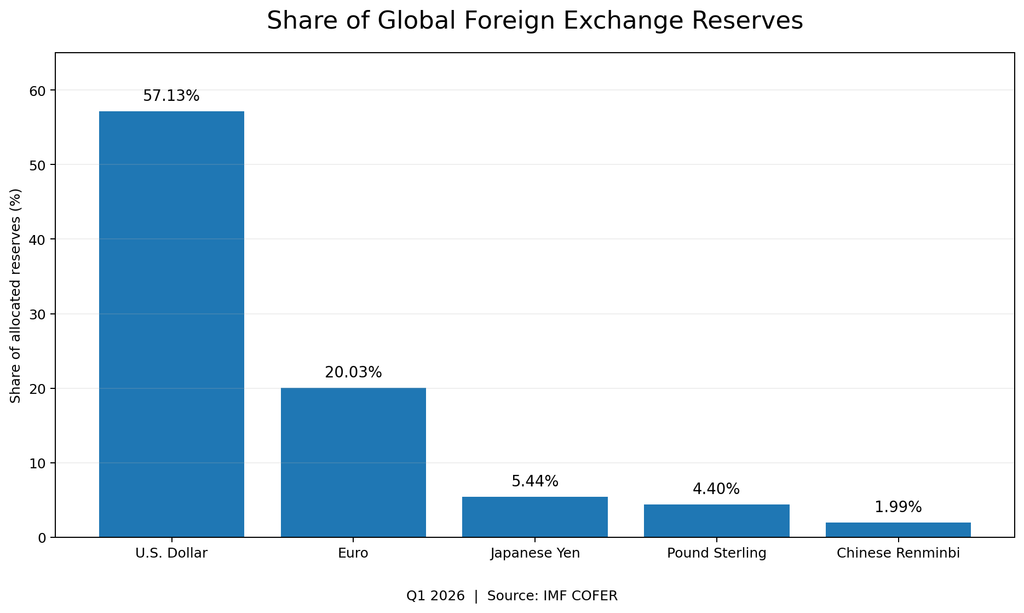
According to IMF data for the first quarter of 2026, the world’s official foreign exchange reserves totaled about $13.1 trillion.
The U.S. dollar accounted for 57.13% of allocated reserves, compared with 20.03% for the euro and only 1.99% for the Chinese renminbi.
This tells us something important. China may be the world’s second-largest economy and one of its largest trading nations, but the renminbi is still far from challenging the dollar as the world’s main reserve currency.
The Dollar Is Even More Dominant in Currency Trading
The foreign exchange market gives us another perspective.
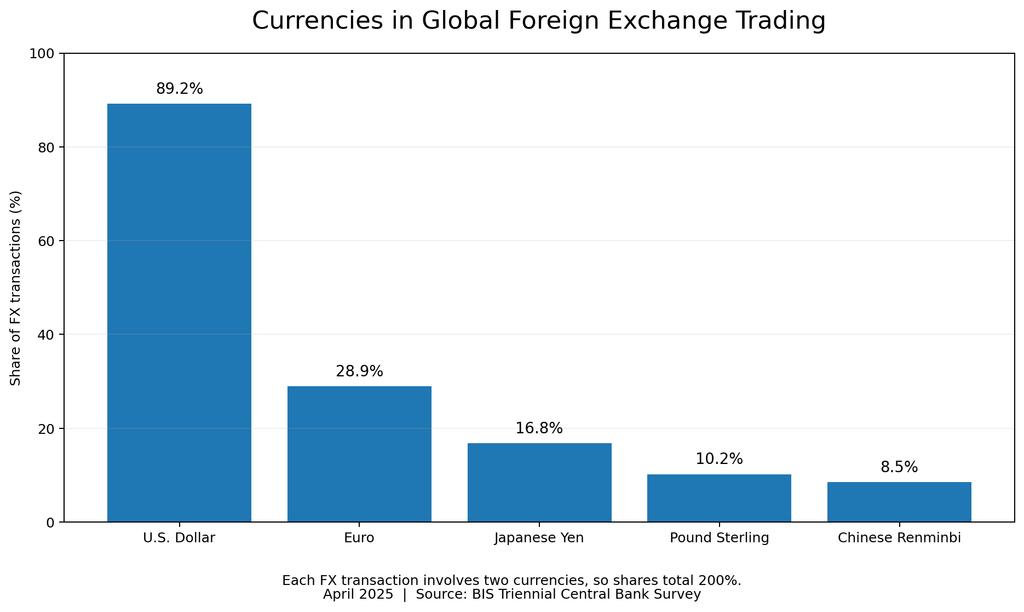
According to the Bank for International Settlements (BIS), global foreign exchange trading reached approximately $9.6 trillion per day in April 2025.
The U.S. dollar was on one side of 89.2% of all foreign exchange transactions.
The euro appeared in 28.9%, the Japanese yen in 16.8%, the British pound in 10.2%, and the Chinese renminbi in 8.5%.
These percentages add up to more than 100% because every foreign exchange transaction involves two currencies.
For example, when someone exchanges euros for dollars, both the euro and the dollar are counted.
The striking point is simple: almost nine out of every ten foreign exchange transactions involve the U.S. dollar.
Why Does the World Still Use Dollars?
There is a simple reason: everyone uses dollars because everyone else uses dollars.
Oil and other commodities, international loans, corporate bonds and many cross-border contracts have traditionally been priced or settled in U.S. dollars.
Banks therefore need dollars. Companies need dollars. Investors need dollars. And central banks want to hold dollar assets.
This creates a powerful network effect.
The dollar is not dominant simply because the United States has a large economy. It is dominant because an enormous global financial infrastructure has developed around it.
Once such a system is established, replacing it is extremely difficult — even when the balance of economic power in the world begins to change.
What About China?
China presents the most interesting long-term challenge to the dollar.
The Chinese renminbi appeared on one side of 8.5% of global foreign exchange transactions in April 2025, making it one of the world’s most actively traded currencies.
Yet its role as a reserve currency remains surprisingly small. In the first quarter of 2026, the renminbi accounted for only about 2% of global foreign exchange reserves.
Why the difference?
International investors and central banks do not look only at the size of an economy. They also want deep and liquid financial markets, a large supply of safe assets, confidence in the legal and financial system, and the ability to move money freely across borders.
China is a huge trading nation, but its financial system remains more controlled than those of the United States and other major Western economies.
So the renminbi may become increasingly important in international trade without necessarily replacing the dollar as the world’s leading reserve currency
And What About Bitcoin and Stablecoins?
Digital currencies introduce another interesting possibility.
Bitcoin attracts enormous attention, but its role in ordinary international trade and cross-border payments remains relatively limited.
Stablecoins may be more important.
Unlike Bitcoin, most major stablecoins are designed to maintain a stable value, usually by linking their value to the U.S. dollar.
According to the BIS, stablecoins recorded roughly $35 trillion in total transaction volume during 2025. However, actual payment-related flows were estimated at only about $390 billion.
Even more interestingly, around 98% of stablecoins are denominated in U.S. dollars.
This creates a fascinating paradox.
We often think of cryptocurrencies as potential competitors to traditional currencies. But if more people around the world use dollar-backed stablecoins for digital payments, new technology could actually extend the international reach of the dollar rather than weaken it.
In other words, the future of money may become more digital — without necessarily becoming less dollar-based.
A Multipolar World — But Not Yet a Multipolar Currency System
The world economy is clearly changing.
China is larger and more influential. Emerging economies are trading more with each other. New payment technologies are developing rapidly, and some countries are actively trying to reduce their dependence on the U.S. dollar.
But changing the currency at the center of the international financial system is much harder than changing the ranking of the world’s largest economies.
For now, the numbers tell a surprisingly clear story:
The world economy is becoming more multipolar, but the world’s monetary system remains overwhelmingly dollar-centered.
The more interesting question may therefore not be whether the dollar will disappear from the top position.
It is how much of its dominance it will eventually have to share.
Sources
- International Monetary Fund — Currency Composition of Official Foreign Exchange Reserves (COFER), Q1 2026
- Bank for International Settlements — 2025 Triennial Central Bank Survey of Foreign Exchange Markets
- Bank for International Settlements — Stablecoins: Framing the Debate
Music for the Day
After looking at trillions of dollars moving around the world, let’s finish with a little music.
Dire Straits — Money for Nothing
The song isn’t about international finance, of course. But after a discussion of dollars, euros, renminbi and digital money, the title seems too appropriate to resist.
Enjoy the music — and see you in the next story.