
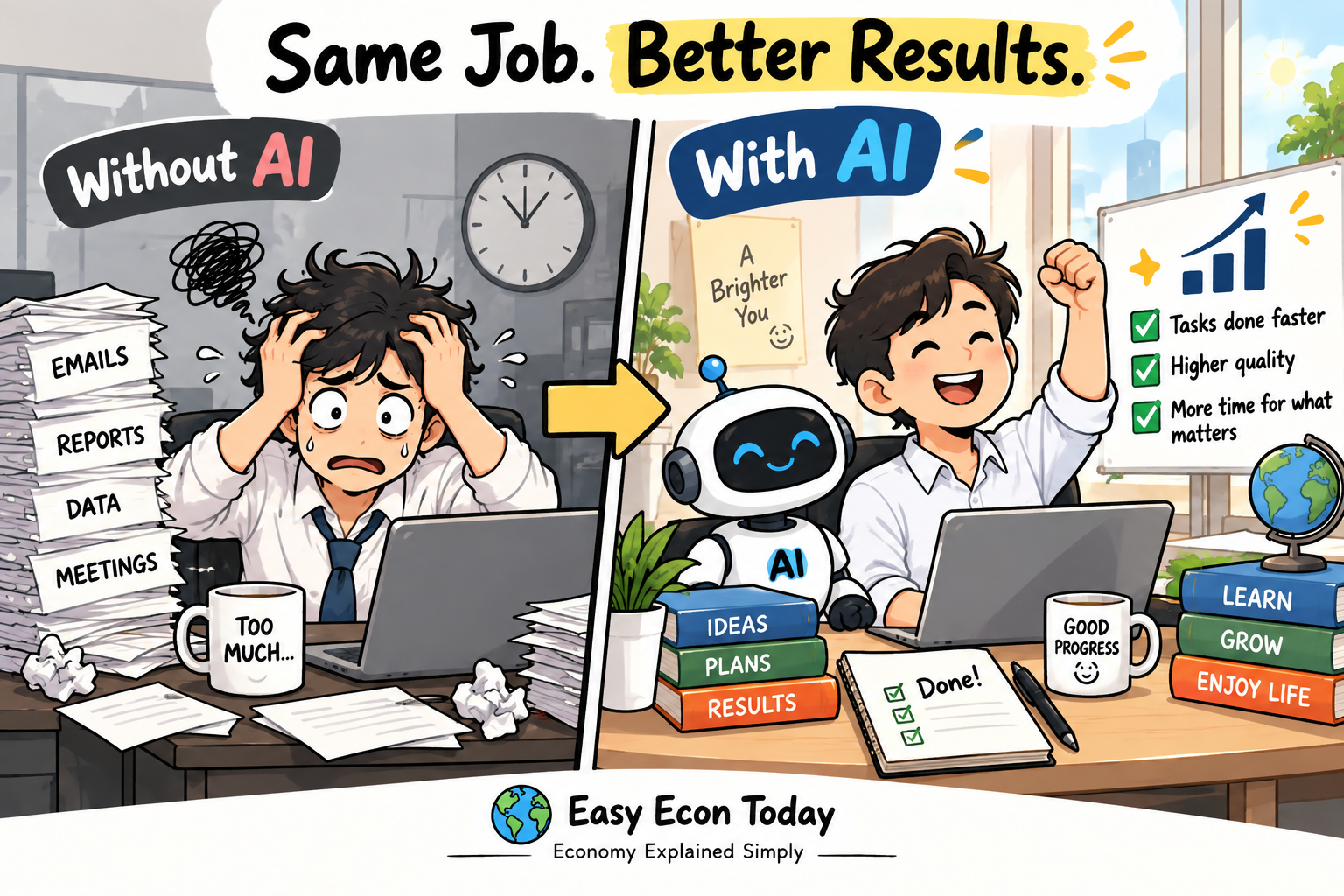
Monday Morning, 9:03 A.M.
Imagine a woman named Emma arriving at work on Monday morning.
She makes a cup of coffee, opens her laptop, and begins the same routine she has followed for years.
There are 27 emails waiting.
A customer wants an answer. Her manager needs a short report. Someone has sent her a spreadsheet with hundreds of rows of numbers. There is also a meeting at 10:30 for which she has not yet prepared.
Then her company introduces a new coworker.
It never sleeps.
It never asks for a holiday.
And it can draft an email, summarize a report, analyze a spreadsheet, and prepare meeting notes in seconds.
Its name is AI.
At first, Emma is delighted.
“This is wonderful,” she thinks. “I can finally get home on time.”
But several months later, another thought enters her mind.
If AI can do half of my work, does that make me twice as valuable — or half as necessary?
That simple question may become one of the most important economic questions of the AI age.
AI Is Not Coming to Work. It Is Already There.
For years, discussions about artificial intelligence sounded futuristic.
Robots would drive trucks. Computers would diagnose diseases. Machines might one day replace office workers.
But something important has changed.
AI is no longer only a technology of the future. It is becoming an everyday tool.
People use it to write emails, translate languages, create images, summarize documents, write computer code, analyze information, prepare presentations, and answer customer questions.
Across OECD countries, more than one-third of individuals used generative AI tools in 2025. Among people in employment, the figure was more than 40%.
The new coworker has already arrived.
And unlike previous workplace technologies, it does not only perform physical or repetitive tasks.
It can perform parts of jobs once considered distinctly “white collar.”
But Is AI Really Taking Our Jobs?
This is where the story becomes more complicated.
The International Labour Organization estimates that roughly one in four workers worldwide is employed in an occupation with some exposure to generative AI.
In high-income countries, the share is even higher — about one in three.
That sounds frightening.
But exposure is not the same thing as replacement.
A job is usually a collection of many different tasks.
Consider an accountant.
An accountant may enter data, check transactions, prepare reports, interpret tax rules, talk to clients, notice unusual circumstances, explain difficult decisions, and take responsibility when something goes wrong.
AI might automate some of those tasks.
That does not necessarily mean it can replace the entire person.
This is why the ILO says the more likely outcome for most occupations is transformation rather than complete replacement.
The job may remain.
But the job may become very different.
The Productivity Puzzle
Now imagine that Emma used to prepare five reports a week.
With AI, she can prepare ten.
Economists call this an increase in productivity.
More output can now be produced with the same amount of human time.
Historically, productivity growth has been one of the main engines of rising living standards.
Machines helped farmers produce more food.
Factories allowed workers to manufacture more goods.
Computers allowed offices to process information faster.
AI may become another major productivity technology.
Research reviewed by the OECD suggests that generative AI can significantly improve performance on some tasks, although the size of the benefit depends heavily on the worker, the task, and how the technology is used.
That sounds like good news.
And potentially, it is.
But there is another question.
Who receives the benefit of that extra productivity?
One Worker, Twice the Output
Suppose a small company once needed ten employees to complete a certain amount of office work.
AI allows those same ten employees to produce 30% more.
Several things could happen.
The company could produce more, expand, lower prices, attract more customers, and eventually hire additional workers.
It could pay its existing employees more because they are now more productive.
It could reduce working hours while maintaining the same output.
Or it could decide that eight employees using AI can now do what ten employees used to do.
All four outcomes are economically possible.
That is why the question “Will AI destroy jobs?” is almost too simple.
A better question is:
What will companies do with the productivity that AI creates?
The Missing Pay Raise
This distinction matters because higher productivity does not automatically mean that every worker immediately receives a higher salary.
A company might become more profitable while wages change very little.
Consumers might benefit through lower prices.
Shareholders might receive higher returns.
Highly skilled workers who know how to use AI effectively might command higher salaries.
Other workers might find that parts of their jobs have become easier to automate.
The benefits can be real while still being unevenly distributed.
Recent ILO research reviewing evidence from workplaces around the world finds that AI-related productivity gains are emerging, but they are uneven. Large-scale job displacement has so far remained limited, and time savings reported by workers have not automatically translated into equivalent increases in measured output or earnings.
In other words:
AI can create more economic value without guaranteeing that everyone receives an equal share of it.
That may explain part of the anxiety surrounding AI.
The Most Important Skill May Be Knowing What Not to Give AI
There is another side to Emma’s story.
After several months, she notices something interesting.
AI is excellent at producing a first draft.
But sometimes the draft is confidently wrong.
It can summarize the customer complaint, but it does not know that this particular customer has worked with the company for 15 years.
It can analyze the spreadsheet, but it may not understand why one unusual number matters.
It can suggest what Emma should say in a difficult conversation.
But Emma still has to have the conversation.
This reveals an important difference between doing a task and being responsible for an outcome.
The more AI handles routine production, the more valuable some human abilities may become:
judgment,
trust,
context,
responsibility,
empathy,
negotiation,
and knowing when something simply does not look right.
AI may produce an answer.
A human still has to decide whether the answer makes sense.
The New Divide at Work
The biggest divide of the AI era may therefore not simply be between people who have jobs and people who do not.
It may be between people who learn to work with AI and people whose work is gradually reorganized around them without their participation.
Imagine two employees doing similar jobs.
One avoids AI because it feels unfamiliar.
The other spends 20 minutes a day learning how to use it.
After a year, the second worker may not simply be faster.
That person may have learned how to ask better questions, check AI-generated work, combine information, automate routine tasks, and spend more time solving problems that require human judgment.
The technology is the same.
But the economic value of the two workers may begin to diverge.
What Ordinary Workers Can Do Now
Nobody knows exactly how quickly AI will change individual occupations.
That uncertainty is itself a reason to prepare.
The first step is simple: use the technology rather than only reading about it.
Try asking AI to summarize something you already understand. Let it draft an email and then improve the draft yourself. Give it a spreadsheet and check whether its conclusions are correct.
The purpose is not to hand your job to AI.
It is to discover which parts of your work AI does well — and which parts still need you.
Second, strengthen the skills that become more valuable when information itself becomes cheap.
If anyone can produce a reasonable first draft in seconds, the valuable skill may become knowing which draft is good.
If anyone can generate ten ideas, judgment about which idea is worth pursuing becomes more important.
If information is abundant, trust and interpretation become scarce.
Third, avoid defining yourself too narrowly by one task.
“I prepare reports” is vulnerable if report preparation becomes automated.
“I help businesses understand what their numbers mean and make better decisions” is much broader.
The task may disappear.
The underlying human problem may remain.
Finally, maintain some financial flexibility where possible.
Technological transitions rarely happen smoothly. A modest emergency fund, manageable debt, and the willingness to learn new skills can provide something extremely valuable during periods of change:
time to adapt.
Perhaps AI Is Not Really Our New Coworker
By Friday afternoon, Emma closes her laptop.
AI has helped her answer emails, analyze data, prepare reports, and organize meetings.
She has accomplished more than she could have imagined a few years earlier.
But AI did not decide which customer deserved a personal phone call.
It did not notice that a colleague was struggling.
It did not take responsibility for a difficult decision.
And it did not decide what kind of worker Emma wanted to become.
Perhaps calling AI a “coworker” gives it too much credit.
A better description may be an extraordinarily powerful tool — one that changes what humans can accomplish, but also changes what employers expect from humans.
The future of work may therefore be neither humans versus machines nor humans replaced by machines.
It may increasingly be humans with machines — competing with other humans who also have machines.
And that brings us back to Emma’s original question:
If AI can do half of my work, am I twice as valuable or half as necessary?
There is no single answer.
But perhaps the safest place to be is not the person who can do what AI can do.
It is the person who knows what AI should do, what it should not do, and what to do next.
Easy Econ Today
Economy Explained Simply