
Jobs, Productivity, Investment and the Industries of the Future
Artificial intelligence is no longer simply a technological innovation. It is becoming one of the major forces reshaping the global economy and the structure of entire industries.
The internet and smartphones transformed how information was produced and distributed. AI goes a step further: machines are beginning to perform or assist with forms of intellectual work that were traditionally done by people.
Companies now use AI to develop software, write documents, analyse data and serve customers. Manufacturers use it to optimise production and manage quality, while adoption is rapidly expanding across professional services such as finance, accounting, law and healthcare.
AI is no longer confined to the experimental stage. According to the Stanford AI Index, the share of organisations using AI rose sharply from 55% in 2023 to 78% in 2024.
But the economic significance of the AI revolution is not simply that “AI will do jobs that people used to do.”
The bigger questions are:
How much will AI increase productivity?
Who will benefit from those productivity gains?
And who will be the new winners and losers of the AI era?
These three questions may become an important starting point for understanding the global economy in the years ahead.
1. AI’s Most Important Economic Impact May Be Higher Productivity
Productivity is one of the most important drivers of long-term economic growth.
If the same number of people can produce more goods and services in the same amount of time, the economy can generate higher incomes and living standards.
This is one of the main reasons economists are so interested in AI.
Recent research is beginning to show evidence of these productivity gains.
A 2026 BIS study of European firms found that adopting AI increased labour productivity by an average of about 4%. Interestingly, these productivity gains were not accompanied by short-term reductions in employment.
Experiments involving programmers have shown even larger effects.
In a field experiment discussed by the BIS, programmers using generative AI increased their code output by more than 50%, with particularly strong gains among less-experienced workers.
Of course, results from particular tasks cannot simply be applied to the entire economy.
But they point to an important possibility.
AI does not need to replace people completely in order to create economic value.
For quite some time, one of the most important models of production may simply be:
Human + AI
AI can handle repetitive and time-consuming tasks while people concentrate on judgment, responsibility, negotiation, creativity and more complex decisions.
2. Will AI Take People’s Jobs?
One of the biggest concerns surrounding AI is employment.
And the concern is not without reason.
Tasks that are repetitive and follow predictable rules are likely to be among the first affected by AI and automation.
Data entry, basic translation and document preparation, some customer service, repetitive accounting tasks and basic software coding are obvious examples.
But the relationship between technological change and employment is more complicated than it first appears.
According to a 2025 ILO study, around one in four workers worldwide is employed in an occupation with some degree of exposure to generative AI.
But an important distinction is necessary:
A job exposed to AI is not the same as a job eliminated by AI.
Most occupations consist of many different tasks.
AI may be able to perform some of them, while other tasks still require human judgment, accountability and interaction.
For this reason, the ILO sees job transformation, rather than mass job destruction, as the more likely overall outcome of generative AI.
So the important question may increasingly shift from:
“How many jobs will AI eliminate?”
to:
“Which parts of today’s jobs will move from humans to AI?”
3. This Technological Revolution Is Reaching White-Collar and Professional Work
Earlier waves of automation mainly affected factory work and repetitive manual tasks.
Generative AI changes the picture.
This time, white-collar and professional occupations are also at the centre of technological change.
Accountants, lawyers, financial analysts, translators, marketers, programmers and researchers are already beginning to use AI as part of their everyday work.
Consider accounting.
The value of tasks such as data entry, repetitive calculations and first-stage document processing may gradually decline.
But interpreting complicated tax rules, understanding a client’s individual circumstances, comparing alternatives and providing final judgment and accountability remain important.
In the AI era, the most valuable worker may therefore be less likely to be the person who simply remembers the most information.
Instead, it may increasingly be:
the person who knows how to use AI effectively — and can still judge whether its answer is correct.
4. The Other Side of the AI Race Is Massive Capital Investment
There is another defining feature of the AI industry:
It requires enormous amounts of capital.
According to the Stanford AI Index 2026, private AI investment in the United States reached approximately $285.9 billion in 2025.
China invested around $12.4 billion in the same year, meaning U.S. private AI investment was roughly 23 times larger.
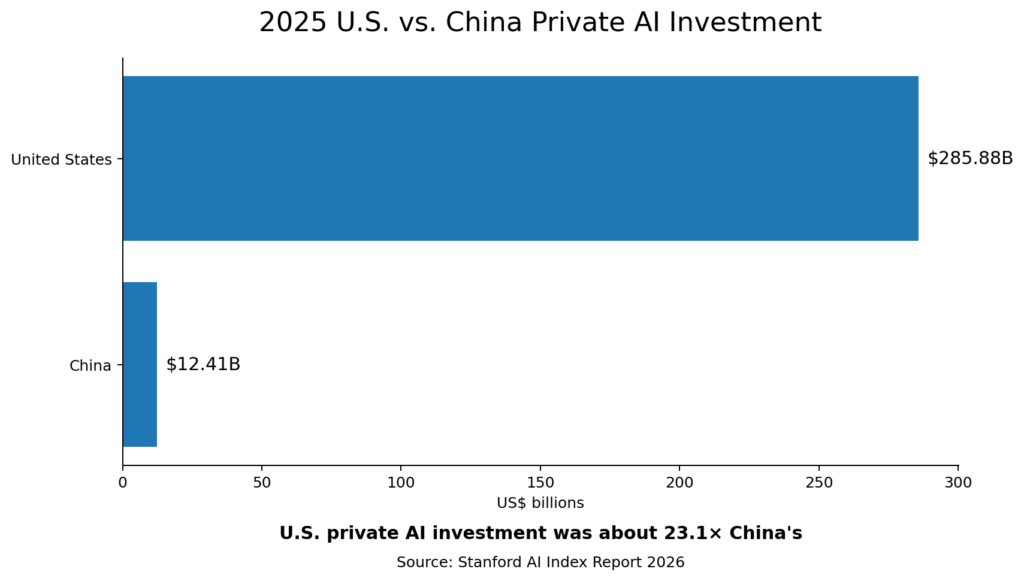
Investment in generative AI alone increased by more than 200% in 2025 and accounted for nearly half of total private AI investment.
Why does AI require so much money?
Developing and operating advanced AI models requires high-performance semiconductors, huge data centres, electricity, networks and large teams of researchers.
AI competition is therefore not simply a software race.
A vast industrial ecosystem is emerging:
Semiconductors → Data Centres → Electricity → AI Models → AI Services
5. In the AI Era, Electricity Becomes a Strategic Resource
AI may be digital technology, but its foundations are surprisingly physical.
Training and operating AI models requires enormous computing power.
That means running large numbers of high-performance chips.
And data centres require huge amounts of electricity.
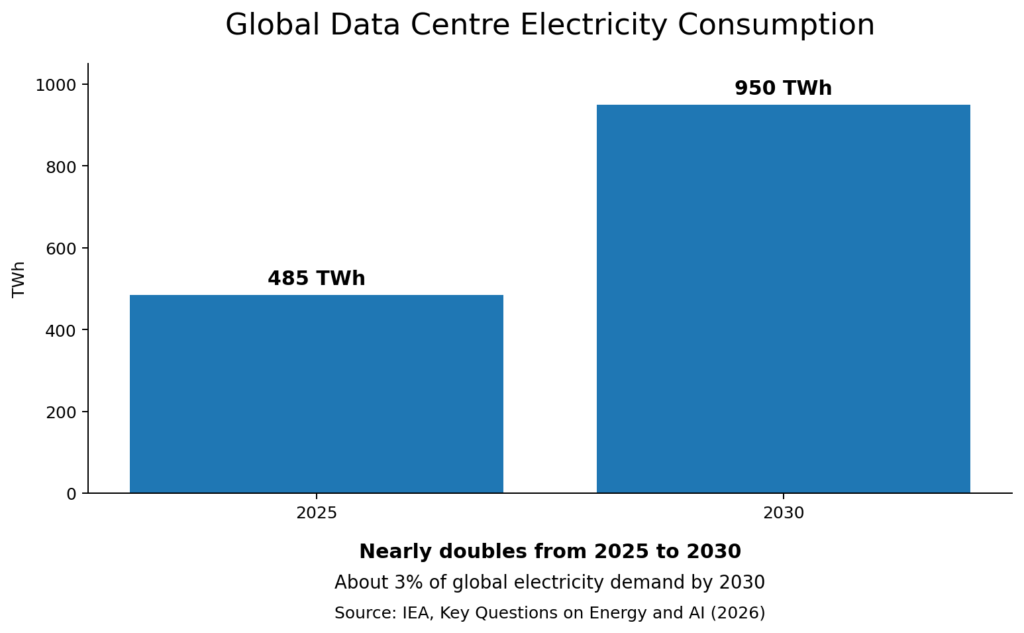
The IEA projects that global data-centre electricity consumption could rise from about 485 TWh in 2025 to around 950 TWh by 2030 — almost doubling in five years.
That would amount to roughly 3% of global electricity consumption.
Even more striking is the speed of growth.
Electricity consumption by accelerated servers, which are used heavily for AI workloads, is projected to grow by around 30% per year through 2030.
This means competitiveness in the AI era will not be determined by algorithms alone.
Semiconductor manufacturing, data centres, power generation, transmission grids and reliable electricity supply are all becoming part of the essential infrastructure of AI.
Related: Are AI Data Centers Raising Your Electricity Bill? Here’s How It Really Works
6. AI Is a New Arena of Strategic Competition Between the U.S. and China
The AI race is not only competition between companies.
It is also competition between nations.
And the rivalry between the United States and China is particularly important.
The United States has many of the world’s leading AI companies, advanced semiconductor design capabilities, enormous cloud infrastructure and deep capital markets.
According to the Stanford AI Index 2026, the United States produced 50 notable AI models in 2025, compared with 30 in China.
China, however, remains strong in AI research papers and patents, while the performance gap between leading Chinese and U.S. AI models has narrowed considerably.
So the race for AI leadership is not simply about which country can build the smartest model.
It is increasingly a competition over who can secure:
semiconductors, energy, data, talent, capital and supply chains.
7. Who Will Capture the Wealth Created by AI?
Even if AI raises productivity across the economy, the benefits will not automatically be shared equally.
If the companies controlling AI technology, data and computing resources dominate their markets, a significant share of the gains could become concentrated among a relatively small number of companies and capital owners.
The gap between large companies and smaller businesses may also widen.
The BIS study of European firms found that productivity gains from AI adoption were relatively stronger among medium-sized and large companies.
This highlights an important point.
Simply purchasing AI software does not automatically make an organisation more productive.
Companies also need data, employee training and changes to their working systems.
In the AI era, competitive advantage may therefore depend less on whether an organisation has AI and more on:
how effectively it integrates AI into real work and real business processes.
8. The AI Revolution and an AI Investment Bubble Can Exist at the Same Time
This is particularly important for investors.
AI can be a revolutionary technology while some AI investments are still poor investments.
History gives us plenty of examples.
Major technological revolutions have often been accompanied by periods of excessive investment and speculation.
The railway boom of the nineteenth century and the internet boom of the late 1990s are two famous examples.
Railways transformed the economy.
The internet transformed the economy.
But that did not mean everyone who invested in railway companies or internet companies made money.
AI may follow a similar pattern.
Investors therefore need to separate two questions:
“Is AI a revolutionary technology that will transform the global economy?”
and
“How much of that future value is already reflected in today’s AI-related share prices?”
Answering “yes” to the first question does not automatically answer the second.
9. What Ultimately Matters Is How Well We Use AI
There is no need to be excessively optimistic about AI.
But there is no need to be excessively afraid of it either.
Technology by itself does not determine economic outcomes.
For businesses, the key question is not simply how quickly they adopt AI, but where they can apply it to generate genuine productivity gains.
For workers, the challenge may be less about competing directly with AI and more about learning how to use AI to expand their own capabilities.
The same is true for countries.
Investing in AI technology alone is not enough.
Education, semiconductors, energy, electricity grids, communications infrastructure, capital markets and competition policy all need to develop alongside it.
Conclusion — The Real Question of the AI Era
We still do not know exactly how dramatically AI will transform the global economy.
It may become a general-purpose technology that raises productivity across the economy for decades, much as the internet did.
Or some of today’s expectations may eventually prove excessive.
Most likely, both things will happen at the same time.
AI may be revolutionary, but not every AI company will succeed.
And before we reach a world in which AI replaces all human work, we are more likely to see an economy in which people use AI to accomplish far more than they could before.
So perhaps the most important question of the AI era is not simply:
“Will AI replace humans?”
A more important question may be:
“Who will capture the new productivity and wealth created by AI — and how well will businesses, workers and governments adapt to the change?”
The economic winners and losers of the AI revolution may ultimately be determined by how we answer that question.
☕ A Moment to Pause
After thinking about the future of AI, productivity and work, take a moment to slow down and enjoy some music.
Sources
Stanford Institute for Human-Centered AI (HAI) — The 2026 AI Index Report
U.S. and China private AI investment, AI adoption and global AI trends.
Bank for International Settlements (BIS) — AI adoption, productivity and employment: evidence from European firms
Evidence on AI adoption, labour productivity and employment.
Bank for International Settlements (BIS) — Generative AI and labour productivity: a field experiment on coding
Evidence on productivity gains among programmers using generative AI.
International Labour Organization (ILO) — Generative AI and Jobs: A Refined Global Index of Occupational Exposure
Global estimates of workers and occupations exposed to generative AI.
International Energy Agency (IEA) — Key Questions on Energy and AI
Data-centre electricity demand and the energy requirements of AI.