
Economics of Everyday Life ②
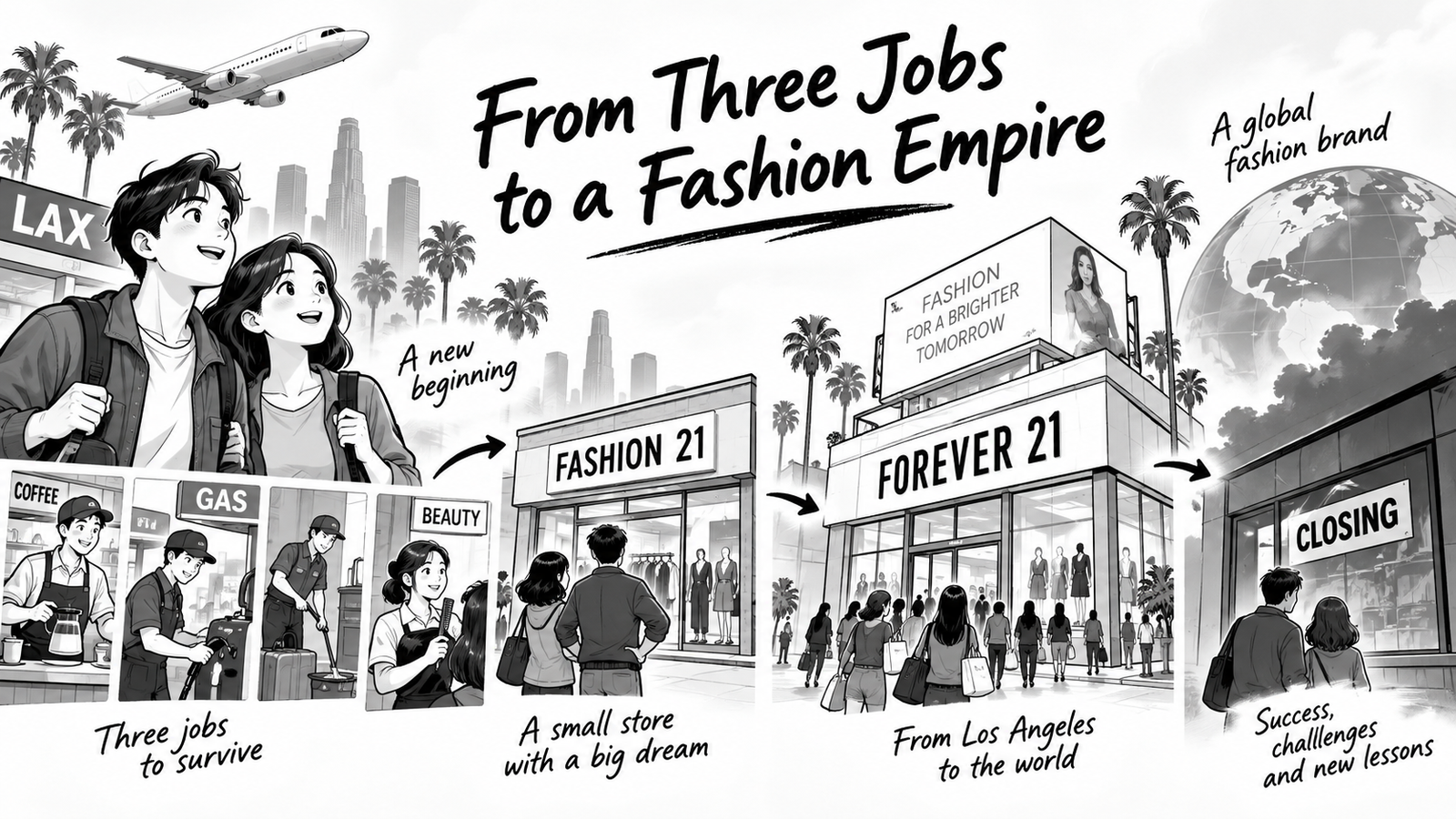
In 1981, a young couple left South Korea and arrived in Los Angeles.
They were Do Won Chang and his wife, Jin Sook Chang.
They had no large amount of capital waiting for them and no guaranteed careers in America.
Do Won Chang worked at a coffee shop, a gas station and as a janitor, at one point juggling three jobs. His wife worked as a hairdresser.
In a new country, survival came first.
When they woke up each morning, their first thought may simply have been how to make it through another day.
But Do Won Chang was doing more than working.
He was watching.
A Small Clue at a Gas Station
Years later, Chang recalled noticing something while working at a gas station.
Some of the people driving expensive cars seemed to be working in the clothing business.
That observation helped spark his interest in fashion.
There is an interesting economic lesson here.
We often imagine that great business ideas arrive suddenly, like flashes of genius.
But in the real world, observation often comes before inspiration.
What are people buying?
Where are they spending their money?
Which stores are attracting customers?
And who seems to be making money?
For Chang, the gas station was not merely a place to earn a living.
It was also a small window into the American economy.
$11,000 Saved in Three Years
The couple worked for about three years.
During that time, they saved approximately $11,000.
In 1984, they used those savings to open a small clothing store of about 900 square feet in Los Angeles.
It was not originally called Forever 21.
Its first name was Fashion 21.
The store was small.
But the results were not.
In its first year, sales reportedly reached about $700,000.
The couple built a price advantage by sourcing discounted inventory and buying merchandise directly from manufacturers.
A store started with $11,000 had generated around $700,000 in sales in its first year.
Of course, $700,000 in sales does not mean $700,000 in profit.
But the market was sending a very clear signal:
“People want what this store is selling.”
Success Came From Seeing Trends Quickly
Fashion 21 grew and eventually became Forever 21.
What the company did well was not simply selling cheap clothes.
It learned to identify what younger consumers wanted and get fashionable designs into stores quickly at relatively affordable prices.
This brings us to an important business concept:
inventory turnover.
A fashion item that is popular today may be forgotten next year.
Once a trend passes, unsold clothes remain on the shelves and eventually have to be discounted.
So in fast fashion, success is not simply about producing cheaply.
It is also about quickly recognising what is selling and getting it to customers.
The Changs developed that skill in their small store.
Small Success Led to Bigger Success
Once the first store succeeded, the couple kept going.
At one stage, Forever 21 was reportedly opening a new store roughly every six months.
What began as a small immigrant family business started expanding across America and eventually around the world.
By 2009, Forever 21 reportedly operated about 460 stores in 13 countries, with estimated annual sales of around $1.7 billion.
The expansion continued.
By around 2015, annual sales had reportedly peaked at roughly $4.4 billion, while the company’s global store network grew to more than 800 locations.
A couple who had once worked multiple jobs had built a global fashion empire.
If we stopped the story here, it would sound like a familiar success story:
Work hard.
Spot an opportunity.
Start a business.
Become successful.
But economics rarely ends there.
In fact, what happened next may teach us even more.
What Made You Successful Once May Not Keep You Successful
When a business keeps growing, it is easy to begin believing:
“What worked before will keep working.”
Forever 21 continued expanding.
More countries.
More stores.
Bigger retail spaces.
When sales are growing rapidly, expansion can look like an obvious strength.
Open another store, generate more sales, then use that growth to open another.
But every new store also creates fixed costs.
There is rent.
There are wages.
There are electricity and maintenance costs.
And every store needs inventory.
When business is strong and customers keep coming, those costs may be manageable.
The problem begins when customer behaviour changes.
The World Was Changing Outside the Stores
The fashion industry was changing quickly.
Online shopping was growing, while new global fast-fashion competitors were becoming increasingly powerful.
Young consumers no longer assumed that buying clothes meant visiting a shopping mall.
They could search for products, compare prices and order clothes from their phones.
Forever 21, meanwhile, had built a huge network of physical stores.
The very assets that had helped create its success could now become a burden as the market changed.
Among the problems often associated with Forever 21’s difficulties were rapid expansion, challenges in responding to changing fashion trends, and growing online competition.
Here we can see one of the great paradoxes of business:
Sometimes the very thing that created your success can make the next stage of success harder.
2019: Forever 21 Faces a Crisis
In 2019, Forever 21 filed for Chapter 11 bankruptcy protection in the United States.
By then it was a major global fashion retailer, but it also carried the costs of a large physical store network.
By then, Forever 21 had become a major global employer and was generating billions of dollars in annual sales.
The contrast with that first store in 1984 is striking.
In a 900-square-foot shop, the owners could move quickly.
They could see which clothes were selling and adjust their next purchases.
But a global company with hundreds of stores cannot change direction so easily.
A small boat can turn quickly.
The bigger the ship becomes, the more time and effort it takes to change course.
Growth Has a Cost Too
Economists call the advantages that come from becoming larger economies of scale.
Buying products in large quantities can lower costs.
Advertising, logistics and distribution can also become more efficient.
That is one reason businesses want to grow.
But bigger is not always better.
As an organisation grows, decisions can become slower, fixed costs can rise, and adapting to a changing market can become more difficult.
The Forever 21 story therefore raises an important question:
“How fast should a business grow?”
And perhaps an even more important one:
“Are we growing at a speed we can actually manage?”
Was Do Won Chang a Success or a Failure?
There is probably no useful way to answer that question with a single word.
Turning an $11,000 investment into a global company generating billions of dollars in annual sales was clearly an extraordinary entrepreneurial achievement.
At the same time, excessive expansion and difficulties adapting to a changing market became part of the company’s history too.
Those two facts do not contradict each other.
Success and failure can exist in the same life.
Perhaps that is much closer to how real economics — and real life — actually works.
When we look at successful people, it is easy to imagine that they knew the right answer from the beginning.
But most businesses are built through a long series of decisions.
Some decisions work.
Others don’t.
What matters is not simply remembering the successful decisions, but understanding what can be learned from the ones that went wrong.
Today’s Economics Lesson
The story of Do Won and Jin Sook Chang shows us two very different stages of business.
The first was the stage of starting small.
What did they need then?
Hard work.
Saving.
Observation.
And courage.
The second stage was running a large global company.
That required a different set of skills:
Risk management.
Adapting to change.
Controlling costs.
And sometimes knowing when not to grow.
Perhaps the most important economic lesson in this story is:
The skills that help you start a successful business are not always the same skills that help you protect it.
And perhaps that lesson applies to our personal lives as well.
When we have little money, learning how to earn more is important.
Once we have accumulated some wealth, learning how to protect it becomes important too.
When a business is small, having the courage to seize opportunities matters.
But when it becomes large, having the discipline to say no to some opportunities may matter just as much.
A long road stretched between the days when Do Won Chang watched expensive cars arrive at a gas station and the days when Forever 21 became a global fashion company.
And that journey reminds us of something important:
Economic success is not a destination. It is an ongoing process of making decisions.
Perhaps after achieving success, the most useful question is no longer:
“How much bigger can we become?”
but instead:
“What do we need to change to protect what we have already built?”
Sources
- Forbes — Exclusive Interview With One of America’s Most Successful Immigrants: Forever 21’s Do Won Chang
- Forbes — Forever Profitable
- Los Angeles Times — Why Forever 21 Filed for Bankruptcy: Big Stores, Small Crowds
☕ A Moment to Pause
A young immigrant couple began by working multiple jobs in an unfamiliar country.
Their small clothing store eventually became a global company.
But even that success did not last forever.
Life and economics rarely move in a straight line.
Sometimes we rise. Sometimes we fall. And somewhere along the way, we learn how to choose the next direction.
As we come to the end of today’s story, take a moment to slow down and enjoy some music.
Frank Sinatra — My Way
Key References
This article was rewritten and adapted by Easy Econ Today using publicly available information about Do Won and Jin Sook Chang and the history of Forever 21.
- Forbes — Interviews with Do Won Chang and coverage of Forever 21’s founding and growth
- Los Angeles Times — Reporting on the Changs’ immigrant journey, the growth of Forever 21, and its 2019 bankruptcy filing
- Forbes — Coverage of Forever 21’s sales, store expansion and business growth
Key events and figures were checked against publicly available sources. The story and economic interpretation have been rewritten to make the lessons easier for readers to understand.