
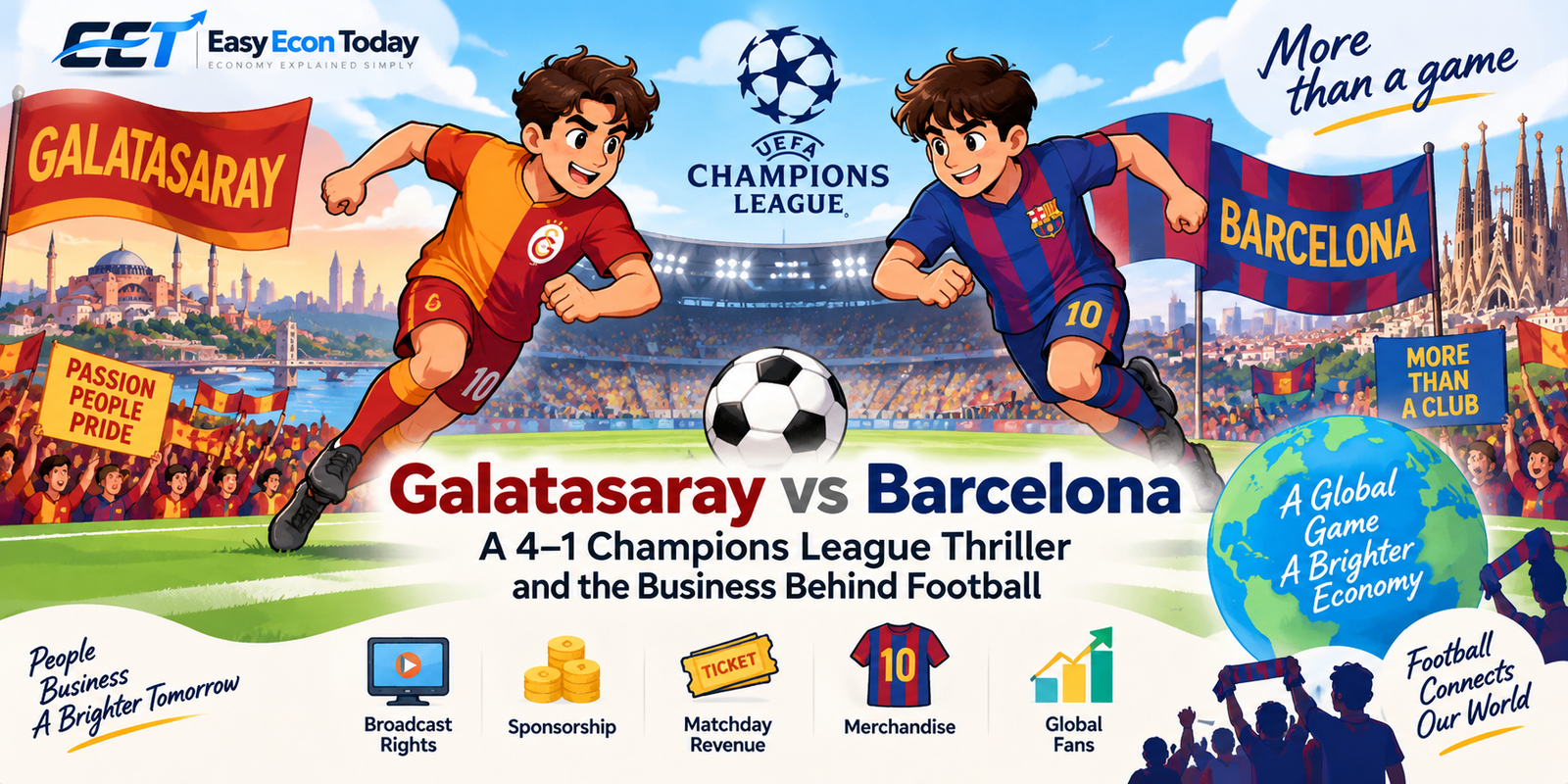
Barcelona came from behind to defeat Galatasaray 4–1 in Istanbul. But beyond the goals and excitement, the match tells a bigger story about how football has become a global entertainment business.
Barcelona’s Stunning Comeback in Istanbul
On October 13, 2026, two of Europe’s most recognizable football clubs met at RAMS Park in Istanbul for a UEFA Champions League league-phase match.
Galatasaray, backed by its passionate home supporters, took an early lead. Aleksey Batrakov scored in the 28th minute, giving the Turkish side hope of a memorable victory.
But Barcelona responded with remarkable attacking quality.
João Cancelo equalized in the 43rd minute, bringing the visitors level before halftime.
After the break, Barcelona took control.
Fermín López scored in the 50th minute, followed by Anthony Gordon just three minutes later. Karim Adeyemi completed the 4–1 victory in the 65th minute.
Young star Lamine Yamal played a particularly important role, providing two assists during Barcelona’s second-half surge.
The result gave Barcelona its second Champions League victory of the season, while Galatasaray suffered another disappointing European defeat.
Why This Match Attracted Attention
Barcelona is one of the world’s most recognizable football brands, with supporters far beyond Spain.
Galatasaray, meanwhile, represents one of Turkey’s most passionate football traditions.
When these clubs meet, the audience extends beyond the stadium and the two countries involved.
Fans across Europe, Asia, the Americas, and other regions can follow the same match through television, streaming services, social media, and online sports coverage.
This international attention is one reason major football competitions have become valuable commercial properties.
A single match can create opportunities for broadcasters, advertisers, sponsors, merchandise sellers, and digital media companies.
Football Is No Longer Just a Sport
For millions of supporters, football is about loyalty, competition, and unforgettable moments.
For clubs and businesses, however, football is also a sophisticated international industry.
Major clubs operate through several interconnected revenue streams:
Broadcasting rights: Television networks and streaming platforms pay for the opportunity to show major competitions to viewers.
Sponsorship: Companies associate their brands with clubs, players, and competitions to reach international audiences.
Matchday revenue: Tickets, hospitality packages, and stadium-related spending generate income when supporters attend matches.
Merchandise: Shirts and other licensed products allow supporters around the world to express their loyalty.
Digital engagement: Social media, online video, and digital partnerships help clubs build commercial relationships beyond their home markets.
The significance of these activities extends well beyond the final score.
The Economic Value of the Champions League
The UEFA Champions League is one of the most prestigious competitions in club football.
Its economic importance comes partly from the ability to bring together famous teams from different national leagues under a single international competition.
That creates an attractive product for broadcasters and commercial partners.
Participation can also generate financial distributions for clubs, although the amounts depend on competition rules, sporting performance, and other factors.
A strong European campaign may bring additional benefits, including greater international exposure and commercial opportunities.
However, sporting success does not automatically translate into financial profitability.
Football clubs also face substantial costs, including player salaries, transfers, stadium operations, travel, and administration.
The challenge is to turn global popularity into sustainable long-term revenue.
Barcelona: A Global Brand Beyond Spain
Barcelona provides an interesting example of the relationship between sporting success and international business.
The club’s appeal is not limited to supporters living in Barcelona or even Spain.
Its international reputation, famous players, and footballing history have helped establish a worldwide audience.
That audience matters commercially.
A fan watching from New York, Seoul, or Sydney may never attend a match at Barcelona’s home stadium, but could still buy licensed merchandise, follow the club online, or watch matches through a broadcasting service.
This illustrates an important feature of modern sport: a club’s potential commercial market can be much larger than its local population.
Yet worldwide recognition also creates pressure to maintain competitive performance, attract talent, and manage substantial operating costs.
Galatasaray and the Power of Local Passion
Galatasaray offers a different but equally interesting perspective.
The Istanbul club has a strong domestic identity and a reputation for passionate supporters.
That local connection is a valuable asset.
Supporters create the atmosphere that makes football emotionally compelling, while international competitions provide opportunities to introduce that identity to a much wider audience.
Even a disappointing result against a famous opponent can attract significant international attention.
But there is an important distinction between visibility and financial success.
A club must still manage its costs, strengthen its commercial operations, and build sustainable relationships with supporters and sponsors.
Why Star Players Matter Economically
One of the most interesting aspects of modern football is the commercial influence of individual players.
Players such as Lamine Yamal attract attention not only because of their technical ability but also because of their international recognition.
Outstanding performances can generate highlights, discussions, news coverage, and social media engagement.
This attention can strengthen the visibility of both the player and the club.
However, popularity alone does not determine a player’s economic value.
Performance, contract terms, age, injury risk, transfer conditions, and commercial opportunities all play a role.
For clubs, the challenge is to balance the sporting benefits of talented players against the financial commitments required to retain them.
What the 4–1 Result Means
Barcelona’s comeback demonstrated the attacking quality and depth of its squad.
For Galatasaray, the defeat highlighted the difficulty of competing against Europe’s strongest teams, even with passionate home support.
Both clubs still have important matches ahead in the Champions League league phase.
Barcelona’s next European opponent is Paris Saint-Germain on October 20, while Galatasaray travels to face Lille on October 21.
These upcoming fixtures will provide further tests of both teams’ ambitions.
The Bigger Picture: Football and the Global Economy
The most interesting lesson from this match may have little to do with the scoreboard.
Modern football demonstrates how entertainment, technology, international audiences, and commercial investment can reinforce one another.
A match played in Istanbul can generate attention across several continents within minutes.
Fans watch, discuss, share highlights, and engage with the clubs through multiple digital platforms.
Businesses seek access to those audiences, while clubs invest in talent and infrastructure to remain competitive.
This creates an international economic ecosystem around what began as a simple sporting competition.
Barcelona’s 4–1 victory will be remembered by football supporters for its dramatic comeback and impressive attacking display.
But the match also reminds us that football has become much more than 90 minutes of competition.
In today’s interconnected world, football is both a global passion and a global business.
Easy Econ Today — Economy Explained Simply.
Sources: UEFA Champions League, FC Barcelona, Galatasaray SK, and Reuters. Match details verified as of October 14, 2026.