
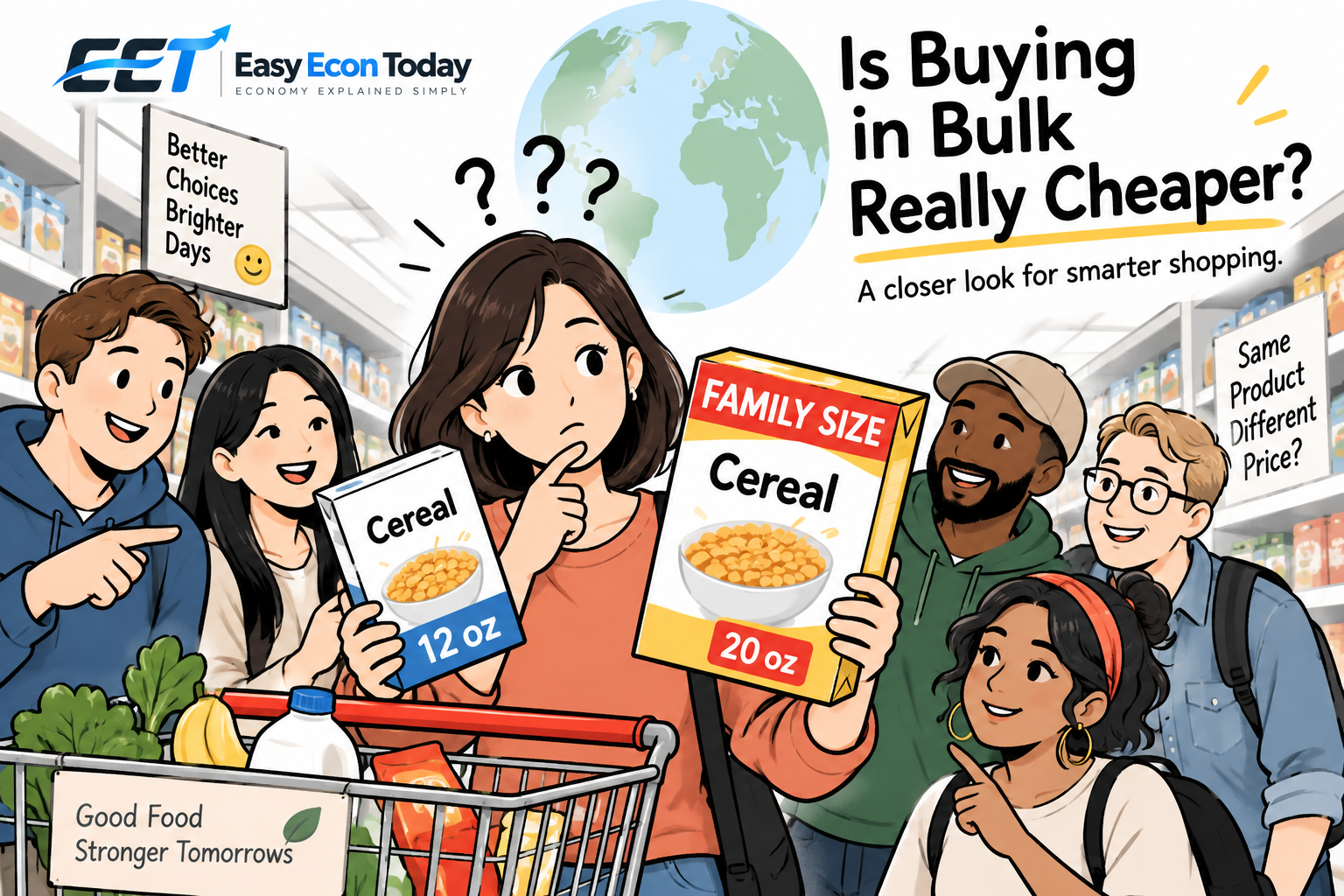
You are standing in a supermarket aisle.
In front of you are two boxes of the same cereal.
One is the regular size. The other says FAMILY SIZE in big letters.
The family-size box costs more, of course. But you probably assume that you are getting more cereal for your money.
So you reach for the bigger box.
It feels like the sensible choice.
But what if it isn’t?
Most of us have learned a simple shopping rule:
Buy more, pay less per unit.
That rule often works. But not always.
Sometimes the bigger package sitting on the supermarket shelf actually costs more per ounce than the smaller one.
And that small surprise tells us something interesting about how we shop — and how businesses price the things we buy.
The Assumption We Rarely Question
Imagine two packages of the same snack.
The prices below are just a simple example:
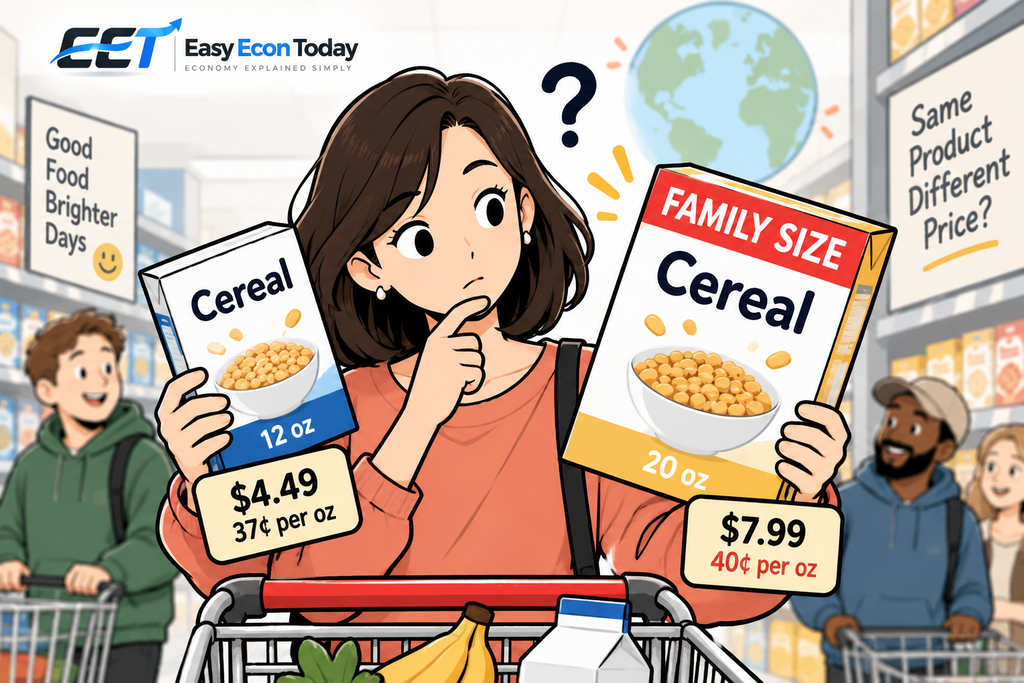
Regular size
12 oz — $4.49
Price per ounce: 37¢
Family size
20 oz — $7.99
Price per ounce: 40¢
At first glance, $7.99 for the larger package may look like the better value.
But it isn’t.
You are actually paying more for each ounce.
Economists and retail researchers have a name for this situation: a quantity surcharge.
It occurs when a larger package has a higher unit price than a smaller package of the same product.
This isn’t just a theoretical possibility.
Research published in the Journal of Retailing examined quantity surcharges in grocery shopping and noted that earlier store surveys had found surcharge pricing in roughly a quarter of brands available in multiple sizes.
The researchers also found something particularly interesting: shoppers may buy the larger package simply because they assume it must be cheaper.
In other words, the shortcut in our heads can sometimes cost us money.
Why Do We Automatically Trust the Bigger Package?
Because most of the time, the idea makes sense.
Producing and selling one large package can be cheaper than producing two smaller ones.
There may be less packaging per ounce, fewer containers to transport and fewer individual items for the store to handle.
Businesses often pass at least some of those savings to consumers.
That is why warehouse clubs and bulk stores became so successful.
We have been trained by experience to associate words such as:
Value Pack. Family Size. Economy Size. Bonus Pack.
with savings.
Eventually we stop doing the calculation.
We see the bigger package and think:
Better deal.
That is where things become interesting.
The supermarket isn’t just a place where products compete.
It is also a place where our assumptions compete with arithmetic.
The Tiny Number That Matters More Than the Big Price
There is a simple way to check.
Ignore the large price for a moment.
Look for the small number on the shelf label showing the unit price.
It might say:
price per ounce
price per pound
price per quart
or sometimes price per item.
The U.S. National Institute of Standards and Technology (NIST) describes unit pricing as one of the most useful tools consumers have for comparing value.
It gives a shopper a common measuring stick.
A 12-ounce package and a 20-ounce package suddenly become easy to compare because both can be reduced to one number:
How much am I paying for one ounce?
Interestingly, unit pricing is not uniformly required across the United States. Rules vary by state, while many retailers provide it voluntarily.
So depending on where you shop, that little number may be easy to find — or not.
Americans Are Still Paying Attention to Grocery Prices
This matters even more when household budgets are under pressure.
According to the U.S. Bureau of Labor Statistics, prices for food consumed at home were 2.2% higher in August 2026 than a year earlier.
Some categories moved considerably more.
Bread was up 3.8%, rice 4.7%, and cookies 5.0% over the same period.
Those percentages may look small compared with some of the dramatic inflation numbers Americans saw earlier in the decade.
But families don’t experience inflation as a statistic.
They experience it one shopping cart at a time.
A few cents more for bread.
A dollar more here.
A smaller package there.
A “value size” that may not actually be the best value.
Individually, these differences seem trivial.
Repeated every week across dozens of purchases, they become part of the household budget.
Then There Is Shrinkflation
There is another reason unit prices have become more useful.
Packages themselves change.
A container that once held 16 ounces might later hold 14 ounces while its shelf price stays similar.
Consumers commonly call this shrinkflation.
NIST has specifically highlighted unit pricing as a useful way for shoppers to deal with package downsizing.
Why?
Because our eyes remember the package.
The unit price remembers the mathematics.
A cereal box can become slightly narrower. An ice cream container can become smaller. A bag can contain a little less.
Those changes can be difficult to notice while walking through a busy supermarket.
But if the price per ounce rises, the unit price exposes the change immediately.
Why Doesn’t Everyone Check?
Because shopping has another cost that doesn’t appear on the receipt:
time.
Think about a typical grocery trip.
You may have 30 or 40 things to buy.
You are checking your phone.
Someone is waiting at home.
Your children may be with you.
You are trying to remember whether you still have milk.
A sale sign catches your eye.
There are six versions of the same product.
Doing a calculation for every item would be exhausting.
So our brains create shortcuts.
Bigger means cheaper.
Sale means bargain.
Family size means value.
The old research on quantity surcharges found evidence consistent with this problem: people facing higher time and information costs were more likely to buy larger packages carrying a surcharge.
That is an economic lesson hiding in a supermarket aisle.
Our attention is scarce, too.
Companies compete not only for our dollars, but also within the limits of the attention we have available to make decisions.
Bulk Buying Can Still Be a Great Deal
None of this means buying in bulk is a mistake.
Often, the bigger package really is cheaper per ounce.
And for a household that regularly uses the product, buying more at a lower unit price can make perfect sense.
But price isn’t the only consideration.
Suppose a giant container of strawberries is cheaper per pound.
If half of them spoil before you eat them, was it really cheaper?
Or imagine buying a huge package because it saves 10 cents per ounce, only to discover six months later that half of it is still sitting in the pantry.
The cheapest unit price is not necessarily the cheapest usable product.
There is also the upfront cost.
A family with plenty of cash may be able to buy a $25 bulk package and enjoy a lower unit price.
Another shopper may only have $10 available today.
The smaller package may cost more per ounce but still be the only realistic choice.
This is one of the quiet inequalities of everyday economics:
Sometimes saving money requires having enough money to buy the cheaper option in the first place.
The Supermarket Is a Small Economics Classroom
We often think economics happens at the Federal Reserve, on Wall Street or in government offices.
But economics also happens while you are deciding between two jars of peanut butter.
It happens when you choose convenience over price.
It happens when a company decides how large a package should be.
It happens when a supermarket decides how prominently to display the unit price.
And it happens when your brain decides that calculating three different prices isn’t worth another minute of your time.
The decisions are tiny.
Multiply them by millions of shoppers, and they become economics.
One Simple Habit
You don’t need a calculator for everything you buy.
You don’t need to spend ten minutes comparing cereal boxes.
Just develop one small habit.
When two packages of the same product are different sizes, don’t automatically look at the biggest package.
Look at the smallest number on the shelf.
Price per ounce.
Price per pound.
Price per item.
Then decide whether buying more actually makes sense for your household.
Because sometimes the words FAMILY SIZE describe the package.
They don’t necessarily describe the bargain.
And in an economy where every dollar seems to be working a little harder, that tiny number on the shelf may be worth a second look.
Sources
U.S. Bureau of Labor Statistics — Consumer Price Index, August 2026
National Institute of Standards and Technology (NIST) — Unit Pricing Guide: A Best Practice Approach to Unit Pricing
National Institute of Standards and Technology — Uniform Unit Pricing: Tools for Consumers to Fight Shrinkflation
Journal of Retailing — Consumer Price Awareness in Food Shopping: The Case of Quantity Surcharges