
How Stablecoins Differ from Bitcoin — and Why They Could Change the Way We Send Money
Imagine that you want to send $1,000 from South Korea to your child living in the United States.
Most of us would use a bank or an international money-transfer service. Korean won is converted into U.S. dollars, transfer fees are paid, and in some cases the money passes through intermediary financial institutions before reaching a U.S. bank account.
But what if you could send a digital version of the dollar over the internet, without being as dependent on traditional banking hours?
This is where stablecoins become interesting.
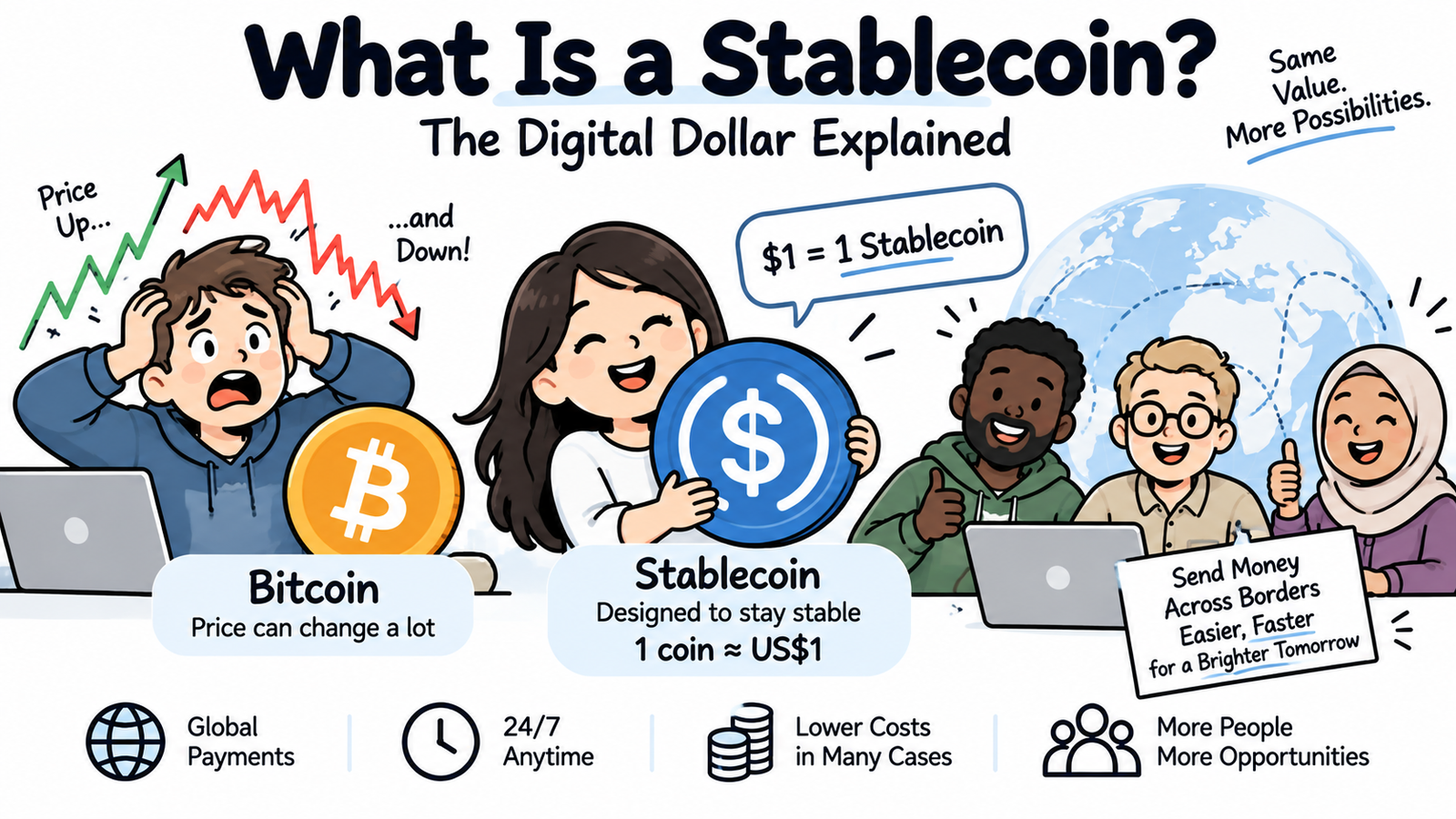
Like Bitcoin, stablecoins use blockchain technology. But unlike Bitcoin, they are generally not designed to rise and fall dramatically in price. Major U.S. dollar stablecoins are designed to keep the value of one coin close to one U.S. dollar.
That raises two interesting questions:
If we already have dollars, why create something that looks like a “digital dollar”?
And:
Could stablecoins really change the way we send and receive money across borders?
For now, we will leave the more complicated technology in the background and look at stablecoins from the perspective that matters most to ordinary users: how we send, receive and use money.
1. How Does International Money Transfer Work Today?
Suppose you want to send $1,000 from South Korea to the United States.
From the outside, it can look simple. You open your banking app, tap a few buttons, and the transfer is done.
But the actual movement of money across borders can be more complicated.
In a traditional international bank transfer, Korean won must be converted into U.S. dollars. Depending on the banks and transfer route, intermediary institutions may also be involved.
Along the way there may be foreign-exchange costs, transfer fees and intermediary-bank charges, and the time required for the money to arrive can vary.
Put simply, when we send $1,000 to the United States, a bundle of dollar notes does not physically fly from Korea to America.
Instead, money moves through changes in records across accounts, payment systems and settlement networks — records showing who has paid whom and how much.
This is where stablecoins offer a different idea.
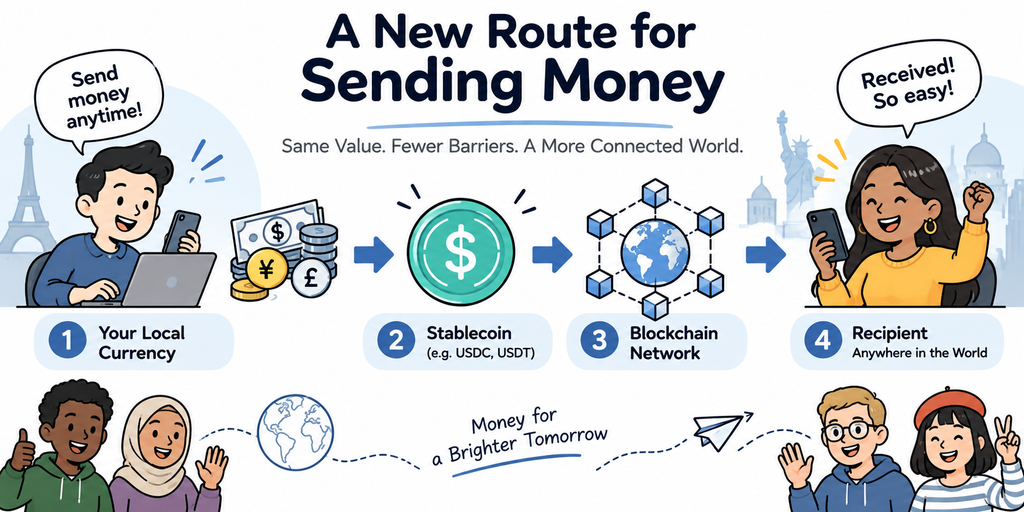
With a U.S. dollar-linked stablecoin, the route could conceptually look like this:
Korean won → U.S. dollar stablecoin → Recipient’s digital wallet in the United States
Because the value can move through a blockchain network, stablecoins create a route that is different from a traditional international bank transfer.
That does not mean stablecoins are always cheaper or faster.
There may be costs when converting Korean won into a stablecoin and again when the recipient converts the stablecoin into ordinary dollars.
We will return to that point later.
2. So What Exactly Is a Stablecoin?
A stablecoin is a digital asset designed to maintain a relatively stable value.
The most common examples are linked to the U.S. dollar.
Two well-known dollar stablecoins are USDT (Tether) and USDC. Their basic goal is to maintain a value of approximately:
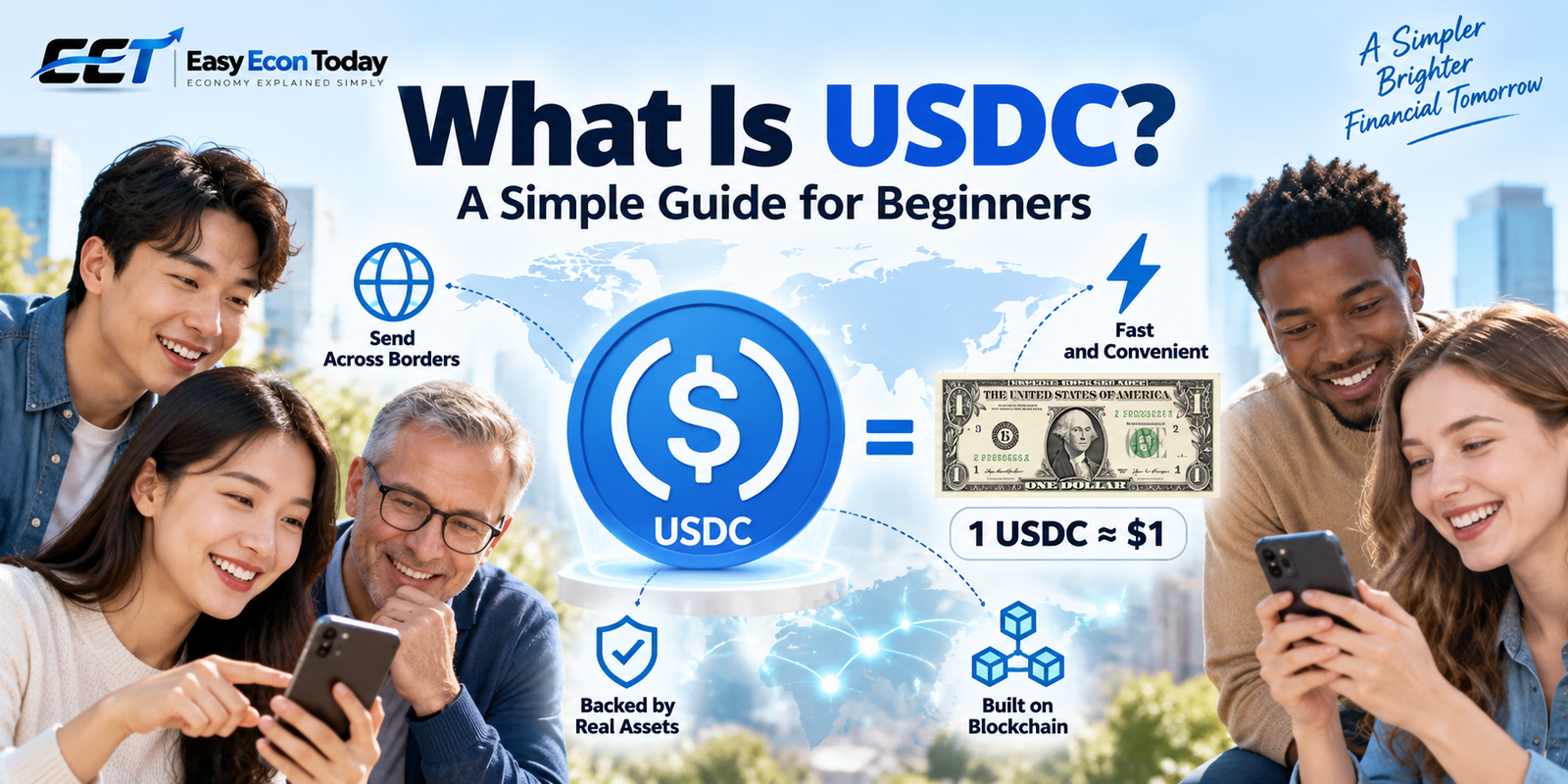
1 coin ≈ US$1
This is where the difference from Bitcoin becomes clearer.
Bitcoin’s market price can rise or fall substantially depending on supply and demand.
A dollar stablecoin, by contrast, is primarily designed to store and move dollar-like value in digital form, rather than to generate gains through price appreciation.
Imagine sending $1,000 worth of Bitcoin overseas. If Bitcoin’s price moves sharply before the recipient uses it, the value received may change.
But if you send 1,000 units of a stablecoin designed to track the U.S. dollar, the goal is for those tokens to remain worth approximately $1,000.
So instead of thinking of a stablecoin simply as “another cryptocurrency to invest in,” it may be easier to think of it as:
“Dollar-like digital value that can move across blockchain networks.”
But that leaves an important question:
Who makes sure that one coin is really worth about one dollar?
Understanding that question is essential because it reveals both the strengths and the risks of stablecoins.
3. How Does a Stablecoin Stay Close to $1?
For simplicity, consider a stablecoin backed by dollar-denominated reserve assets.
Imagine a company receives $1 million from customers and issues one million digital tokens, each intended to be worth $1.
The company then holds assets corresponding to that money, such as cash or relatively liquid short-term U.S. government securities.
Token holders can then believe:
“If necessary, these tokens can ultimately be redeemed for dollars.”
That confidence, together with an effective redemption mechanism, helps keep the market price of each token close to $1.
Major dollar stablecoins use reserve-based structures, although the details differ.
This means several questions become very important:
What assets are actually held in reserve?
Are those assets sufficiently liquid and reliable?
Can users redeem their stablecoins when they need to?
This reveals something important about stablecoins.
The key is not simply the blockchain technology.
Trust in the issuer, the reserve assets and the redemption structure matters enormously.
And this brings us back to our international-transfer example.
Stablecoins may allow value to move quickly through the digital world, but the confidence behind that value ultimately remains connected to real-world dollars and financial assets.
So the next question is obvious:
Are stablecoin transfers really cheaper and faster than bank transfers?
4. What Changes When Stablecoins Are Used for International Transfers?
Return to our example of sending $1,000 from South Korea to the United States.
With a conventional bank transfer, Korean won is converted into dollars and sent through banks and international payment networks to the recipient’s account.
Foreign-exchange spreads, fees and intermediary institutions can affect the total cost.
With a stablecoin, the route can be different.
Korean won could first be converted into a dollar stablecoin, which is then transferred through a blockchain network to the recipient’s digital wallet in the United States.
Because blockchain networks can operate outside normal banking hours, the transfer of the digital asset itself may take place without waiting for a bank branch to open.
But there is an important detail that is easy to overlook.
There may be a cost to convert Korean won into the stablecoin.
And once the recipient receives it, there may be additional costs or procedures involved in converting it into actual U.S. dollars and moving those dollars into a bank account.
So we cannot simply say:
“Stablecoins are always cheaper than banks.”
The answer depends on the amount being sent, exchange rates, service providers, blockchain networks and the cost of converting between stablecoins and ordinary currency.
Nevertheless, there is a clear reason why stablecoins are attracting attention in cross-border payments.
They introduce another possible route for moving money internationally, alongside the traditional bank-centred system.
The important question is therefore not simply:
“How much does the blockchain transfer cost?”
It is:
“What is the total cost from the Korean won leaving my hands until usable U.S. dollars reach the recipient?”
5. What Else Could Stablecoins Be Used For?
Cross-border remittances are only one possible use.
Stablecoins could also be used to pay an overseas supplier, purchase goods and services internationally, or allow a worker living abroad to send money home to family.
International commerce often requires different currencies, banks and payment systems to interact.
A form of digital dollar that can move 24 hours a day could therefore become another payment option.
The idea is also interesting for businesses.
If receiving or paying overseas invoices becomes simpler, companies may gain additional options for managing international payments and cash flow.
But this does not mean you can travel overseas today and expect every café or shop to accept stablecoins.
For stablecoins to become widely used in everyday commerce, many issues still need to be addressed, including merchant acceptance, financial regulation, consumer protection, taxation and accounting.
For that reason, the first major impact of stablecoins may be less about:
“What can I buy with this coin?”
and more about:
“Can this make moving money across borders easier and more efficient?”
6. Does “Stable” Mean Safe?
The word stable can easily create the impression that a stablecoin is as safe as dollars held in a bank account.
That would be a mistake.
Being designed to stay close to $1 is not the same thing as guaranteeing that your principal is safe.
There are several risks.
First, there is issuer and reserve risk.
A stablecoin depends heavily on confidence that the issuer actually holds the promised reserves and can meet redemption requests.
Second, the link to $1 is not guaranteed to remain perfect at every moment.
If markets become stressed or confidence in the reserves weakens, a stablecoin can temporarily trade above or below its intended $1 value.
Third, there are wallet and exchange risks.
Users may lose access credentials, send funds to an incorrect address, or face problems if the exchange or service they use encounters difficulties.
These risks can be very different from those involved in ordinary bank transfers.
Fourth, regulation and consumer protection vary.
Bank deposits may be covered by banking regulation and deposit-protection arrangements, depending on the country and institution.
Stablecoins can have very different legal and consumer-protection structures depending on the issuer and jurisdiction.
So a stablecoin is best understood as:
“A digital asset designed for price stability,”
not:
“An asset that can never lose money.”
7. Why Is the United States Interested in Stablecoins?
If we think of stablecoins only as another product in the crypto market, we may miss a much larger issue.
Most widely used stablecoins are linked to the U.S. dollar.
Imagine people around the world using dollar stablecoins for payments and transfers.
They may not be using physical U.S. dollar notes, but they are still measuring and moving value in dollars in the digital world.
There is another connection.
Issuers of dollar stablecoins may hold cash and short-term U.S. Treasury securities as part of the reserves supporting their tokens.
As the stablecoin market grows, this could create an additional source of demand for certain U.S. government securities.
From the U.S. perspective, that is an interesting development.
A new digital payment technology does not necessarily have to push the dollar aside.
Instead, it could become another way for the dollar to travel around the world through blockchain networks.
This means stablecoin growth is not simply about the growth of the crypto industry.
It may also be connected to a much larger question:
How influential will the U.S. dollar remain in international payments and finance in the digital age?
Perhaps stablecoins are not competitors to the dollar at all.
They may be one way the dollar adapts to the digital era.
8. What Could Stablecoins Mean for South Korea?
Stablecoins are not simply an overseas crypto-market issue for South Korea.
If the use of dollar stablecoins continues to expand globally, they could also affect the Korean won and the domestic financial system.
Return again to the international-transfer example.
If people sending money from South Korea to the United States increasingly choose to buy dollar stablecoins rather than exchanging won for dollars through traditional banking channels, the role of dollar stablecoins in international payments could grow.
That could bring convenience, but it also raises questions.
If Korean consumers and businesses begin using dollar stablecoins widely in domestic and international transactions, they may increasingly choose dollar-denominated digital money instead of won-denominated money in some parts of the digital economy.
This helps explain why there has also been discussion about won-denominated stablecoins.
If a properly regulated won stablecoin were developed, it could potentially create new possibilities for digital payments, international transfers and business transactions.
But creating a won stablecoin would not solve every problem automatically.
Important questions would remain:
Who should be allowed to issue it?
How should reserves be managed?
How should users be protected?
How should it connect with banks and existing payment systems?
So the important question for South Korea may not simply be:
“Should stablecoins be allowed?”
A broader question may be:
“How can the Korean won remain convenient, trusted and useful as money in an increasingly digital financial system?”
9. Will Stablecoins Become the Money of the Future?
Let’s return one final time to our original example: sending $1,000 from South Korea to the United States.
Today, banks and international money-transfer services remain the most familiar options for most people.
It would be premature to assume that banks will suddenly disappear or that every international transfer will move to stablecoins.
But stablecoins raise an interesting question:
Why should money moving across borders always depend on multiple financial institutions, banking hours and complicated settlement processes?
Could money in the digital age cross borders more like information moves across the internet?
Stablecoins are one attempt to answer that question.
They also bring important challenges.
Trust in issuers and reserve assets, regulation, consumer protection, wallet security and connections with the traditional financial system all matter.
So rather than declaring stablecoins to be “the future money that will replace banks,” it may be more useful to see them as:
a new way for existing money to move through a digital environment.
And one of the first places where that change may become visible is cross-border payments and international commerce.
So perhaps the final question is not simply:
“Are stablecoins a new form of money?”
It may be:
“Are stablecoins a new road that allows the dollars we already use to travel through the digital world?”
Key References
Federal Reserve — Payment Stablecoins and Cross-Border Payments
Examines the potential for stablecoins to reduce time and intermediaries in cross-border payments, while also considering costs involved in converting between stablecoins and fiat currency.
BIS — The Impact of Stablecoins on the International Monetary and Financial System
Discusses the growth of stablecoins, the international role of the U.S. dollar and possible implications for national monetary and financial systems.
Federal Reserve — Stablecoins, Digital Payments, and the International Role of the U.S. Dollar
Explores how stablecoins and digital payments could affect the international role of the U.S. dollar.