
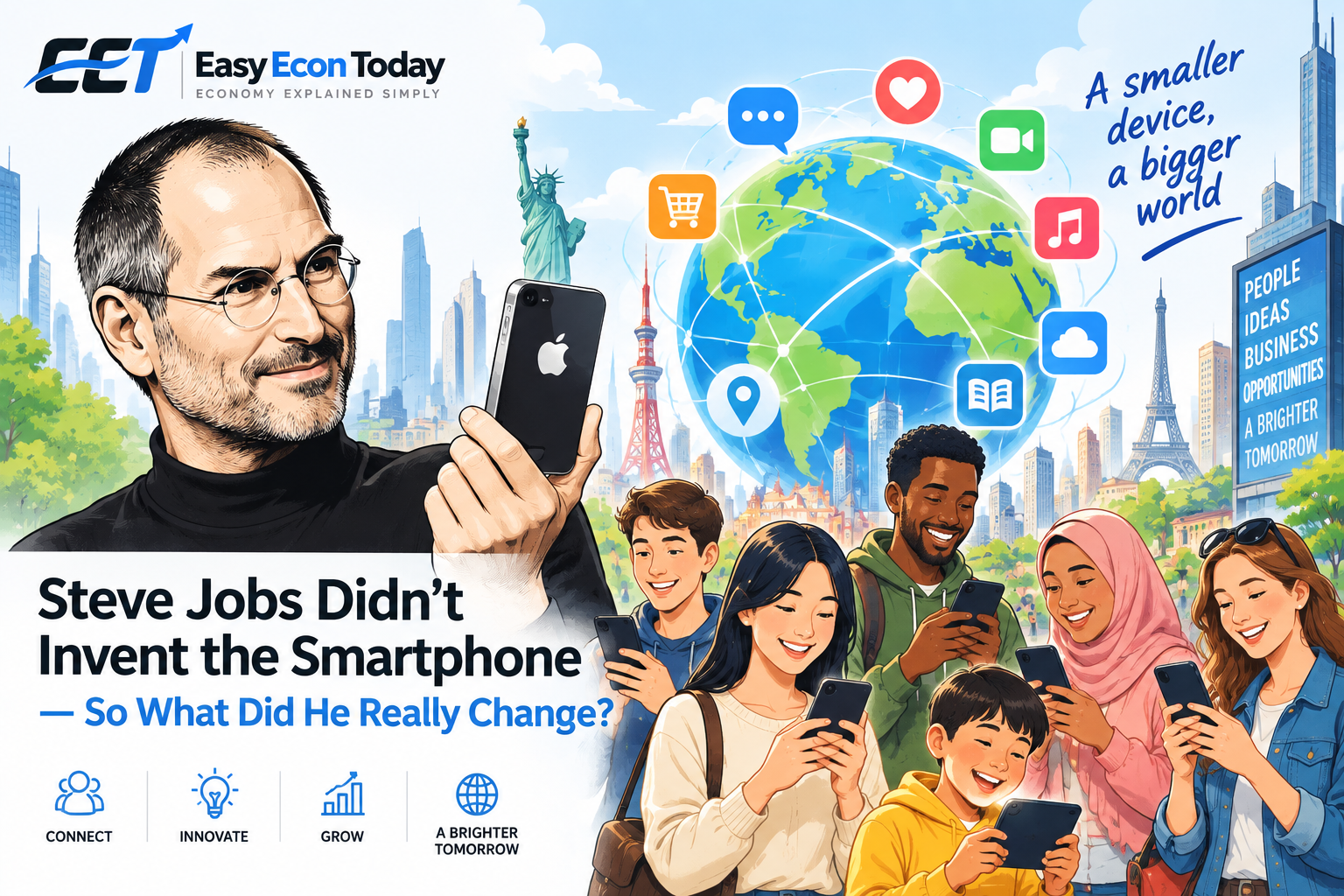
When I first saw a smartphone, I was not particularly impressed.
I remember looking at that small device, barely larger than the palm of my hand, and wondering what could possibly be so special about it.
How much difference could something this small really make to our lives?
At the time, I certainly did not imagine that one day a device like this would replace my camera, map, newspaper, music player and calculator — and eventually become a way to communicate, shop, bank and work.
Looking back, perhaps that doubt is what makes the story of Steve Jobs so interesting.
His greatest achievement may not have been inventing a completely new technology.
It may have been seeing, before many of us did, how technologies that already existed could be brought together into something ordinary people would actually want to use — and pay for.
And in doing so, he helped change not only the technology industry, but the economy around it.
A Phone, an iPod and the Internet
On January 9, 2007, Steve Jobs walked onto a stage in San Francisco.
He told the audience that Apple was introducing three products.
A widescreen iPod.
A mobile phone.
And an internet communications device.
Then came the trick.
They were not three products.
They were one.
The iPhone.
The original device seems almost primitive by today’s standards. Its screen measured just 3.5 inches. It had a 2-megapixel camera. There was no App Store.
Yet the important idea was already there.
Instead of carrying different devices for music, phone calls and internet access, consumers could begin carrying one device that did many things.
That sounds obvious today.
In 2007, it was not.
Not Everyone Was Convinced
It is easy to look backwards at successful innovations and imagine that everyone immediately understood their importance.
They rarely do.
Looking through people’s memories of the original iPhone today, the reactions are surprisingly familiar.
Some remember wondering why anyone would want a phone without a physical keyboard. Others thought it looked impressive but was simply too expensive. One person recalled thinking that a phone could never become someone’s main computing device.
Another remembered owning a touchscreen PDA at the time. Technically, his device could already browse the web and run programs.
But after watching the iPhone presentation, he felt that his existing device suddenly looked as if it belonged to another age.
That contrast matters.
Innovation is not always about being the first person to invent every component.
Sometimes it is about taking existing technologies and making them simple enough, attractive enough and useful enough that millions of ordinary people change their behaviour.
My own first reaction — wondering what such a small device could really do for me — was therefore hardly unusual.
The market still had to be convinced.
Steve Jobs Was Not Really a Smartphone Inventor
Smartphones existed before the iPhone.
BlackBerry devices were already widely used, particularly in business. Palm and other companies had produced devices combining computing and communication functions.
Apple itself did not invent the touchscreen, the mobile phone, the digital camera or the internet.
So what did Jobs actually do?
One answer is that he understood the economics of combination.
A camera has value.
A music player has value.
A telephone has value.
A map has value.
Internet access has value.
But when all of those functions become easily accessible through one device, their combined value can become greater than the value of the individual parts.
That changes what consumers are willing to pay for.
And once millions of people carry that device everywhere, another economic change becomes possible.
The phone stops being merely a product.
It becomes a platform.
Then Came the App Economy
The transformation became much clearer in 2008, when Apple launched the App Store.
The response was extraordinary.
More than 10 million apps were downloaded in its first three days.
At launch, more than 800 native applications were available, ranging from games and social networking to medical and business productivity tools.
Something important had happened.
Apple was no longer simply selling phones.
Developers could build businesses on top of the device. Consumers could continuously add new functions to something they had already purchased.
A taxi could eventually be summoned through a screen.
A restaurant could reach customers without owning a large advertising budget.
A small developer could create an application and potentially sell it around the world.
Banking, shopping, entertainment, travel, dating, news and work gradually moved into our pockets.
The economic value was no longer contained inside the physical phone.
It increasingly came from the ecosystem surrounding it.

Jobs Understood Something About Consumers
Traditional economics often describes consumers as people choosing between products according to price and usefulness.
Real life is more complicated.
We also pay for convenience.
We pay for design.
We pay for simplicity.
And sometimes we pay to avoid frustration.
Jobs seemed to understand this unusually well.
Apple products were rarely the cheapest products in their categories. Nor did Apple necessarily invent the underlying technologies.
Instead, the company concentrated on making complicated technologies feel simple.
That is economically important because consumers do not buy technology merely because it exists.
They buy it when they can see how it fits into their lives.
The difference between those two things can be enormous.
Failure Was Part of the Story Too
The Steve Jobs story can easily become a heroic tale in which one brilliant man sees the future and everyone else eventually catches up.
The real story was messier.
Jobs co-founded Apple in 1976, but eventually lost a power struggle inside the company and left in 1985.
For someone so closely associated with Apple today, it is remarkable to remember that Apple once continued without him.
Jobs went on to establish NeXT and became deeply involved with Pixar.
Years later, Apple acquired NeXT and Jobs returned to the company he had helped create.
His second period at Apple produced the products for which he is now most remembered: the iMac, iPod, iPhone and iPad.
That period also offers another economic lesson.
Innovation rarely moves in a straight line.
Companies make mistakes. Technologies fail. Consumers reject products. People leave companies and return.
What looks inevitable in hindsight often looked extremely uncertain while it was happening.
The Smartphone Changed More Than Technology
Think again about that small device sitting in your hand.
It changed industries that initially appeared to have little to do with mobile phones.
Camera makers suddenly faced millions of people carrying cameras every day.
Music players largely disappeared into phones.
Printed maps became unnecessary for many journeys.
Newspapers competed with notifications and social media feeds.
Banks built mobile applications.
Retailers entered our pockets.
Taxi industries faced app-based competitors.
Advertising followed consumers onto their screens.
Entire new categories of work appeared — app developers, social-media creators, gig-economy drivers and mobile-commerce businesses among them.
The smartphone did not simply create a new product category.
It reorganised parts of the economy around itself.
But There Was a Price
Not every consequence has been positive.
The same device that gives us instant access to information also competes constantly for our attention.
The same apps that connect friends can encourage endless scrolling.
The same platform that allows a small business to reach customers can also make that business dependent on rules set by enormous technology companies.
Even among people looking back at the early iPhone today, there is nostalgia for a world in which phones occupied less of our attention.
That is worth remembering.
Economic progress rarely gives us benefits without trade-offs.
Convenience has value.
So does our time.
The Small Device in Our Hands
When I think back to my own first reaction to the smartphone, I find it almost amusing now.
What could this palm-sized device really do for me?
The answer turned out to be: much more than I imagined.
But perhaps the most interesting part of the Steve Jobs story is that he did not need to invent every technology inside that device.
He needed to understand how they could fit together.
And, more importantly, how they could fit into our lives.
Today we rarely stop to think about it.
We take a photograph, check the weather, read the news, send money, answer an email, find a restaurant and speak to someone on the other side of the world — sometimes within a few minutes, using the same small object.
That may be Steve Jobs’ most important economic legacy.
He did not simply help put a computer in our pockets.
He helped turn the pocket into a marketplace.
And perhaps that leaves us with a more interesting question than whether Steve Jobs invented the smartphone:
What happens to an economy when one small device becomes the place where we spend not only our money — but also our time?
Sources & Further Reading
- Apple — “Apple Reinvents the Phone with iPhone” (2007)
- Apple — “Apple Sells One Millionth iPhone” (2007)
- Apple — “iPhone App Store Downloads Top 10 Million in First Weekend” (2008)
- Apple — “App Store Downloads Top 100 Million Worldwide” (2008)
- Ars Technica — “Ballmer: iPhone has ‘no chance’ of gaining significant market share” (2007)
- Fast Company — “10 Of The Most Interesting Reactions To The First iPhone Back In 2007”
- Reddit — “People Seeing the iPhone for the First Time — June 29, 2007”