
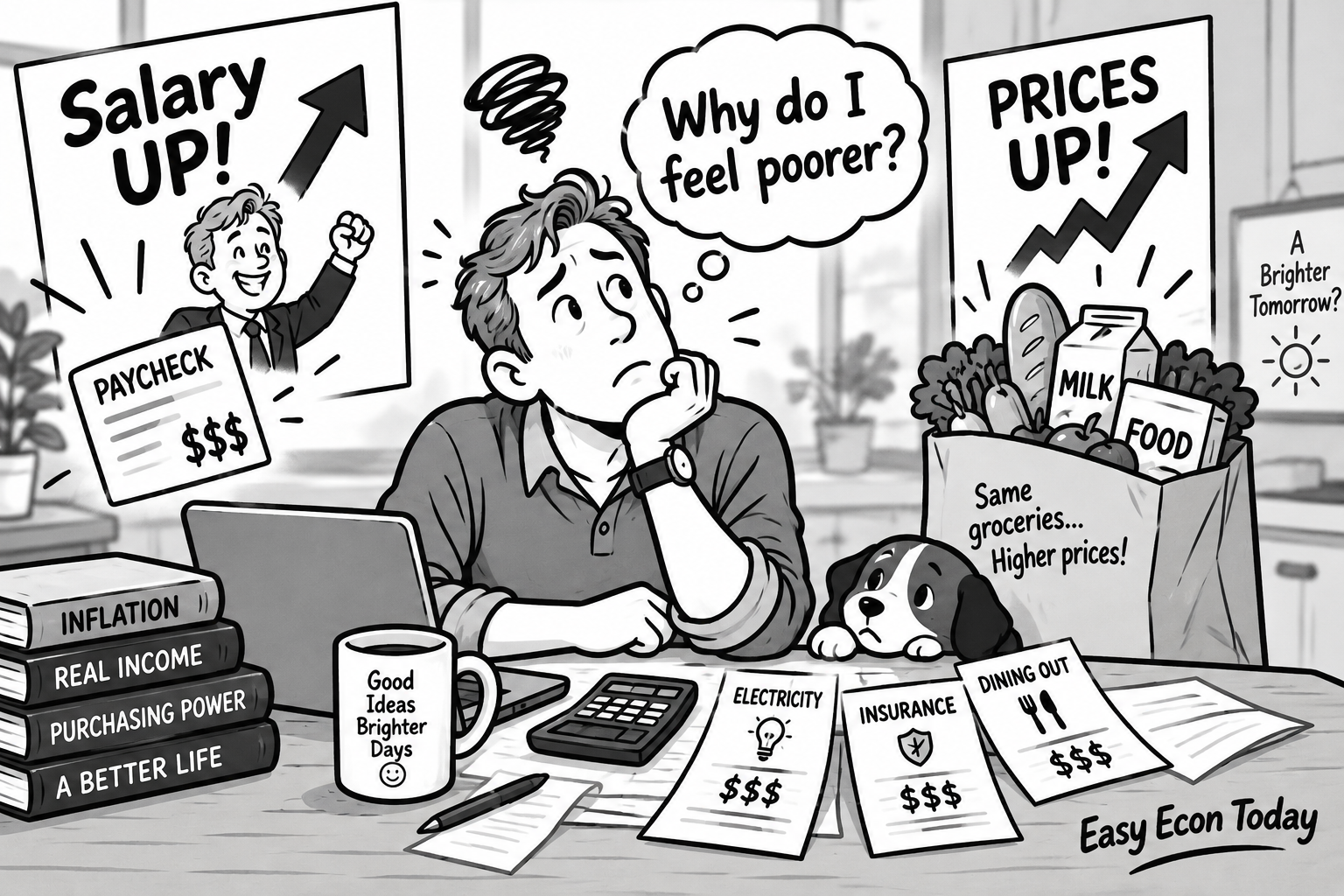
Imagine getting a pay rise — and still feeling poorer.
But something feels strange.
You’re earning more than you did before, yet after buying groceries, paying the electricity bill and insurance, and eating out a few times, there seems to be even less money left in your bank account.
“If I’m earning more, why does life feel tighter?”
It’s a question many of us have probably asked ourselves at some point.
To understand why this happens, we need to look at two simple economic ideas: nominal income and real income.
The terms may sound technical, but the idea behind them is surprisingly simple.
1. If My Salary Rose by 5%, Am I Really 5% Better Off?
Let’s take a simple example.
Suppose someone earned $4,000 a month last year and now earns $4,200.
That’s a $200 increase, or 5%.
Sounds good.
But what if, during the same period, the prices of the goods and services that person normally buys rose by an average of 7%?
Their salary went up 5%, but prices went up 7%.
There is more money arriving in the bank account, but that money can actually buy less than before.
This brings us to an important distinction.
Nominal income is the amount of money you receive. Real income is what that money can actually buy.
So when thinking about our financial well-being, it isn’t enough to ask how much our salary has increased.
A much more important question is:
Has my income risen faster than my cost of living?
[Keep the existing image here]
2. Why Does Inflation Feel Higher Than the Official Number?
You may have watched the news and thought:
“They say inflation is 3%, but it feels more like 10% to me.”
That feeling isn’t necessarily wrong.
Official consumer price indexes combine the prices of many different goods and services to estimate how prices are changing across the economy.
But we don’t all spend our money in the same way.
One household may spend a large share of its income on groceries and housing.
Another may already own its home with little or no mortgage, so housing costs are less of a concern.
One family may run two cars, while another relies mostly on public transport.
That means the national inflation rate may not reflect every household’s individual experience.
Price increases also feel more noticeable when they affect things we buy frequently.
Milk, bread, eggs, fruit and coffee are good examples. We see those prices every week.
This is one reason I think inflation can feel more personal than many other economic statistics. We don’t experience inflation as a percentage on a news report — we experience it at the supermarket, the petrol station and when the next household bill arrives.
By contrast, even if the price of a television or refrigerator falls, we may buy one only every few years. We don’t notice those price changes nearly as often.
That is why there can be a real difference between official inflation and the inflation we experience in our weekly shopping basket.
3. Why Does the Same Inflation Hurt Some People More Than Others?
Inflation does not affect everyone equally.
Imagine two households.
Person A owns a home and has almost no mortgage.
Person B earns roughly the same income but has a large mortgage.
If interest rates rise, Person B’s monthly expenses can suddenly jump.
Their salary may not have changed, but the amount they must pay the bank each month has increased substantially.
Retirees can face a different problem.
When prices rise, workers may eventually negotiate higher wages or move to jobs offering better pay.
But someone living mainly on a fixed pension or savings may see their purchasing power fall much more directly when prices rise quickly.
On the other hand, people with substantial savings may benefit from higher interest rates because they can earn more interest on their deposits.
So the average inflation rate is only part of the story.
What really matters is:
Where does my income come from? Where does my money go? And what assets and debts do I have?
Those three things can make two people experience the very same economy in completely different ways.
4. What Matters Is Not Just How Much You Earn, but What You Can Buy
If we simply compare salaries today with salaries 20 years ago, we may appear much richer.
But the value of money changes over time.
A certain amount of money 20 years ago and the same amount today may look identical on paper, but they cannot necessarily buy the same amount of goods and services.
That is why economists often focus on “real” figures, which adjust wages, income and economic growth for changes in prices.
The same principle applies to our household finances.
Knowing that your monthly salary increased from $4,000 to $4,200 does not tell you whether your standard of living has improved.
You also need to consider what happened to your rent or mortgage payments, groceries, transport, insurance, electricity and other everyday expenses.
In the end, our standard of living is determined not simply by the number appearing in our bank account, but by:
what we can actually buy with that money.
Economists call this purchasing power.
One Number to Check After Your Salary
So the next time someone says,
“My salary went up 4% this year,”
there is another useful question to ask:
“How much did my actual cost of living increase?”
If your income rises by 4% while your living costs rise by only 2%, your purchasing power has probably improved.
But if your income rises by 4% while the goods and services you regularly buy rise by 7%, your salary may be higher on paper while everyday life feels tighter.
Perhaps understanding economics is not really about memorising complicated numbers.
It begins with understanding the money we earn, the money we spend, and how the value of that money changes over time.
The next time you are shopping and find yourself thinking,
“Why has this become so expensive?”
you may already be starting a small economics lesson of your own.
Because the price tags at your local supermarket may be the economics textbook closest to everyday life.
Sources
- Stats NZ — What Is the Consumers Price Index (CPI)?
- Stats NZ — Household Living-costs Price Indexes
- Reserve Bank of New Zealand — Inflation