
Gold is a rather unusual asset.
It doesn’t pay interest like a bank deposit. It doesn’t generate profits as a growing company can. And unlike property, it doesn’t provide rental income.
Yet whenever the global economy becomes uncertain, people often turn to gold.
Central banks hold large amounts of it, and individual investors often become more interested when gold prices start rising.
Why?
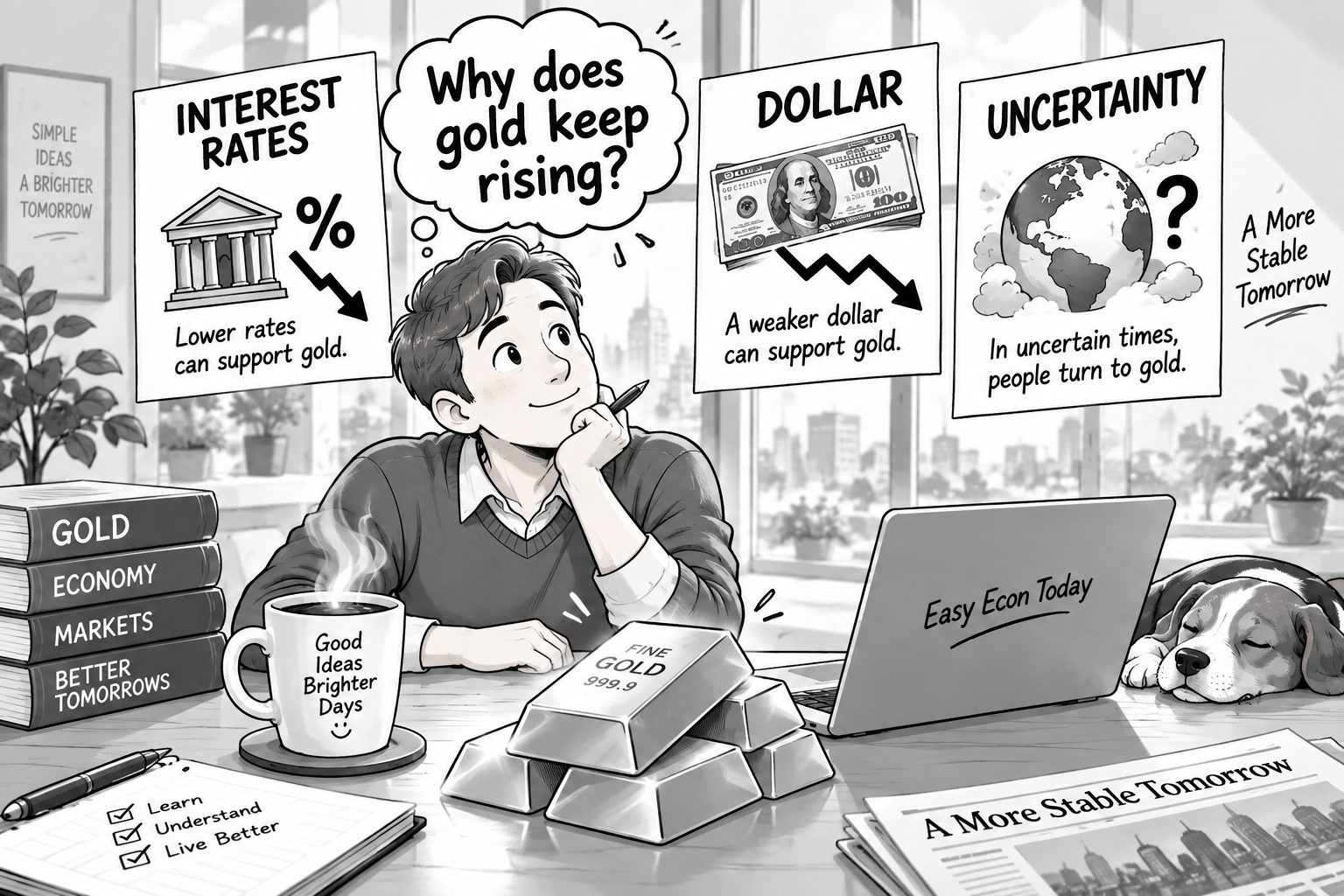
One of the easiest ways to understand gold is to forget complicated charts for a moment and remember just three words:
interest rates, the dollar and uncertainty.
1. Interest Rates — Gold’s Strongest Competitor
Let’s start with interest rates.
Suppose you have $100,000.
If you can put that money in the bank and earn 5% interest, while gold pays you nothing, a bank deposit or bond may look much more attractive.
But what if interest rates are only 1%?
The interest you give up by holding gold becomes much smaller. In other words, the opportunity cost of owning gold falls.
In general, lower interest rates — especially lower real yields — can make gold relatively more attractive, while higher real yields can create a headwind for gold.
But there is another important point.
Financial markets don’t just look at today’s interest rates. They are constantly thinking about where interest rates are heading next.
Suppose investors begin to believe:
“The central bank may cut interest rates soon.”
Gold prices may start moving even before the first rate cut actually happens.
That is because financial markets are always trying to look ahead.
2. The Dollar — Another Price to Watch Alongside Gold
Gold is traded internationally mainly in U.S. dollars.
That makes the value of the dollar another important factor.
When the dollar strengthens, buyers using other currencies may need more of their own money to purchase the same ounce of gold.
When the dollar weakens, gold may become relatively more affordable for those buyers.
That is why we often hear that a weaker dollar can support gold, while a stronger dollar can put pressure on it.
Of course, the real world is rarely that simple.
Sometimes the dollar and gold rise at the same time.
During periods of serious global uncertainty, investors may seek both the U.S. dollar and gold because they see them as relatively safe places to hold wealth.
So rather than thinking,
“If the dollar rises, gold must fall,”
it is better to think of the dollar as one important factor influencing demand for gold.
3. Uncertainty — When Gold Becomes Special
Gold’s unusual character becomes most obvious when the economy or the geopolitical environment becomes uncertain.
War, financial crises, high inflation, concerns about banks or rapidly rising government debt can all make the future harder to predict.
At such times, people begin asking:
“Where can I keep my money safely?”
Cash depends on confidence in a government and its currency.
Bonds depend on confidence that the issuer will repay its debts.
Stocks depend on confidence in a company’s future earnings.
Gold is different.
It does not depend solely on the promise of one company or one country.
Gold itself has been recognised as a store of value across different societies for centuries.
This is one reason gold is often described as a “safe-haven asset.”
That does not mean gold prices will always rise whenever the world becomes uncertain. Financial markets are influenced by many forces at the same time.
But it helps explain why investors often take another look at gold when uncertainty increases.
Why Do Central Banks Hold Gold?
It isn’t only individual investors who own gold.
Central banks around the world also hold it as part of their reserves.
Those reserves may include foreign currencies and government securities denominated in dollars, euros and other currencies, as well as gold.
Why gold?
One reason is diversification.
A country may not want all of its reserve assets to depend too heavily on one currency or one financial system.
Gold provides another way to spread that risk.
Its unusual characteristics can become particularly important when concerns about geopolitical tensions or financial sanctions increase.
Foreign currencies and government bonds are ultimately connected to another country’s financial system.
Physical gold is different because it is relatively less dependent on that relationship.
So when central banks buy more gold, it does not necessarily mean they are simply betting that:
“The price of gold is going up.”
Their decisions can also reflect a long-term effort to diversify reserves and manage risk.
Will Gold Just Keep Going Up?
This is where we need to be careful.
Just because gold has risen strongly does not mean it will continue rising at the same pace.
Interest rates could remain higher for longer than investors expect.
The dollar could strengthen.
Geopolitical tensions could ease, reducing demand for safe-haven assets.
And there is another important possibility.
If investors have already bought gold because they expect good news in the future, that good news may already be reflected in today’s price.
This is one of the most important lessons in investing:
A good asset and a good price are not the same thing.
Even an excellent asset can be a poor investment if you pay too much for it.
And an ordinary asset can sometimes become an attractive investment if the price is low enough.
That is why statements such as,
“Gold has gone up, so I should buy now,”
or
“Gold has risen too much, so it must fall,”
are usually too simple.
Three Things to Remember When Watching Gold
The next time you hear that gold prices are rising, you don’t need to begin with a complicated chart.
Start with three questions:
Are interest rates expected to rise or fall?
Is the U.S. dollar getting stronger or weaker?
Is uncertainty about the global economy and geopolitics increasing or decreasing?
Thinking about those three questions can explain a large part of what may be driving gold prices.
And if you want to add one more, ask:
How much gold are central banks buying?
Gold is not an asset that grows like a company.
In many ways, it is an asset that reflects how much confidence people have in money, financial systems and the future.
That is why watching the price of gold can tell us something beyond the value of the metal itself.
Gold can also be a window into how secure — or uncertain — the world feels about the economy.
Sources
- International Monetary Fund — Gold in Central Bank Reserves: Strategic Considerations, Market Risks, and Practical Guidance
- World Gold Council — Gold Mid-Year Outlook 2026
- World Gold Council — Central Bank Gold Reserves Survey 2026
This article is for general educational purposes only and is not a recommendation to buy or sell any particular investment.
☕ A Moment to Pause
Let’s put economics aside for a moment and enjoy some music.
Today, take a short break with “Song of the Wind” by Cho Yong-pil.