
Why owning a home is becoming harder in America — and across the world
You have a job.
You save money every month.
You avoid unnecessary spending, put something aside for a down payment, and try to do all the things that previous generations told you were sensible.
And yet, the home you hope to buy seems to move further away.
You save another $10,000.
The house gets another $30,000 more expensive.
Your salary rises.
But mortgage payments rise even faster.
For millions of people, this has become one of the great economic frustrations of modern life.
So what happened?
The Problem Is Not Just That Houses Cost More
Almost everything costs more than it did 30 years ago.
Salaries are higher too.
That is why simply comparing the price of a house today with its price in 1995 doesn’t tell us very much.
A more useful question is:
How many years of income does it take to equal the price of a typical home?
This is called the house price-to-income ratio.
Imagine a typical household earns $80,000 a year and a typical home costs $400,000.
The ratio is 5.
The house costs five times one year’s household income.
This does not mean the family can buy the house after working for five years. They still have taxes, food, rent, childcare and countless other expenses.
But it gives us a simple way to see whether housing is moving closer to — or further away from — ordinary incomes.
And that is where the story becomes interesting.
America: From About 3 Times Income to About 5 Times
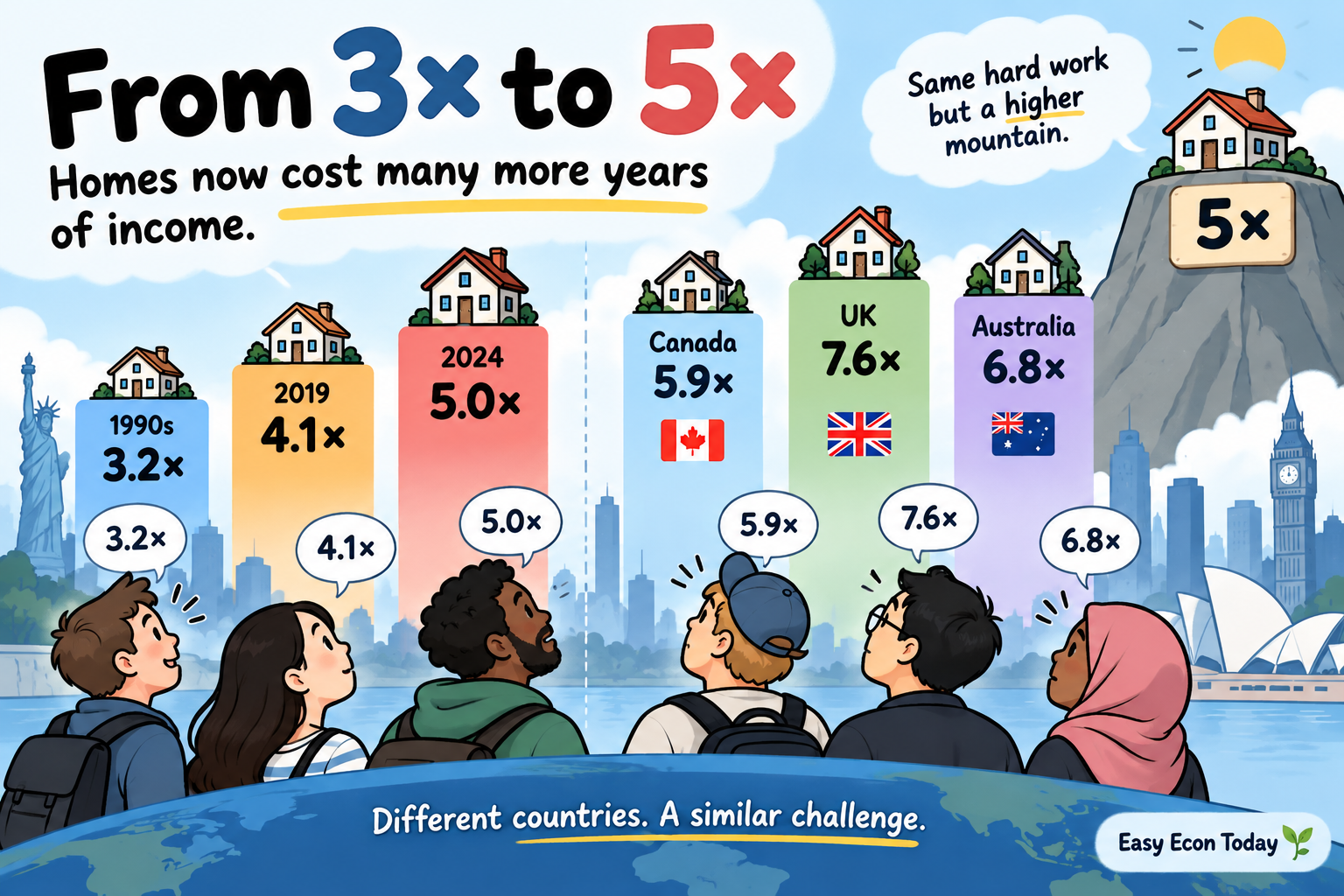
In the United States, home prices averaged roughly 3.2 times median household income during the 1990s.
By 2019, the ratio had reached about 4.1.
By 2024, it was around 5.0.
In other words, the ladder to home ownership became considerably taller.
A household in the 1990s looking at a typical home faced a price equivalent to a little over three years of household income.
Today, that figure is closer to five.
And prices are only half of the story.
Then Comes the Mortgage
Most people don’t buy a house with cash.
They borrow.
That means the price of money — the interest rate — matters enormously.
In September 2026, the average U.S. 30-year fixed mortgage rate was around 7%.
Consider two buyers purchasing the same-priced house.
One borrows when mortgage rates are 3%.
The other borrows when rates are close to 7%.
Even if the house price is identical, their monthly payments can be dramatically different.
Today’s buyer therefore faces a difficult combination:
High house price + high mortgage rate = high monthly payment
That is one reason looking only at house prices can underestimate the problem.
“But My Parents Had High Interest Rates Too”
They did.
This is important.
It would be too simple to say that buying a home was easy for previous generations.
In some periods during the 1970s and 1980s, mortgage rates were extraordinarily high. Buyers faced economic recessions, unemployment and inflation as well.
Every generation had its difficulties.
But there is an important difference.
The price of the house itself was generally much lower relative to income.
A high interest rate can eventually fall, allowing some homeowners to refinance.
But the original purchase price does not disappear.
Today’s buyers in many markets are starting with a much larger price relative to what they earn.
And America Is Not Alone
Cross the border into Canada and the problem becomes even more obvious.
Canadian home prices have risen much faster than household incomes over recent decades.
According to OECD analysis, since the Global Financial Crisis, growth in real house prices has outpaced growth in real disposable incomes by roughly 60%.
That makes it harder not only to make mortgage payments but also to save the initial deposit.
Now cross the Atlantic.
In England in 2025, the median home cost about £300,000, while median annual earnings for a full-time employee were around £39,300.
That puts the house price at approximately 7.6 times annual earnings.
Affordability has actually improved somewhat since its recent peak because wages have grown faster than house prices.
But compared with earlier decades, buying a home remains difficult.
Then travel to Australia.
Between 2011 and 2024, the average price of residential property rose by roughly 104%.
Over a similar period, median household disposable income increased by about 56%.
The house ran ahead.
Income tried to follow.
But it couldn’t keep up.
The Deposit Has Become a Race of Its Own
Before worrying about a mortgage, a first-home buyer has another problem:
the down payment.
Suppose a home costs $300,000.
A 20% deposit is $60,000.
If the same type of home later costs $600,000, the deposit becomes $120,000.
Even if your salary has risen, saving that extra $60,000 can take years.
And while you are saving, house prices may continue moving.
This creates one of the strangest feelings in personal finance:
You are saving, but you don’t feel as if you are getting closer.
Australia offers a striking example.
By late 2024, estimates suggested that a median-income household would need about 10.6 years to save a 20% deposit on a median-priced dwelling, compared with a 20-year average of about nine years.
For a young household, that is a significant portion of adult life.
Why Don’t We Just Build More Houses?
Now we reach another part of the problem.
Supply.
In many desirable cities, the number of homes has not increased quickly enough to match demand.
There are many reasons.
Land may be scarce.
Planning rules can restrict density.
Construction costs can rise.
Infrastructure takes time.
Skilled workers may be in short supply.
Local residents sometimes oppose new development.
And houses cannot be produced overnight like smartphones.
When more people want homes than there are homes available, prices face upward pressure.
This is why housing is not simply a story about greedy sellers, wealthy investors or young people spending too much on coffee.
It is a much larger economic system.
Housing Has Also Become Wealth
There is another reason the problem is difficult to solve.
A home is two things at once.
It is a place to live.
But it is also an asset.
Existing homeowners often welcome rising house prices because the value of their wealth increases.
Future buyers see exactly the same price increase and feel poorer.
The same headline —
“Home prices rise 10%”
— can therefore produce two completely different reactions.
The homeowner smiles.
The first-home buyer sighs.
This creates a difficult political and economic tension in almost every country where home ownership is important.
The Generational Divide
This helps explain why conversations between generations sometimes become frustrating.
A parent may say:
“We struggled too. We saved carefully and bought a modest first home.”
That may be completely true.
A younger person may reply:
“But your house cost much less compared with your salary.”
That may also be true.
The two generations are not necessarily disagreeing about effort.
They may simply have entered very different housing markets.
Previous generations often faced higher interest rates.
Today’s generation often faces much higher price-to-income ratios.
Both matter.
So Is Home Ownership Becoming Impossible?
No.
But the path is changing.
Some buyers are purchasing later in life.
Some are choosing smaller homes.
Some are moving farther from expensive city centres.
Some receive help from parents.
Others decide that renting and investing their savings elsewhere makes more sense for them.
And some simply wait.
There is no single correct answer because housing decisions depend on income, family, location, interest rates and personal priorities.
But understanding the economics helps us make sense of why the decision feels so much harder.
The Bigger Lesson
For decades, owning a home represented a simple idea:
Work. Save. Buy.
That path still exists.
But in many parts of the world, the distance between those steps has grown.
The most revealing number may not be the price written on a real-estate advertisement.
It may be the relationship between two numbers:
the price of a home and the income of the person hoping to buy it.
When home prices rise faster than incomes for many years, something important changes.
The house doesn’t just become more expensive.
The ladder becomes taller.
And for millions of people looking up from the bottom, that may be the real reason home ownership feels further away than it did for the generation before them.
Easy Econ Today
Big economic changes, explained through everyday life.
Sources
Bank for International Settlements — Residential Property Price Statistics
Federal Reserve Board — A Long-Term View on the Costs of Shelter (2026)