
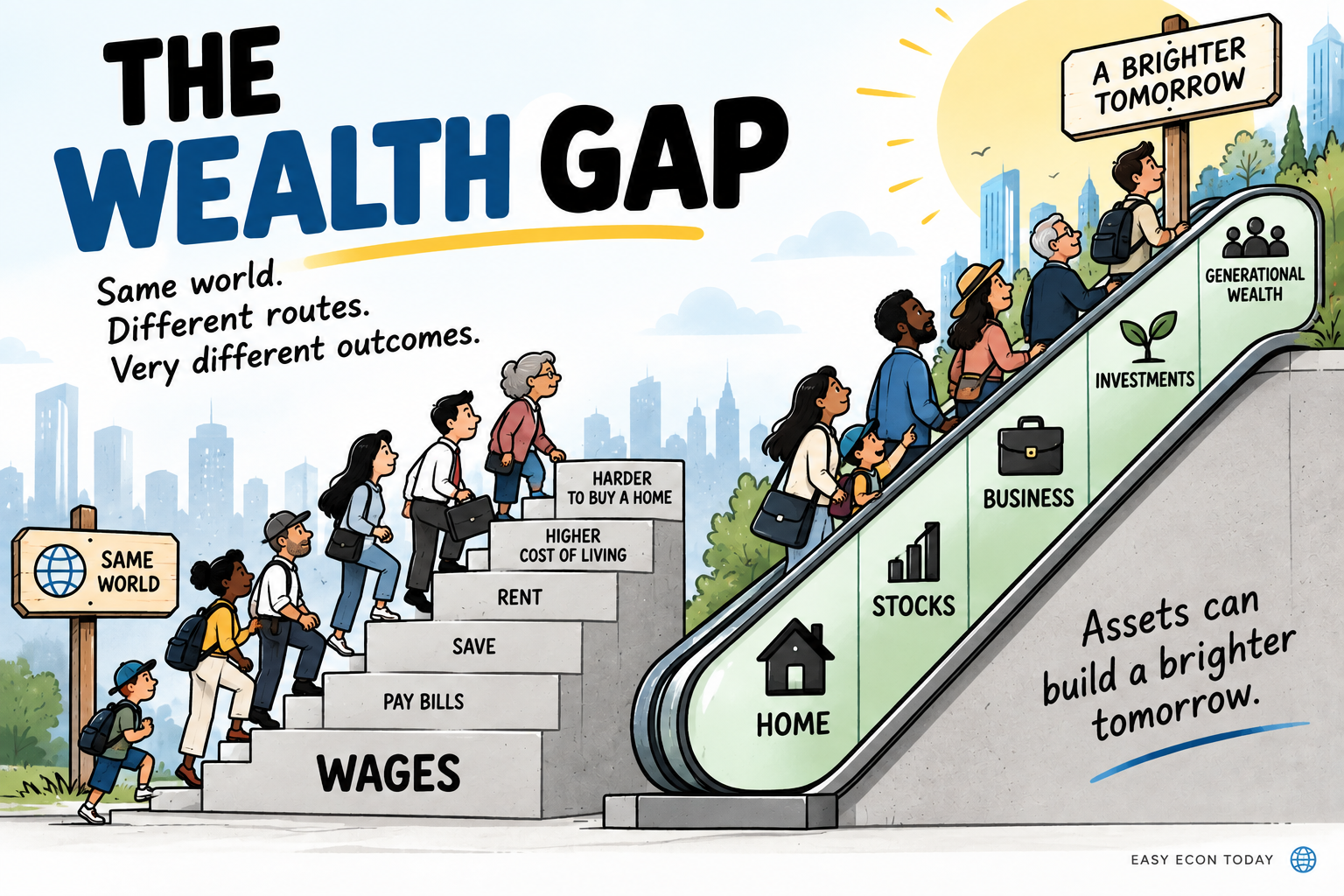
Imagine two families living in the same city 40 years ago.
Both parents worked. Their incomes were not dramatically different.
But there was one important difference.
One family bought a modest home and gradually invested some of its savings.
The other family rented and depended mainly on wages.
Fast-forward several decades.
The first family may now own a valuable home, retirement investments and perhaps a portfolio of shares. Their children may eventually inherit some of those assets.
The second family may have worked just as hard.
But without assets rising in value behind them, their financial position could look very different.
Perhaps you have seen something similar in your own family.
Someone bought an ordinary home decades ago — not because they were trying to become wealthy, but simply because they needed somewhere to live.
Years later, that ordinary decision may have become one of the biggest sources of their wealth.
This simple story helps explain one of the biggest economic changes of our time:
The growing importance of wealth.
And it also explains why the distance between people who own appreciating assets and those who do not can become surprisingly large over time.
Income and Wealth Are Not the Same Thing
Before going further, there is an important distinction.
Income is what you earn.
It includes wages, salaries, business income and investment income.
Wealth is what you own minus what you owe.
It includes:
- houses
- shares
- businesses
- savings
- retirement assets
minus debts such as mortgages and other loans.
Someone earning a high salary may have high income but relatively little wealth.
Another person may have retired and receive a modest annual income but own a valuable home and a large investment portfolio.
That person may have much greater wealth.
This distinction matters because wealth can grow.
A house can rise in value.
Shares can appreciate.
A business can become more valuable.
Investments can generate returns that are reinvested.
And then those returns can generate further returns.
That is the power of compounding.
And compounding has something wages do not have:
time working on its side.
How Unequal Is Wealth Today?
The numbers are striking.
According to the World Inequality Report 2026, the richest 10% of the world’s population own about three-quarters of global wealth.
The bottom 50% own only about 2%.
The richest 1% alone control roughly 37% of global wealth.
But numbers this large can become difficult to imagine.
So instead of thinking only about percentages, think again about ordinary families.
One household may own a home, retirement savings and shares.
Another household may earn a similar income but own almost none of those things.
Twenty or thirty years later, the difference between them may be far greater than the original difference in their salaries.
How did we get here?
The Story Did Not Begin Yesterday
Economic inequality has existed for centuries.
In the 19th and early 20th centuries, wealth in many societies was extremely concentrated. Land, factories and financial capital were largely owned by relatively small groups.
Then something unusual happened.
During much of the middle of the 20th century, inequality declined in several advanced economies.
The decades following World War II brought rapid economic growth, expanding manufacturing employment, rising wages, broader access to education and growing social protection.
Homeownership also expanded in many countries.
For millions of households, wages were enough not only to survive but also to begin accumulating assets.
A large middle class grew.
For many families, there was a relatively simple idea behind economic progress:
Work, save, buy a home and gradually build a better life.
It was never easy for everyone.
But for a significant part of the population, the ladder seemed reachable.
From around the late 1970s and 1980s, however, the economic landscape began changing again.
The 1980s: A Turning Point
There was no single cause.
Technology advanced.
International trade expanded.
Manufacturing increasingly moved across borders.
Financial markets became larger and more important.
Labour markets changed.
Tax systems and regulations also changed in many countries.
At the same time, ownership of financial assets became increasingly important to household wealth.
Economic growth continued.
Productivity continued improving.
But wages were no longer the only important path to prosperity.
Owning assets that could increase in value became increasingly powerful.
And this created a subtle but important change.
The economy increasingly rewarded not only what you did, but also what you already owned.
America Shows How Large the Difference Can Become
The United States provides one of the clearest examples.
The Federal Reserve has tracked the distribution of American household wealth since 1989.
By the second quarter of 2026, the bottom half of American households together held about $4.3 trillion in net wealth.
The wealthiest 10% held roughly $128 trillion.
That does not mean every person in the top 10% is extraordinarily rich, nor that everyone in the bottom half is poor.
But it shows how concentrated accumulated wealth can become.
The difference becomes even more interesting when we look at what households own.
For many ordinary families, their home is their most important asset.
Among wealthier households, shares, businesses and other financial assets play a much larger role.
And unlike wages, those assets can continue increasing in value while their owners sleep.
Housing Created Another Divide
Housing deserves special attention because this is where economics becomes very personal.
Think about your own life for a moment.
Over the past ten or twenty years, which has probably grown faster:
your salary — or the price of a house you wish you had bought years ago?
For many people, the answer is uncomfortable.
Imagine an American household that bought a modest home decades ago.
They probably did not sit around the kitchen table saying:
“Let’s make a brilliant investment.”
They needed somewhere to live.
They borrowed money, paid the mortgage month after month, repaired the roof, paid property taxes and worried when interest rates increased.
Then the years passed.
The mortgage became smaller.
The house became more valuable.
Without necessarily thinking of themselves as investors, they accumulated substantial wealth.
Now imagine another household with a similar income that continued renting.
Renting may have been perfectly rational. Perhaps they moved frequently for work, could not afford a deposit or simply preferred the flexibility.
But they did not accumulate home equity.
This creates an unusual economic divide.
For an existing homeowner:
Higher house price → potentially greater household wealth
For someone trying to buy their first home:
Higher house price → a larger financial barrier
The same price increase creates two completely different emotions.
One person looks at the rising value of their house and feels more financially secure.
Another looks at exactly the same price and wonders:
How will I ever afford that?
The Federal Reserve reported that in 2025, 63% of American adults owned their home.
But homeownership varied sharply with income.
About 33% of adults earning less than $50,000 owned their home, compared with 86% of those earning $100,000 or more.
This is why the modern wealth divide is not always simply:
rich versus poor.
Increasingly, it can also be:
asset owners versus non-owners.
Then Asset Prices Became Even More Important
Housing is only part of the story.
Consider two people.
One has $5,000 invested in shares.
Another has $500,000.
If the market rises by 10%, the first gains $500.
The second gains $50,000.
Same percentage.
Very different dollars.
And those additional dollars can remain invested and generate further returns.
Over five, ten or thirty years, the difference can become enormous.
This is the mathematical engine behind wealth accumulation:
returns on assets can themselves earn returns.
There is nothing mysterious about it.
But when it continues for decades, the results can be extraordinary.
The Financial Crisis Changed the Story Again
Then came the 2008 global financial crisis.
Central banks around the world responded with very low interest rates and other measures designed to stabilize financial systems and economies.
These policies served important economic purposes.
But the years that followed also demonstrated how important asset ownership had become.
Prices of shares, bonds and property eventually rose substantially in many places.
People who already owned those assets participated directly in those gains.
People without significant assets did not.
This does not mean monetary policy alone caused wealth inequality.
It did not.
But it illustrates a broader principle:
When asset values rise faster than wages for long periods, existing asset owners can move further ahead.
Then Came the Pandemic
COVID-19 created another extraordinary economic period.
Governments spent heavily to protect households and businesses.
Central banks cut interest rates.
Financial markets initially collapsed and then recovered rapidly.
Asset prices rose sharply in many places.
At the same time, millions of workers faced disruption and uncertainty.
Again, people’s experiences depended partly on what they already owned.
A professional able to work from home while owning a house and an investment portfolio could experience the economic side of the pandemic very differently from a renter working in hospitality or retail.
They were living through the same pandemic.
But economically, they could have been living in two different worlds.
The pandemic did not create wealth inequality.
But it made the importance of a household’s starting position much easier to see.
Why Doesn’t Working Hard Automatically Close the Gap?
This may be the most important question.
Imagine someone earning $70,000 a year.
After tax, housing, food, transport and family expenses, perhaps they can save $5,000.
Now imagine another household owns $1 million in investments.
If those investments rise by 7%, their wealth increases by $70,000.
Markets do not rise every year, of course. They can fall sharply too.
But the example illustrates something fundamental.
Labour income is constrained by time.
There are only so many hours a person can work.
Capital does not have the same limitation.
A person can simultaneously own shares, property, a business, retirement investments and other financial assets.
This is one reason I have come to think that one of the most important financial questions in life is not simply:
“How much do I earn?”
It is also:
“What am I gradually building and owning?”
Income pays today’s bills.
Assets can help shape tomorrow’s choices.
Wealth Can Also Pass Between Generations
There is another powerful mechanism.
Inheritance and family assistance.
Imagine two young adults with identical jobs and identical salaries.
One receives $150,000 from their parents toward a house deposit.
The other receives nothing.
The first can buy a home earlier.
The second continues renting while trying to save.
Ten years later, their salaries may still be almost identical.
Their balance sheets may not be.
One has spent a decade accumulating home equity.
The other may still be trying to enter the housing market.
And this is where statistics about inequality become something much more human.
Many parents naturally want to help their children.
There is nothing unusual about that.
But when one generation’s accumulated wealth helps the next generation buy assets earlier, the advantage can compound again.
A difference that began with the grandparents may still be affecting the grandchildren.
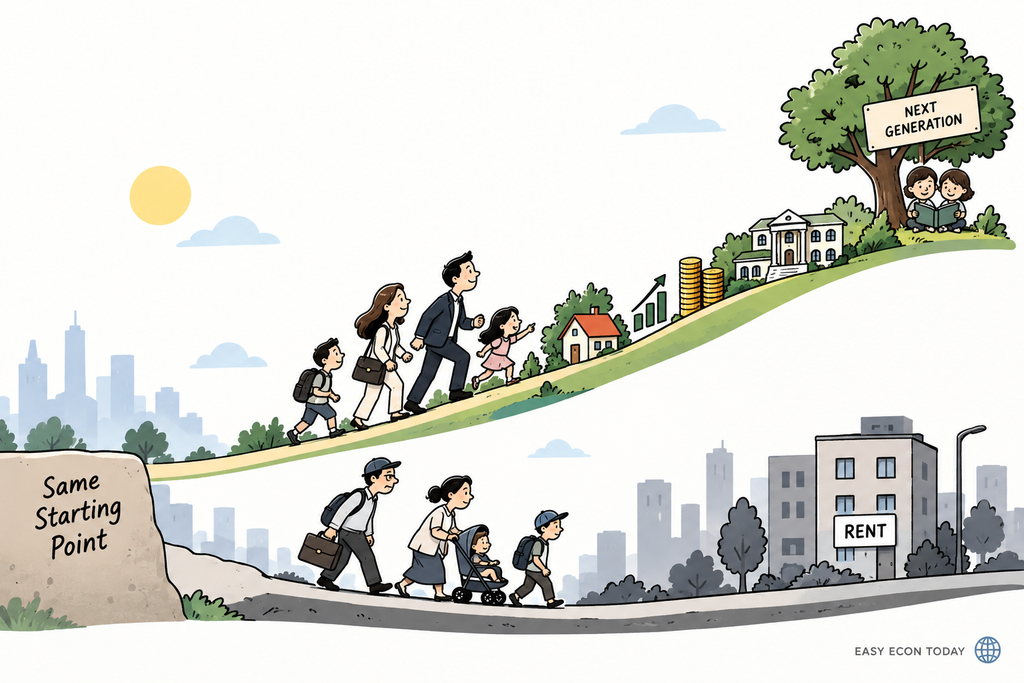
This is where wealth inequality can gradually become inequality of opportunity.
Why Does the Wealth Gap Matter?
Some degree of inequality exists in virtually every market economy.
People have different skills.
They make different choices.
Some save more.
Some take greater risks.
Some start successful businesses.
And luck also plays a role.
The important economic question is therefore not simply:
Why doesn’t everyone have the same amount of money?
A more useful question is:
Can ordinary people still move up the economic ladder?
That question matters.
If young households need decades to save a house deposit, wealth accumulation becomes harder.
If access to good education, housing or business opportunities increasingly depends on family resources, the circumstances of birth become more important.
If large numbers of people believe that working harder will never allow them to get ahead, confidence in economic institutions can weaken.
The health of an economy therefore depends not only on how much wealth it creates.
It also depends on whether people believe there is still a realistic path to participate in that prosperity.
But There Is an Important Paradox
Here the story becomes more complicated.
Global inequality has not simply moved in one direction everywhere.
Global income inequality declined substantially between 1990 and 2019 as incomes in many developing economies grew faster than those in richer parts of the world.
At the same time, wealth remains highly concentrated.
The World Inequality Report 2026 estimates that the global top 10% own around three-quarters of wealth, while the bottom half owns only around 2%.
So two things can be true at the same time:
Poorer countries can catch up with richer countries while wealth remains highly concentrated within societies.
This is why saying simply “inequality is rising” does not tell the whole story.
We need to ask:
Income or wealth?
Which country?
Which generation?
Before or after taxes?
Between countries or within countries?
Economics is rarely as simple as a headline.
And Now Comes AI
The next chapter may already be beginning.
Artificial intelligence could dramatically increase productivity.
That could make societies considerably richer.
But there is another question I find equally interesting:
Who will own the machines, models, data centers and companies producing that wealth?
If AI makes workers more productive and the benefits spread through higher wages, lower prices and new opportunities, technological progress could benefit a very broad part of society.
But if a large share of the gains flows mainly to the owners of technology and capital, existing wealth differences could become larger.
Neither outcome is inevitable.
Technology does not decide by itself how its rewards are distributed.
Competition, education, labour markets, entrepreneurship, ownership and public policy all play roles.
Perhaps, therefore, the biggest economic question about AI is not simply:
“How many jobs will AI replace?”
It may also be:
“Who will own the wealth AI creates?”
In the End, Wealth Is Also About Time
The older I get, the more I realize that wealth is not always created by one brilliant decision.
Often, it is the result of many ordinary decisions given enough time.
Buying a modest home.
Saving a little.
Investing regularly.
Building a small business.
Avoiding unnecessary debt.
And then waiting.
Of course, not everyone begins from the same starting line.
Not everyone has money available to invest.
Not everyone has parents who can help with a house deposit.
And sometimes people simply encounter bad luck.
That is precisely why the wealth gap is more complicated than saying that one person worked harder than another.
Perhaps this is also why wealth inequality feels different from many other economic statistics.
It is not just a number on a chart.
We see it when our children struggle to buy their first home.
We see it when two people with similar salaries reach retirement with completely different levels of financial security.
And sometimes we see it when we look back and realize how much one ordinary decision — buying a home, starting a business or investing a small amount early — changed the course of a family’s life.
For much of modern economic history, we have asked:
How much do you earn?
Increasingly, another question matters:
What do you own?
Economics talks about capital, returns, inequality and compounding.
But behind those words are something much simpler:
people, families and time.
And perhaps understanding that is the first step toward understanding why the wealth gap has become one of the defining economic questions of our age.
Sources
- World Inequality Lab — World Inequality Report 2026
- Federal Reserve Board — Distributional Financial Accounts
- Federal Reserve Board — Economic Well-Being of U.S. Households in 2025
- World Bank — global income inequality
- International Labour Organization — Artificial Intelligence