
You may never buy a U.S. Treasury bond in your life.
You may not follow the bond market. You may not even know what the “10-year Treasury yield” means.
But that number can still affect the price of your home, your mortgage, your investments, the company you work for — and eventually the amount of money left in your wallet.
That is why the recent surge in U.S. Treasury yields matters far beyond Wall Street.
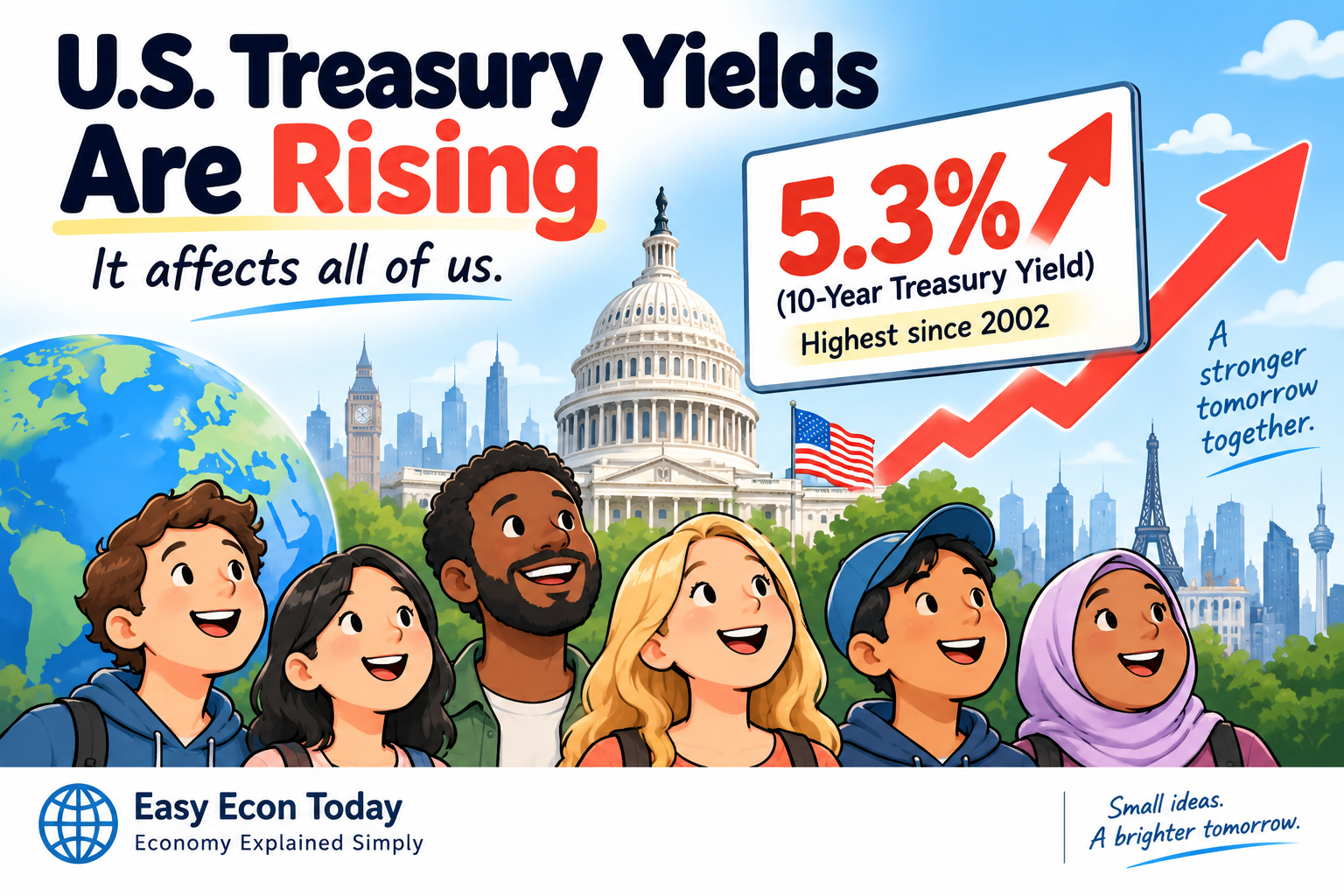
In early October 2026, the yield on the benchmark 10-year U.S. Treasury briefly reached around 5.34%, its highest level since 2002.
That may sound like just another financial-market statistic.
It isn’t.
The U.S. Treasury market sits near the foundation of the global financial system. When Treasury yields move sharply, the effects can spread through mortgages, corporate borrowing, stock markets and government finances.
So what exactly is happening — and what should ordinary people do about it?
First, What Is a Treasury Yield?
The U.S. government regularly borrows money by selling Treasury securities.
Investors lend money to the government and receive interest in return.
The “yield” is essentially the return investors receive for holding those securities.
There is one important relationship to understand:
When bond prices fall, yields rise.
Imagine an older Treasury bond pays $40 a year in interest and was originally worth $1,000.
If investors become less interested in owning it and its market price falls, a new buyer can purchase that same stream of interest payments more cheaply.
The effective return — the yield — therefore rises.
This is why headlines about a “bond sell-off” are often accompanied by headlines saying that “Treasury yields are rising.”
Investors are selling bonds, prices are falling, and yields are moving higher.
Why Are Treasury Yields Rising Now?
There is no single explanation.
Several forces are pushing in the same direction.
One is inflation.
If investors believe inflation will remain higher for longer, they generally demand a higher return for lending money for ten, twenty or thirty years.
After all, receiving 4% interest is less attractive if inflation is eating away a large part of that return.
Recent increases in energy prices have added to those concerns.
Another factor is the strength of the U.S. economy.
A strong economy is normally good news. But if growth remains strong while inflation is still uncomfortable, investors may conclude that the Federal Reserve will have to keep interest rates high — or even raise them further.
That expectation can push Treasury yields higher.
Then there is a much bigger structural issue:
The United States needs to borrow a lot of money.
The U.S. Treasury estimated that it would need $628 billion in privately held net marketable borrowing during the final quarter of 2026 alone.
When governments issue large amounts of debt, investors must be persuaded to absorb that supply.
And sometimes the price of persuading them is a higher yield.
In simple terms:
More borrowing + inflation concerns + higher-for-longer interest rates = upward pressure on Treasury yields.
Why Is the U.S. Treasury Buying Back Bonds?
This is where the story becomes especially interesting.
The U.S. Treasury has expanded its program of buying back some older, longer-term government securities.
In August, the Treasury announced that it would at least double the maximum size of certain buyback operations involving 10- to 30-year securities.
At first glance, this can look like the government is trying to push interest rates down.
But there is an important distinction.
The Treasury says the purpose of these operations is primarily to improve liquidity.
Some older Treasury bonds trade less frequently than newly issued bonds. By buying back some of those older securities, the Treasury can make the market function more smoothly.
That is different from the Federal Reserve launching a major monetary-policy program designed specifically to lower interest rates.
Still, the timing has attracted attention.
The expansion came while long-term Treasury yields were climbing sharply, so investors naturally wondered whether policymakers were becoming uncomfortable with the rise in borrowing costs.
And there is another reason to keep the scale in perspective.
The Treasury market is enormous.
Even several billion dollars of additional buybacks is relatively small compared with the size of the overall market.
So buybacks may help market liquidity, but they cannot simply make the deeper forces pushing yields higher disappear.
Why Should Someone With No Treasury Bonds Care?
Because Treasury yields act like a starting price for money throughout much of the economy.
Suppose the U.S. government has to pay more than 5% to borrow money for ten years.
A company is riskier than the U.S. government.
A household is riskier.
A property developer is riskier.
So those borrowers normally have to pay something above the government borrowing rate.
That creates a chain reaction:
Treasury yields rise
→ borrowing becomes more expensive
→ mortgages and corporate financing become more expensive
→ investment can slow
→ consumers have less money to spend
→ economic growth can weaken.
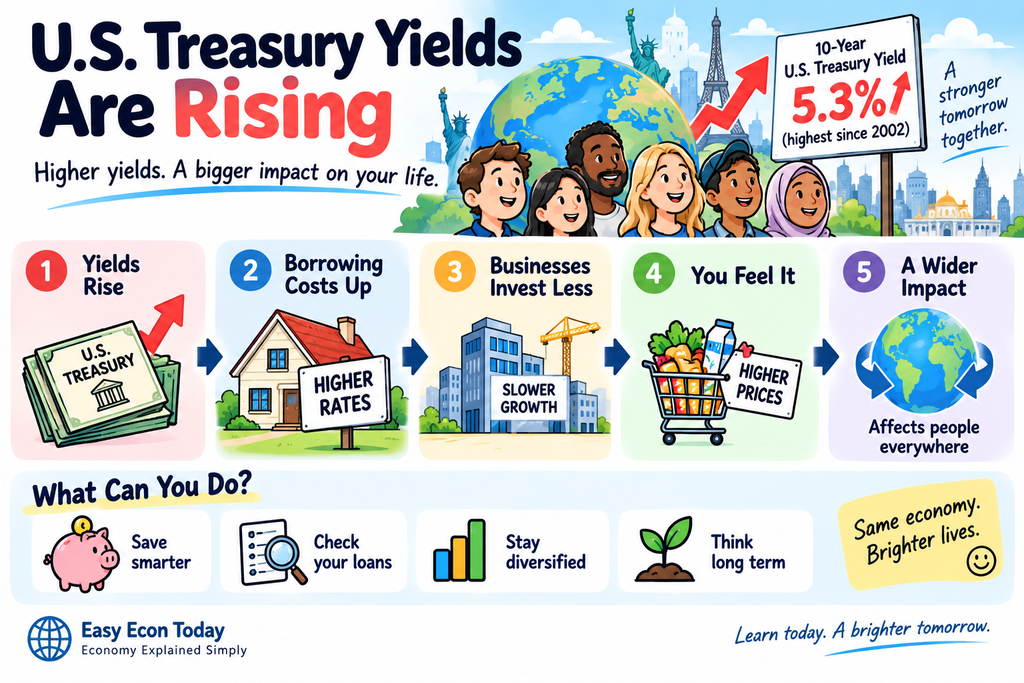
This is how a number on a bond-market screen in New York can eventually reach an ordinary household.
Your Mortgage May Be One of the First Places You Notice
Housing provides perhaps the clearest example.
U.S. mortgage rates do not move exactly with the 10-year Treasury yield, but long-term Treasury yields are an important influence on mortgage borrowing costs.
By September 24, the average U.S. 30-year fixed mortgage rate had risen to about 7.03%, according to Freddie Mac.
A percentage point may not sound dramatic.
But over a 30-year mortgage, small changes in interest rates can translate into substantial differences in monthly payments.
That affects more than new homeowners.
Higher mortgage rates can reduce the number of people who can afford to buy a house.
That can slow housing transactions, construction, renovations, furniture purchases and many other activities connected with the housing market.
One interest rate begins to spread across an entire industry.
Businesses Feel It Too
Companies constantly borrow money.
They borrow to build factories, open stores, construct data centers, purchase equipment, develop new products or acquire competitors.
If the risk-free government borrowing rate rises, corporate borrowing normally becomes more expensive as well.
Imagine a company considering a new project expected to earn a 7% return.
If it can finance that project at 4%, it may look attractive.
But if financing costs rise toward 6% or 7%, management may decide the project is no longer worth the risk.
The project is postponed.
A factory is not built.
Equipment is not ordered.
Workers are not hired.
This is one reason higher long-term interest rates can eventually cool the economy even without an immediate recession.
And Then There Is the Stock Market
Higher Treasury yields also change the competition for investors’ money.
When safe government bonds paid very little, investors had a strong incentive to take more risk in stocks.
But consider the choice when Treasury yields move above 5%.
An investor may ask:
Why take substantial stock-market risk if I can earn an attractive return from U.S. government debt?
That does not mean stocks must fall whenever Treasury yields rise.
Strong economic growth can support corporate profits and stocks even while yields are high.
But higher bond yields raise the hurdle that equities must clear.
They can be particularly challenging for highly valued growth companies whose expected profits lie far in the future.
In financial markets, money always has alternatives.
When one alternative suddenly becomes more attractive, the others have to compete harder.
Higher Yields Also Hit the Government
There is another borrower we should not forget:
The U.S. government itself.
As older government debt matures, some of it must be refinanced.
If new debt carries higher interest rates, the government’s interest bill gradually rises.
That matters because money spent servicing debt cannot simultaneously be spent on infrastructure, healthcare, defense, education or other priorities without additional borrowing or taxes.
This can create an uncomfortable cycle.
Large deficits require more borrowing.
More borrowing increases the supply of government debt.
Investors may demand higher yields.
Higher yields increase government interest costs.
And higher interest costs can contribute to larger future deficits.
This does not mean a U.S. debt crisis is inevitable.
But it does explain why investors now pay close attention not only to inflation and the Federal Reserve, but also to government borrowing and fiscal policy.
Are Higher Treasury Yields Always Bad?
No.
This is an important part of the story that often disappears from alarming headlines.
For savers, higher interest rates can be welcome.
Bank deposits, money-market products and newly issued bonds may offer better returns.
For years, conservative savers complained that keeping money in safe assets produced almost nothing.
That world has changed.
Someone approaching retirement may find a 5% government bond far more attractive than the near-zero yields available during the ultra-low-rate era.
There is also a difference between existing bondholders and new bond buyers.
When yields rise, the market value of existing lower-yielding bonds generally falls.
That can hurt investors who need to sell.
But a new investor entering the market can now buy bonds offering higher yields.
The same event can therefore be bad news for one investor and an opportunity for another.
What Can Ordinary People Do?
The first thing is not to panic.
A rising Treasury yield is an important economic signal, but it is not a prediction that a financial crisis will occur tomorrow.
Instead, think about where higher interest rates touch your own finances.
If you are considering a mortgage or refinancing a loan, pay close attention to borrowing costs rather than assuming rates will soon return to the ultra-low levels of the past.
If you carry expensive variable-rate debt, reducing that debt may become more valuable when interest rates remain high.
If you hold large amounts of cash, compare what your savings are earning. A higher-rate environment means leaving money in a very low-yield account can have a greater opportunity cost.
Investors should also remember diversification.
Stocks, bonds and cash respond differently to changing economic conditions. Moving everything from one asset to another because of a frightening headline can create more risk rather than less.
And perhaps most importantly, avoid trying to predict every daily move in Treasury yields.
Even professional bond traders struggle to do that consistently.
It is more useful to understand the direction of the financial environment than to guess tomorrow’s number.
The Bigger Story
The recent rise in U.S. Treasury yields is really telling us something larger.
For much of the period following the global financial crisis, the world became accustomed to unusually cheap money.
Governments could borrow cheaply.
Companies could borrow cheaply.
Homebuyers could borrow cheaply.
Investors became comfortable with very low bond yields.
That assumption is now being challenged.
If investors increasingly demand higher returns to compensate for inflation, government borrowing and uncertainty, the cost of money across the economy may remain higher than people became accustomed to.
And that changes decisions.
A family may buy a smaller house.
A company may delay a new factory.
An investor may choose a Treasury bond instead of a technology stock.
A government may discover that servicing its debt consumes a larger part of its budget.
None of these decisions looks dramatic on its own.
Together, however, they can reshape an economy.
So the next time you hear that the 10-year Treasury yield has moved above 5%, don’t think of it as a number that belongs only to Wall Street.
Think of it as the price of money moving through the economy.
And eventually, the price of money reaches almost everyone.
Sources
- U.S. Department of the Treasury — Treasury Announces Increased Sizes of Nominal Long-End Liquidity Support Buybacks Beginning September 9
- U.S. Department of the Treasury — Marketable Borrowing Estimates
- Freddie Mac — Primary Mortgage Market Survey
- Reuters — Why are world bond markets selling off again?
- Reuters — Treasury yields are rising — why does it matter?
- Reuters — Treasury’s smaller-than-expected buybacks fuel debate over aims