
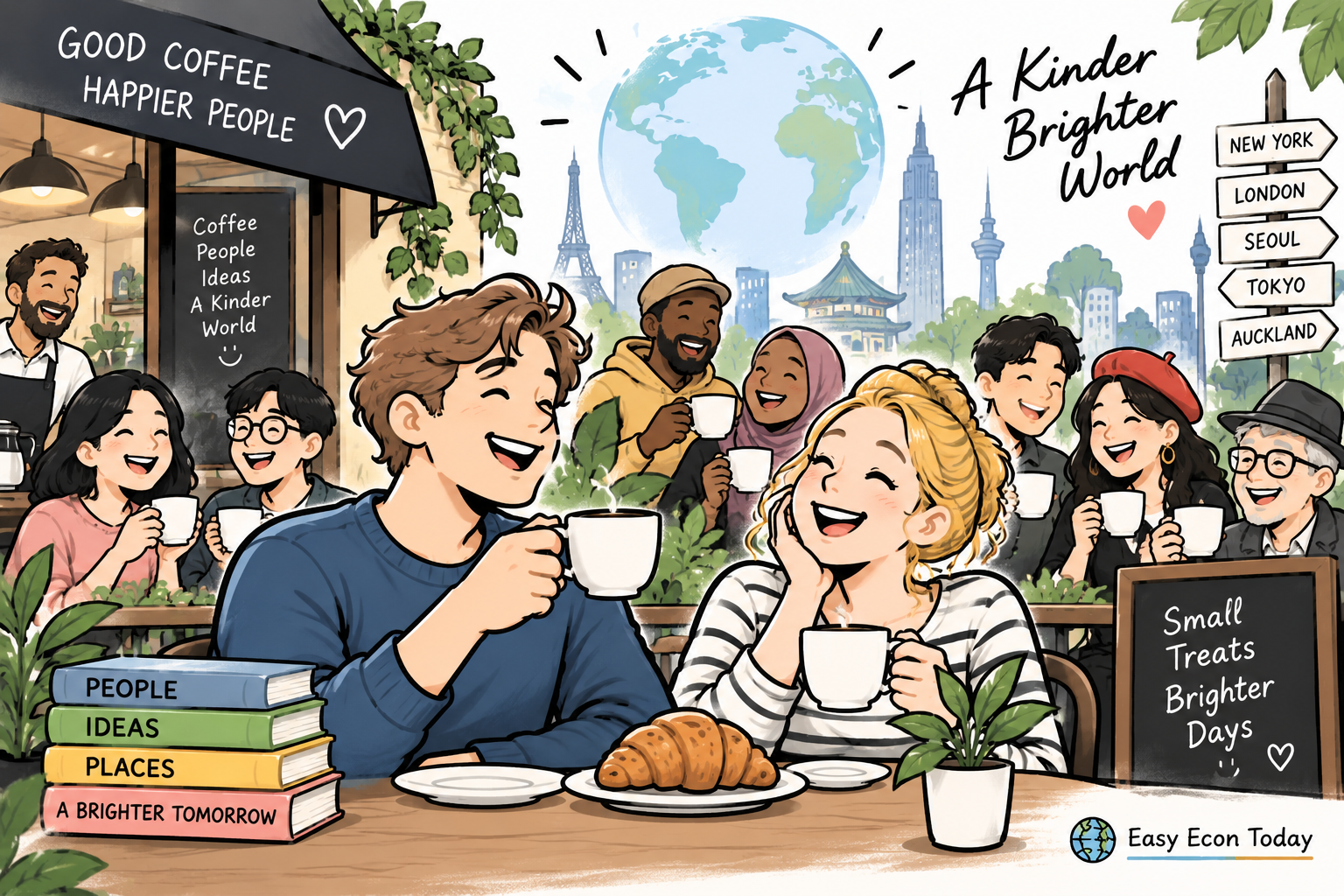
The Economics of Small Luxuries in Hard Times
You tell yourself this morning:
“I really need to spend less this month.”
Then, on the way to work, you stop for coffee.
It costs $7.
You hesitate for a moment, look at the price, and buy it anyway.
Later that evening, someone else orders a favorite meal instead of cooking at home. Another person buys a small cosmetic product. Someone downloads a new game. Someone else pays a little extra for a good bottle of olive oil.
None of these purchases is essential.
And yet people continue making them even when money feels tight.
Why?
The answer tells us something surprisingly important about economics — and about human nature.
Welcome to the “Little Treat Economy”
Economists usually talk about consumers as if we carefully divide our income between necessities, savings and discretionary spending.
Real life is more complicated.
When people become worried about money, they often postpone big purchases.
A new car can wait.
A new sofa can wait.
An overseas holiday can wait.
But a cup of coffee?
A favorite dessert?
A small birthday gift?
Those purchases feel different.
A 2026 SurveyMonkey study of more than 2,000 American adults found that 62% bought themselves a small, affordable treat at least once a month. Among those who did, 52% typically spent $25 or less on each purchase. Food and beverages were the most common category.
There is now even a name for this behavior:
“Treatonomics.”
It describes the tendency to seek small, affordable pleasures when larger purchases feel difficult or uncertain.
An Old Idea in a New Form
The phenomenon itself isn’t new.
Economists and marketers have long discussed something called the “lipstick effect.”
The basic idea is simple.
During difficult economic periods, people may cut back on expensive goods while continuing to buy — or sometimes becoming more interested in — relatively inexpensive luxuries.
Someone who cannot afford a designer handbag might still afford a lipstick.
Someone postponing an expensive holiday might still enjoy a good restaurant meal.
And someone worried about the mortgage might still buy a $7 coffee.
Today, lipstick is only one example.
The modern small luxury might be specialty coffee, skincare, takeaway food, a streaming subscription, a hobby item or a small upgrade at the supermarket.
The product changes.
The human desire for a small reward does not.
Saving and Splurging at the Same Time
At first, this behavior seems irrational.
If people are worried about money, shouldn’t they simply spend less?
But consumers don’t necessarily choose between being “frugal” and being “spenders.”
They can be both.
McKinsey’s research illustrates this apparent contradiction. In late 2025, 75% of US consumers surveyed said they had traded down in at least one category, while 39% still intended to splurge somewhere.
That might mean buying supermarket-brand cereal instead of the familiar brand — and then meeting a friend for coffee.
Or postponing a new television — while buying better ingredients for dinner.
This isn’t necessarily contradictory.
People often save money in areas they care less about so they can spend it on things they value more.
That is economics happening at the kitchen table.
Why Does a $7 Coffee Feel So Different From $7 in the Bank?
Purely financially, $7 is $7.
Psychologically, however, the two can feel very different.
Money left in a bank account promises a future benefit.
A coffee with a friend offers something immediately: warmth, conversation, a break from work and perhaps twenty peaceful minutes in a difficult day.
That immediate reward has value too.
SurveyMonkey found that people reported using small treats for several reasons: 35% said they helped them stay motivated toward larger goals, 30% used them to cope with a stressful day or bad news, and 27% used them to celebrate a personal success.
So people aren’t always buying the product itself.
Sometimes they are buying a feeling.
A small purchase can become a small piece of control in a world that feels increasingly difficult to control.
And This Isn’t Just an American Habit
The exact spending patterns vary by country and culture, but treating ourselves appears far from uniquely American.
Deloitte surveyed consumers across 23 countries and found that more than three-quarters reported making a purchase to treat themselves during the previous month.
Interestingly, only 42% said they could afford to spend money on something that brought them joy.
That gap tells us something.
Small luxuries are not simply the behavior of wealthy people with spare money.
They can also appear when people feel financially constrained.
A person may say:
“I can’t afford the holiday I want.”
But that doesn’t necessarily become:
“I will allow myself no pleasure at all.”
Instead it may become:
“I’ll have the nice coffee today.”
The $7 Problem
There is, however, another side to the story.
One coffee will probably not destroy anyone’s finances.
But repeated purchases can quietly become something much larger.
Imagine spending $7 on a small treat five times a week.
That is:
$35 a week.
About:
$150 a month.
And roughly:
$1,800 a year.
Suddenly the “small” purchase doesn’t look quite so small.
This doesn’t mean the coffee was a mistake.
The question is whether you consciously decided that the enjoyment was worth $1,800 a year — or simply never noticed the total.
That distinction matters.
When a Treat Stops Being a Treat
There is another danger.
If something special happens every day, does it remain special?
SurveyMonkey’s research found that frequent treat buyers were more likely than occasional buyers to say their spending affected their financial goals.
This is where a harmless pleasure can become budget creep.
One subscription becomes four.
One takeaway dinner becomes three each week.
The occasional café visit becomes an automatic daily habit.
Each purchase still looks small.
The accumulated cost isn’t.
The problem, therefore, isn’t necessarily the treat.
The problem begins when conscious enjoyment becomes unconscious spending.
Perhaps Frugality Has Been Misunderstood
For generations, personal-finance advice has often sounded like this:
Stop buying coffee.
Stop eating out.
Cancel everything unnecessary.
Save every possible dollar.
There is some truth in that advice. Small recurring expenses do accumulate.
But a life built entirely around eliminating pleasure isn’t necessarily a sensible economic goal either.
Economics is ultimately about choices under limited resources.
And those resources include not only money, but also time, energy and attention.
A coffee shared with an old friend may be worth far more to someone than another $7 sitting unnoticed in a bank account.
Conversely, a coffee bought automatically every morning and barely enjoyed may be worth very little.
The price is identical.
The value is not.
A Better Question to Ask
Instead of asking:
“How can I stop spending money on small pleasures?”
perhaps we should ask:
“Which small pleasures are genuinely worth paying for?”
That changes the conversation.
Keep the things that bring real enjoyment.
Reduce the things you buy automatically.
A weekly dinner with friends may matter.
Three forgotten streaming subscriptions probably don’t.
A good coffee enjoyed slowly may matter.
A daily purchase made simply because it has become routine may not.
This is not extreme frugality.
It is intentional consumption.
The Economics of a Small Happiness
Behind every economic statistic there is a human being making choices.
We save.
We worry.
We compare prices.
We postpone purchases.
And occasionally, despite all our careful calculations, we buy ourselves something simply because it makes the day a little better.
That isn’t necessarily irrational.
But neither should small pleasures become invisible expenses.
Perhaps the lesson of the little-treat economy is surprisingly simple:
Spend less on things you barely notice.
Save for things that truly matter.
And leave a little room for the small pleasures that make ordinary life enjoyable.
Because good personal finance isn’t only about accumulating more money.
It is also about understanding what your money is for.
Sources
- SurveyMonkey — Treatonomics explained: How little treat culture is reshaping consumer spending in America
- McKinsey & Company — The State of the US Consumer 2025
- Deloitte — Understanding splurge spending
- MacDonald & Dildar — Social and psychological determinants of consumption: Evidence for the lipstick effect during the Great Recession
A Moment to Enjoy
Take a moment to slow down, enjoy a cup of coffee, and let the day breathe.