
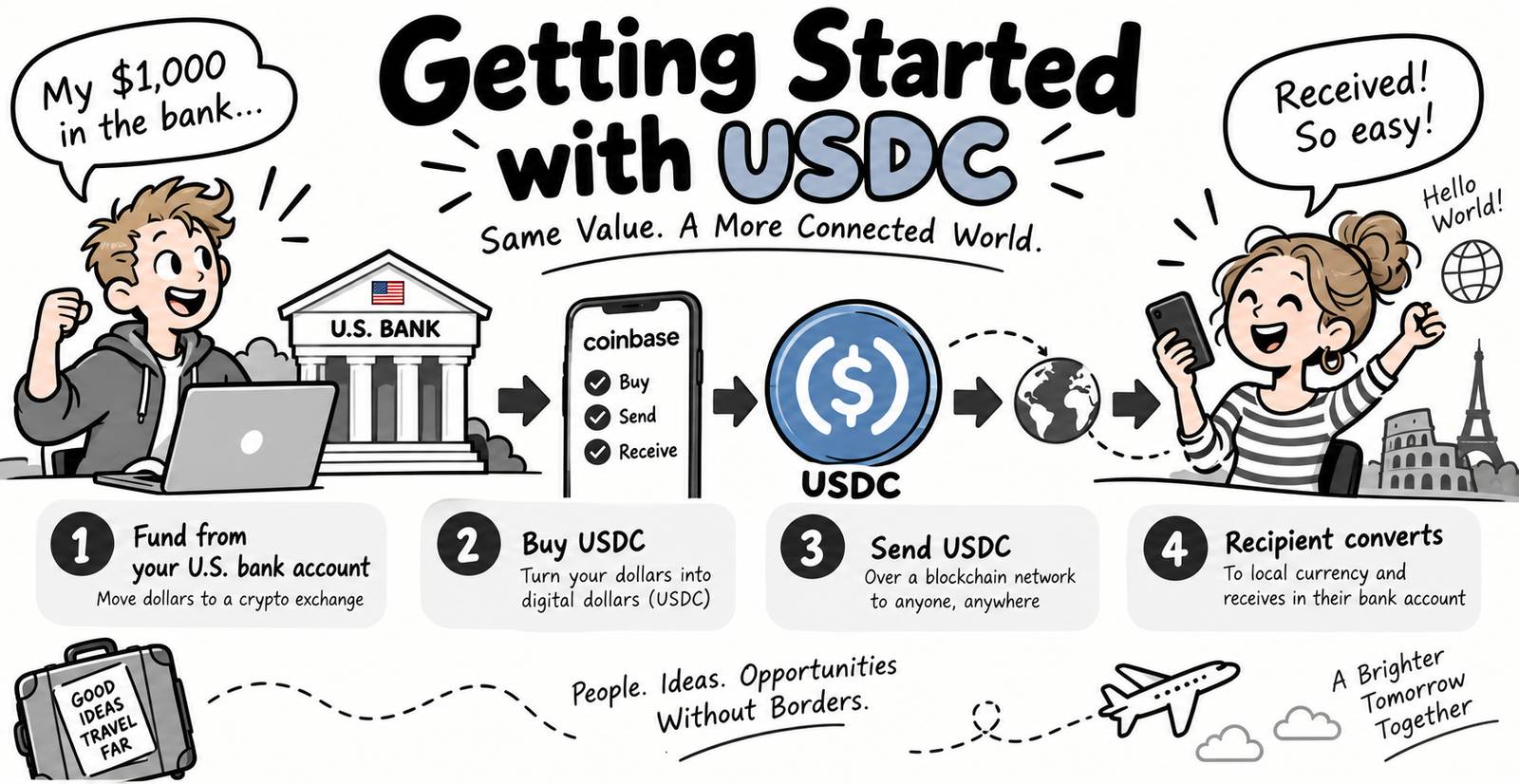
A Simple Step-by-Step Guide to Buying, Sending and Converting USDC
Stablecoins may sound simple in theory. But when you actually try to use one for the first time, the very first question can stop you:
“Where do I even start?”
Using a bank for the first time is relatively straightforward. You open an account, deposit money, and if you want to send money overseas, you arrange an international transfer through the bank.
But USDC has no bank branch to walk into. There is no obvious counter where you can ask someone to open an account for you. Even knowing where to put your money can feel unfamiliar.
Fortunately, once we follow the process one step at a time, the basic structure is simpler than it first appears.
In this guide, we will follow someone who has never used cryptocurrency before as he takes $1,000 from a U.S. bank account, converts it into USDC, sends some to another person, and then sees how the recipient can convert it back into ordinary currency.
Rather than starting with technical terminology, we will compare the process with something most of us already understand: bank accounts and international money transfers.
1. Where Do I Start?
Imagine using a bank for the first time.
First, you choose a bank. Then you open an account, verify your identity and deposit some money.
USDC begins in a similar way.
The difference is that instead of visiting a bank branch, you first need to find an online service or app where you can buy, hold and send USDC.
These services are commonly called crypto exchanges.
The name may sound technical, but for now you can think of an exchange simply as:
“An online service that lets me turn dollars from my bank account into a digital dollar such as USDC, hold it, and send it to someone else.”
Several companies provide these services in the United States.
For this example, we will use Coinbase simply to make the steps easier to understand. This is not a recommendation of any particular company; it is only an example of how someone might get started.
2. Once I Find an Exchange, How Do I Open an Account?
Let’s imagine that John lives in the United States and wants to use USDC for the first time.
Instead of walking into a bank branch, John opens the official website or app of a crypto exchange such as Coinbase.
One thing matters immediately:
Make sure you are using the official website or official app.
Fake websites and phishing attempts exist, so it is important to check the address carefully rather than clicking an unfamiliar search result or link.
John selects Sign up.
The next steps are not very different from opening many other financial accounts online:
Register email → Verify email → Create password → Enter name and phone number → Verify identity
A U.S. user should enter their name as it appears on their identification and complete the required identity-verification process. The service may also ask for identification documents.
Once this is completed, John has an online account from which he can begin using USDC.
But remember:
A Coinbase account is not the same thing as a bank deposit account.
We are comparing the two only to make the process easier to understand.
John now has a starting point for buying and sending USDC.
But his $1,000 is still sitting in his U.S. bank account.
So how does he move from ordinary dollars to USDC?
3. How Do I Turn $1,000 in My Bank Account into USDC?
Suppose John has $1,000 in his U.S. bank account.
First, he needs to connect that bank account to the exchange.
Under Payment methods, he adds his bank account.
In the United States, one common way to transfer money electronically between bank accounts is ACH.
An important point is that the name on the bank account should match the name on the exchange account.
Once the bank account is connected, John can begin the purchase.
He selects Buy, chooses USDC, enters $1,000, and selects the linked bank account as the payment method.
Before confirming, the screen should show the amount being purchased and any applicable fees or other transaction details.
John reviews the information and confirms.
Conceptually, the process looks like this:
John’s U.S. bank account — $1,000
↓
Crypto exchange
↓
John’s USDC balance
John now holds some of his money in the form of the digital dollar USDC.
However, the exact amount of USDC received and the total cost can depend on the terms shown on the transaction screen. We should not automatically assume that $1,000 will always result in exactly 1,000 USDC with no costs or differences.
There is another practical point.
When USDC is purchased through an ACH-linked bank account, the balance may appear in the account before it is available to send to an external wallet.
The service should indicate when the funds become available for withdrawal or external transfer.
Now John has USDC.
But if he wants to send it to another person, what replaces the bank account number?
This is where we encounter the wallet address.
4. What Does the Recipient Need to Give Me? — The Wallet Address
To send money through a bank, you normally need information about the recipient’s bank account.
Sending USDC is similar, but instead of a bank account number, you use a wallet address.
Suppose John wants to send 100 USDC to his friend Mary.
Mary opens the exchange or wallet app she uses.
If she is using a service that supports USDC, she selects Receive or Deposit, then chooses USDC.
The screen may display a long string of letters and numbers, often together with a QR code.
That is the address Mary gives John for receiving USDC.
A simple comparison is:
Bank transfer
Mary: “Here is my bank account information.”
USDC transfer
Mary: “Here is my USDC receiving address.”
But there is one additional issue that is especially important with digital assets:
They must also confirm which blockchain network they are using.
USDC can operate on more than one blockchain network.
So Mary’s receiving address and network must be supported by the service or wallet John is using to send the USDC.
Choosing the wrong address or an incompatible network can make recovery difficult.
John therefore needs three things:
① 100 USDC to send
② Mary’s USDC receiving address
③ A network supported by both sides
Now he is ready to press Send.
5. Let’s Send 100 USDC
John selects Send.
He chooses USDC as the asset and enters 100 USDC.
Next, he enters Mary’s receiving address. He may copy and paste the address or, where supported, use a QR code.
This is not a step to rush.
Before confirming, John checks:
Is the receiving address correct?
Does the network selected on John’s side match the network Mary provided?
The difference from a bank transfer can be pictured like this:
Bank transfer:
My bank account → Recipient’s bank account
USDC transfer:
My exchange or wallet → Blockchain network → Recipient’s USDC address
Before the transfer is confirmed, the service should display the amount being sent and any expected costs.
A network fee may apply, and actual costs depend on the service and blockchain network being used.
Once John reviews the details and approves Send, the transaction begins.
Unlike a traditional bank transfer, there may be no bank employee processing a transfer instruction in the middle.
The transaction is processed through the blockchain network.
When it is completed, Mary should be able to see the received USDC.
For example:
Received: 100 USDC
The actual amount received and how it appears can depend on the service and fee structure.
John’s money has now travelled through this path:
U.S. dollars in John’s bank
→ Exchange account
→ Buy USDC
→ Send to Mary’s USDC address
→ Mary receives USDC
One important question remains:
How does Mary turn the USDC back into ordinary money in her bank account?
6. How Does the Recipient Convert USDC Back into Dollars?
Mary now has the USDC John sent her.
But suppose she wants to use that money for ordinary living expenses through her bank account.
She first checks her USDC balance and then uses the available function to convert or sell the USDC for U.S. dollars.
The basic flow is:
100 USDC received
↓
Convert USDC to USD
↓
USD balance on the service
↓
Withdraw to Mary’s U.S. bank account
If Mary has linked an eligible bank account, she may be able to withdraw available USD to that account.
So the complete journey looks like this:
John’s U.S. bank account
→ Buy USDC
→ John’s USDC
→ Send through a blockchain
→ Mary receives USDC
→ Convert to USD
→ Mary’s U.S. bank account
The structure should now feel a little more familiar.
A stablecoin transfer does not necessarily mean that everything from beginning to end takes place in an entirely new financial world.
There may still be ordinary bank accounts at both ends.
The main difference is that USDC and a blockchain can be used for the middle part of the journey.
Actual conversion methods, withdrawal times and costs can vary by service and payment method, so users should always check the terms shown before confirming a transaction.
But this raises an obvious question:
If John and Mary both live in the United States and already have bank accounts, why use USDC at all?
That question brings us to one of the most interesting aspects of stablecoins.
7. Why Use USDC When You Can Just Send Money Through a Bank?
If John and Mary both live in the United States, it is perfectly reasonable to ask:
“Why turn $100 into USDC and then back into dollars when I could simply send $100 through a bank or payment app?”
In many cases, that may indeed be easier.
The potential usefulness of USDC becomes clearer when money moves across borders or between different financial systems.
Imagine that John is in the United States, but Mary is in South Korea, Japan or New Zealand.
A traditional international transfer may involve the sending bank, the receiving bank and, in some cases, intermediary banks and foreign-exchange processes.
Time and cost can vary depending on the countries and financial institutions involved.
With USDC, another route may be possible.
John can send digital assets to Mary’s USDC address, and Mary may then use a locally available exchange or service to convert them into her local currency.
Conceptually:
John in the United States
U.S. dollars → USDC
↓
Transfer through a blockchain network
↓
Mary in South Korea
USDC → Korean won
This is where the idea behind stablecoins becomes clearer.
Money crossing a border no longer necessarily has to travel only through the traditional international banking network.
There is another possible route.
That does not mean USDC is always cheaper or faster.
The total cost can include buying or selling USDC, blockchain network fees, conversion into local currency and other service charges. Regulation and availability also differ by country.
So rather than thinking of stablecoins as “new money that eliminates banks,” it may be more useful to think of them as:
“another possible route for moving money.”
8. What If John Wants to Send $1,000 from the U.S. to South Korea?
Now let’s consider a more realistic cross-border example.
John in the United States wants to send $1,000 worth of value to Mary in South Korea.
With a traditional bank transfer, John would arrange an international transfer through his U.S. bank and provide Mary’s Korean banking information.
Currency conversion and intermediary institutions may be involved before Korean won finally reaches Mary’s bank account.
Using USDC changes the route.
John first obtains USDC through the service he uses in the United States.
Mary must then check whether the exchange or service available to her in South Korea can receive USDC.
If it can, she selects USDC Deposit or Receive and checks:
① Her USDC deposit address
② The supported blockchain network
Mary sends both pieces of information to John.
John selects Send from his exchange or wallet, enters Mary’s address, and carefully checks that the network supported on both sides is exactly the same.
The complete flow can be pictured in one line:
John’s U.S. dollars → USDC → Blockchain → Mary’s USDC → Korean won → Mary’s Korean bank account
Receiving USDC does not automatically place Korean won into Mary’s bank account.
Mary must check whether the Korean exchange or service she uses allows her to trade or convert USDC into Korean won and whether it supports withdrawals to her registered bank account.
This illustrates an important difference from conventional international banking.
With an international bank transfer, financial institutions handle much of the route. With a stablecoin transfer, the sender and recipient may need to check the exchange, wallet, address and blockchain network themselves.
Stablecoins therefore offer new possibilities, but they also place new responsibilities on the user.
For a first transfer, it can be sensible to review the service instructions and fees carefully and send a small test amount first before sending a larger amount.
9. Bank Transfer vs. USDC Transfer — What Is Different?
Here is the basic comparison.
Starting point
Bank transfer → Bank
USDC transfer → Crypto exchange or wallet
Information needed from the recipient
Bank transfer → Bank name, account number and other banking details
USDC transfer → Wallet address and blockchain network
How the money moves
Bank transfer → Through banks and, where applicable, intermediary institutions
USDC transfer → Through a blockchain network
What the recipient receives
Bank transfer → Local currency such as dollars or won
USDC transfer → USDC
To use the money as ordinary cash
Bank transfer → Usually available through the recipient’s bank account
USDC transfer → May need to be converted into local currency and withdrawn to a bank account
What requires particular care
Bank transfer → Check the recipient and bank-account information
USDC transfer → Check the recipient address and the blockchain network
10. Three Things to Check Before Your First USDC Transfer
For someone sending USDC for the first time, convenience should not be the only consideration.
It is also important to understand what happens if something goes wrong.
With a bank transfer, there may sometimes be an opportunity to contact the bank and request assistance.
A completed blockchain transfer, however, is generally difficult to cancel or reverse at will.
So before pressing Send, develop the habit of checking three things.
First: Is the recipient’s wallet address correct?
Instead of manually typing a long address, copy and paste it where appropriate, then check several characters at the beginning and end.
Second: Are both sides using the same supported network?
Even if the asset is called USDC on both sides, make sure the sending and receiving services support the same blockchain network for that transfer.
Third: If this is your first time, consider a small test transfer.
Before sending a large amount, you may choose to send a small amount first and confirm that it arrives correctly.
Remember, however, that two transfers can mean paying applicable fees twice, so check the actual costs.
Also be cautious about links received through email or text messages.
Whenever possible, verify that you are using the official website or official app of the exchange or service.
Stablecoins can make certain transfers simpler, but they also give users more responsibility for checking addresses and networks.
11. So What Do Stablecoins Actually Change?
At first, stablecoins can look like unfamiliar and complicated financial technology.
But after following John’s $1,000 from beginning to end, the basic path is surprisingly straightforward:
Bank dollars → Exchange → USDC → Blockchain transfer → Recipient’s USDC → Local currency → Recipient’s bank account
In a traditional international transfer, banks and financial institutions handle much of the movement of money.
Stablecoins introduce another route in which exchanges and blockchain networks can be used to move a digital representation of the dollar.
That does not mean stablecoins are about to replace banks.
Banks and other financial services may still be needed at the beginning, when dollars are converted into USDC, and at the end, when USDC is converted back into dollars, won or another local currency.
There are also fees, regulations, security concerns and the additional responsibility of checking wallet addresses and networks.
Even so, stablecoins introduce an important new question:
“Does money crossing a border always have to travel through the traditional banking network?”
Stablecoins offer a new possible answer.
That is why it can be misleading to think of a stablecoin simply as “a cryptocurrency with a stable price.”
A more useful way to understand it is as a new piece of financial infrastructure that allows dollar-denominated digital value, such as USDC, to move across the internet and blockchain networks.
Seen this way, it becomes easier to understand why banks, card companies, fintech firms and governments are paying attention to stablecoins.
And the next time someone says, “I’m sending money with USDC,” you should at least be able to picture where the journey begins, what route the money takes, and how it reaches the recipient.
New to stablecoins? You can also read our earlier guide, “What Is a Stablecoin?”, for a simple introduction to the basic idea and how USDT and USDC work.
Sources
- Circle — USDC: The World’s Digital Dollar
- Circle — Transparency & Stability
- Coinbase Help — Steps to Receive Crypto
- Federal Reserve — Payment Stablecoins and Cross-Border Payments: Benefits and Implications for Monetary Policy Implementation
This article is intended as a general explanation of how stablecoin transfers can work and is not investment advice. Exchange availability, fees, transfer rules and regulations can change. Always check the latest information from the service you intend to use before making a transaction..