
Why Trust, Judgment and Human Connection May Be the Skills of the Future
AI can write an email in seconds.
It can summarize a hundred-page report before we finish our coffee. It can translate languages, analyze data, create images, write computer code and answer questions at almost any hour of the day.
Every few months, it seems to learn something new.
So here is a strange question:
If machines become better at doing things, what becomes more valuable about being human?
For years, much of the discussion about artificial intelligence has focused on one fear:
Will AI take our jobs?
But perhaps there is another side to the story.
As AI becomes cheaper, faster and more widely available, some distinctly human qualities — trust, judgment, empathy, responsibility and genuine human connection — may actually become more valuable, not less.
The Strange New Value of a Human Being
Imagine calling your bank because something has gone wrong with your account.
An AI assistant answers immediately.
It is polite. It knows your transaction history. It explains the rules perfectly.
But your problem is unusual.
You explain it again.
The AI gives you another perfectly written answer — which still does not solve the problem.
What do you eventually say?
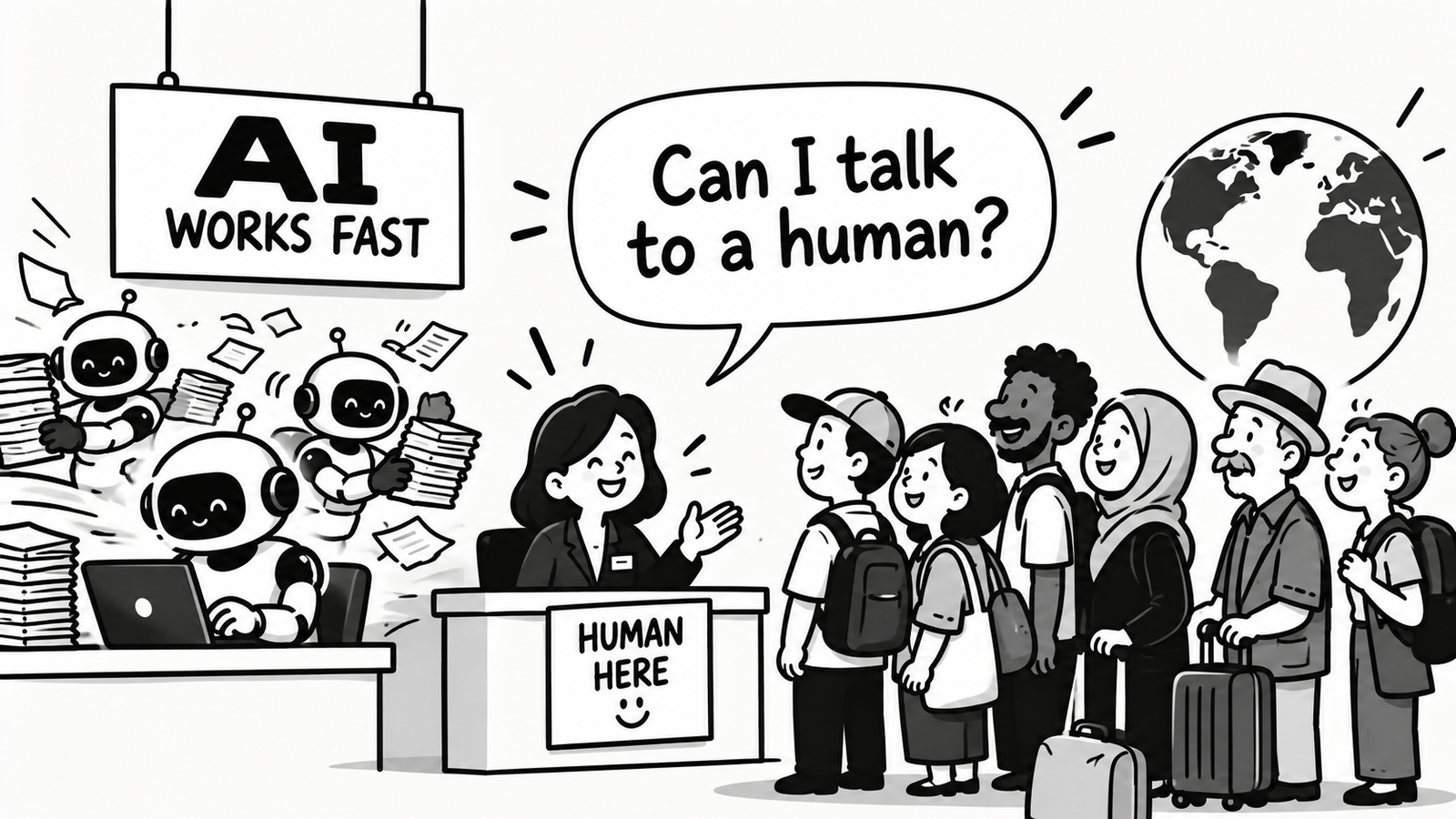
“Can I talk to a human?”
That simple sentence may tell us something important about the future economy.
AI is becoming remarkably good at routine communication. But when something is complicated, emotional, unusual or important, many people still want another person involved.
A 2026 Gartner survey of 3,566 customers found that half said generative AI made customer-service interactions easier.
Yet 87% said companies using generative AI should provide access to a human agent.
That is an interesting combination.
People do not necessarily reject AI.
They may simply want AI and humans.
Perhaps the Job Will Change Before It Disappears
The fear that technology destroys jobs is hardly new.
Factories replaced many forms of manual labour. Computers eliminated countless repetitive office tasks. ATMs changed banking. The internet transformed travel agencies, newspapers, retail and entertainment.
AI will certainly change work too.
But “AI can perform part of my job” is not the same as “AI can replace my entire job.”
The International Labour Organization examined occupations around the world and estimated that roughly one in four workers is in an occupation with some exposure to generative AI.
Its more important conclusion, however, was this:
For most occupations, transformation is more likely than complete replacement.
Why?
Because jobs are bundles of different tasks.
An accountant does not only calculate numbers.
A doctor does not only identify symptoms.
A teacher does not only provide information.
A salesperson does not only describe a product.
And a restaurant owner does much more than produce food.
Once we look at jobs this way, the future becomes more interesting.
Related: Will AI Take Your Job? How AI Is Changing the Way We Work
Consider an Accountant
AI can already categorize transactions, identify unusual numbers, summarize financial information and help draft explanations.
Those abilities will improve.
Does that mean the accountant disappears?
Not necessarily.
Imagine a business owner facing a difficult decision.
Should I buy another business?
Can I afford to employ another person?
Should I borrow money?
What happens if sales fall 20 percent?
The numbers matter.
But eventually the owner may ask:
“What would you do if this were your business?”
At that moment, calculation is no longer enough.
Someone must understand the circumstances, weigh uncertainty, explain the risks and take responsibility for the advice.
AI can provide information.
Trust is something different.
The Same Is True in Medicine
Imagine receiving an AI-generated medical report.
It may be technically excellent.
But if the result is frightening, most people probably do not want the next sentence to come from a chatbot.
They want someone who understands not only the diagnosis but also the person sitting in front of them.
The more serious the decision becomes, the more valuable judgment, responsibility and empathy may become.
Technology may therefore remove some routine work while increasing the relative importance of the human part of the profession.
Human Skills Are Not Disappearing
The World Economic Forum’s Future of Jobs research provides another clue.
AI and big data are among the fastest-growing skills employers expect to need.
But the same employers also continue to emphasize skills such as analytical thinking, creative thinking, resilience and flexibility, leadership and social influence, curiosity and lifelong learning, and empathy and active listening.
In other words, the future may not be technology versus humans.
It may be people who know how to use technology while remaining very good at being human.
Could “Human” Become a Premium Product?
Here is a more provocative possibility.
What happens when AI becomes extremely cheap?
Suppose an AI-generated financial summary costs almost nothing.
An AI customer-service conversation costs almost nothing.
An AI translation costs almost nothing.
An AI-generated advertisement costs almost nothing.
Then something strange may happen.
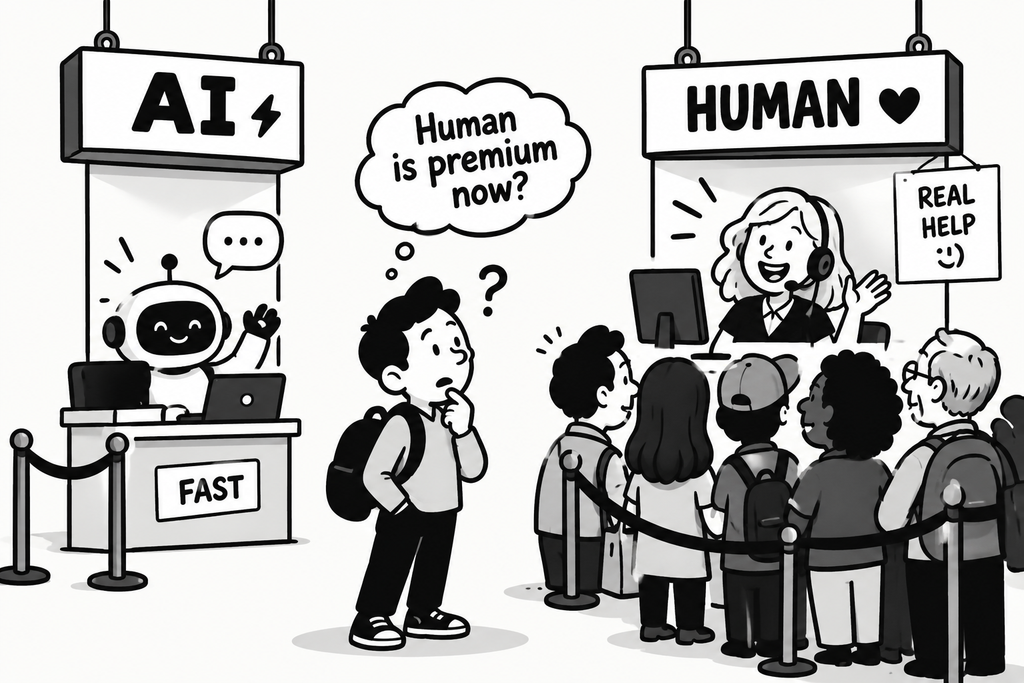
Real human attention becomes scarce.
And economics teaches us that scarcity can create value.
We can already see hints of this.
A company may offer automated support immediately but reserve personal assistance for complicated cases.
A financial service may provide automated information but charge more for personal advice.
A hotel may automate check-in while guests still value the employee who remembers their name.
A restaurant can automate ordering, but people may return because the owner recognizes them.
Perhaps one day we will see a new kind of premium label:
“100% Human Service.”
It sounds like a joke.
But perhaps not entirely.
AI Is Excellent at Answers. Humans May Become More Valuable for Questions.
For centuries, education rewarded people who knew the answers.
AI changes that.
When almost anyone can ask a machine for information, simply knowing facts may become less valuable than knowing what to ask.
Is this information reliable?
What is missing?
What happens if our assumptions are wrong?
Who bears the risk?
Is this technically possible but ethically wrong?
Does this solution make sense for this particular person?
These are judgment questions.
And judgment is difficult to automate because real life rarely arrives as a neat multiple-choice test.
The Winning Combination May Be Human + AI
This does not mean we should resist AI.
Quite the opposite.
A person who refuses to use AI may eventually be at a disadvantage to someone who uses it intelligently.
But a person who relies on AI for everything may have a different problem.
If everyone has access to similar AI tools, the technology itself may stop being the main competitive advantage.
The difference may come from how people use it.
One accountant may use AI simply to produce more reports.
Another may use the time saved to speak with clients and understand their businesses better.
One teacher may use AI to produce worksheets.
Another may use it to spend more time helping students who are struggling.
One small business may automate every customer interaction.
Another may automate routine tasks so employees have more time for customers who genuinely need help.
The same technology can therefore create very different businesses.
Don’t Compete With AI at Being AI
There is little point trying to beat a computer at what computers do best.
Machines will calculate faster.
They will search faster.
They will remember more information.
And they will continue getting better.
The more useful question may be:
What can AI allow us to spend more time doing?
Perhaps the answer is listening.
Thinking.
Explaining.
Creating.
Negotiating.
Taking responsibility.
Building relationships.
And making difficult judgments when there is no perfect answer.
Those abilities may sound old-fashioned.
In an AI economy, they may become surprisingly modern.
The Future May Be More Human Than We Think
Every major technology changes what society values.
When information was scarce, having information was powerful.
When calculation was difficult, being able to calculate quickly was valuable.
When communication was expensive, sending information around the world was valuable.
AI is making many of these things abundant.
And when something becomes abundant, we often begin to value what remains scarce.
Perhaps that scarce resource will be genuine human attention.
Someone who listens.
Someone whose judgment we trust.
Someone willing to say, “I understand your situation.”
Someone willing to take responsibility.
So perhaps the question is not simply:
“Will AI replace humans?”
A better question may be:
“As AI becomes more powerful, which parts of being human become more valuable?”
The answer may determine not only which jobs survive, but what kind of work we choose to create.
A Moment to Pause
Technology may continue to move faster.
But perhaps we do not always have to.
Sometimes the most valuable thing we can offer another person is still remarkably simple:
our attention.
Sources
- Gartner — Survey Finds 87% of Customers Say Companies Using GenAI for Customer Service Must Provide Access to a Human Agent
- International Labour Organization — Generative AI and Jobs: A 2025 Update
- World Economic Forum — The Future of Jobs Report 2025
Sources
Gartner — Gartner Survey Finds 87% of Customers Say Companies Using GenAI for Customer Service Must Provide Access to a Human Agent
Survey of 3,566 customers on GenAI, customer service and access to human agents.
International Labour Organization (ILO) — Generative AI and Jobs: A Refined Global Index of Occupational Exposure
Global estimates of occupational exposure to generative AI and the likely transformation of jobs.
World Economic Forum (WEF) — The Future of Jobs Report 2025
Research on AI, changing skills and the continuing importance of human-centred capabilities.