
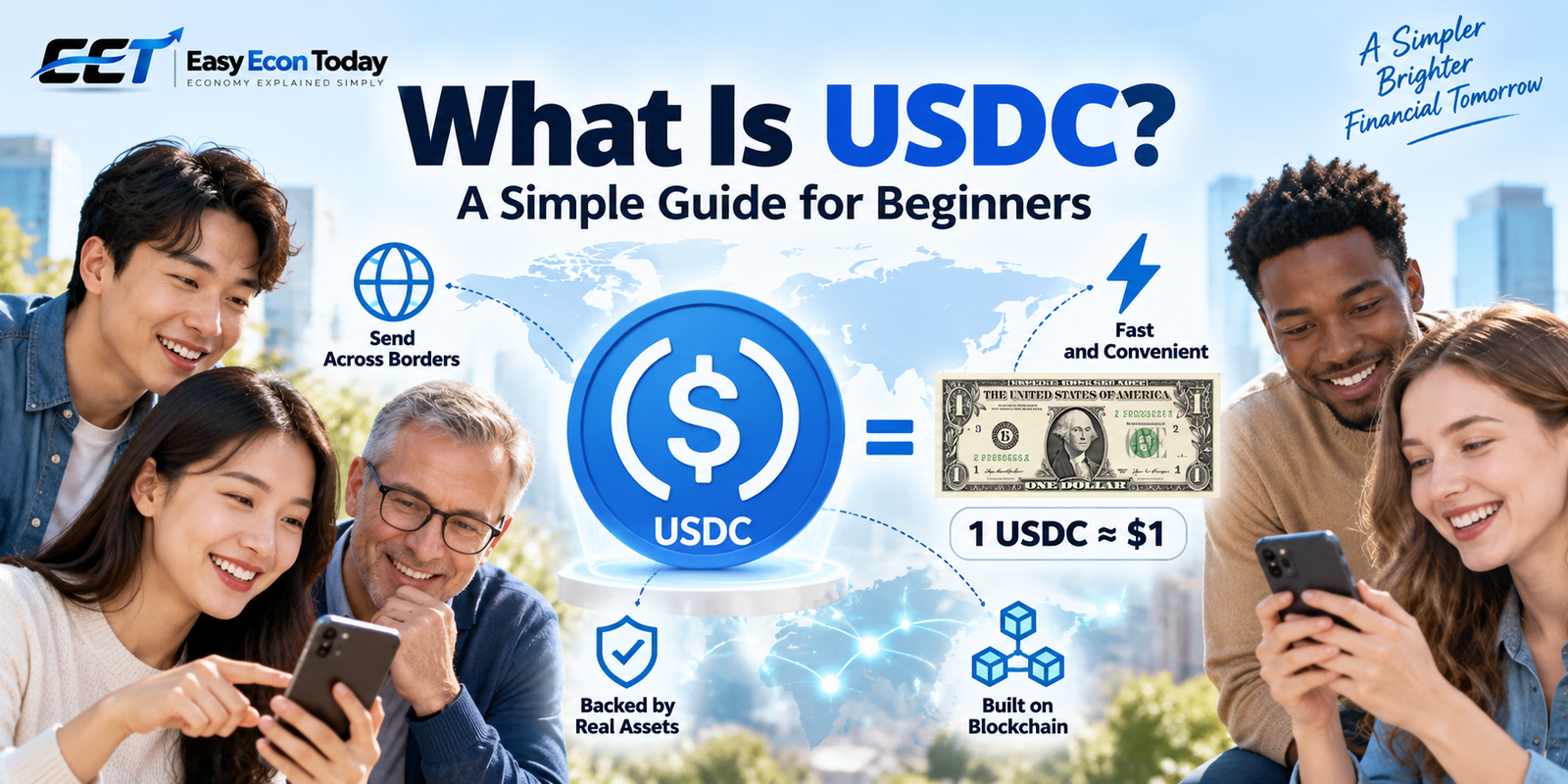
You may have heard people describe USDC as a “digital dollar.”
That sounds simple enough.
But if one USDC is supposed to be worth one U.S. dollar, an obvious question follows:
Why not just use a normal dollar?
The answer is that USDC tries to combine two different things: the relative stability of the U.S. dollar and the ability to move money using blockchain networks.
Let’s look at how it actually works.
What Is USDC?
USDC is a type of cryptocurrency known as a stablecoin.
Unlike Bitcoin, whose price can rise or fall sharply, USDC is designed to maintain a value of approximately:
1 USDC = US$1
USDC is issued by Circle. According to Circle, USDC is backed by highly liquid cash and cash-equivalent dollar assets and is redeemable 1:1 for U.S. dollars under the applicable terms. Circle
Think of it this way:
Traditional dollar → exists in cash or the banking system
USDC → a dollar-linked digital token that can move on blockchain networks
That distinction is the key.
How Does USDC Keep Its $1 Value?
Imagine that US$1,000 is placed into the system and 1,000 USDC are issued.
There should then be dollar-denominated reserve assets backing those tokens.
If USDC is redeemed, the corresponding USDC is removed from circulation as dollars move back out.
Circle says its USDC reserves are held separately from its operating funds and publishes reserve information weekly. A Big Four accounting firm also provides monthly third-party assurance over the reserves. Circle
This reserve structure is what is intended to keep USDC close to one dollar.
It is quite different from Bitcoin.
Bitcoin does not promise:
1 Bitcoin = US$1
Its market price is determined by supply and demand.
USDC, by contrast, is specifically designed to stay close to US$1.
How Does USDC Actually Work?
Suppose Anna in the United States wants to send money to Ben in another country.
Using the traditional banking system, the payment may pass through banks and payment networks before reaching Ben.
With USDC, the basic idea is different.
Anna’s digital wallet → blockchain network → Ben’s digital wallet
Instead of changing the ownership record inside one bank’s database, the transfer is recorded on a blockchain.
USDC is available natively across many blockchain networks, so the precise speed and transaction cost depend on which network and service are being used. Circle
That makes USDC useful for applications such as cross-border transfers, digital payments and other blockchain-based financial services.
Can You Actually Buy Things With USDC?
Yes — where a merchant or payment service accepts it.
But USDC is not accepted everywhere like cash or ordinary bank-card payments.
For many people today, its more common uses include transferring value between digital wallets, moving funds between crypto services, making certain cross-border payments and using blockchain-based financial applications.
In other words, USDC is better thought of as internet-native dollar value than as a replacement for the notes in your wallet.
Is USDC Exactly the Same as Having $1 in a Bank?
No.
This distinction is important.
USDC is designed to maintain a $1 value, but holding USDC is not identical to holding a dollar in an ordinary bank account.
Circle itself notes that although it issues and redeems eligible USDC at a 1:1 rate under its terms, prices on third-party platforms can sometimes move slightly above or below $1. Circle
There are also risks associated with digital wallets, exchanges, blockchain networks and sending funds to an incorrect address or using an unsupported token or network.
So “stablecoin” does not mean “risk-free.”
Why Would Anyone Use USDC Instead of Dollars?
The attraction becomes clearer when we think about the internet.
An email can travel across the world in seconds.
Information does not normally need to wait for a bank to open on Monday morning.
Money, however, has traditionally depended heavily on banking hours, national borders and financial intermediaries.
Stablecoins are an attempt to make money move more like information.
A dollar-linked digital asset can potentially travel between compatible digital wallets across borders without following exactly the same route as a conventional international bank transfer.
That doesn’t make banks obsolete.
But it creates another way of moving dollar-denominated value.
One Important Detail: Not All “USDC” Is Necessarily the Same
USDC operates across many blockchains.
Users therefore need to pay attention to which blockchain they are using and whether the USDC is native or a bridged version.
Circle warns that bridged versions are not necessarily issued or supported by Circle in the same way as native USDC, and sending an unsupported version to the wrong destination can result in lost funds. Circle
For beginners, this is one of the reasons cryptocurrency payments can still feel considerably more complicated than using a credit card.
So, What Is USDC in One Sentence?
USDC is a digital token designed to represent one U.S. dollar and move dollar-linked value across blockchain networks.
That simple idea may have much larger implications.
For most of history, money has moved through banks, card networks and other financial institutions.
USDC and other stablecoins ask a different question:
What happens when dollars can move across the internet almost as naturally as information does?
That may be the more interesting story.
Sources
Circle — USDC Overview
Circle USDC Overview
Circle — Transparency & Reserves
Circle Transparency & Reserves
Circle — USDC Terms & Risk Factors
Circle USDC Terms & Risk Factors