
How the U.S.–Iran Conflict Is Changing Everyday Life Around the World
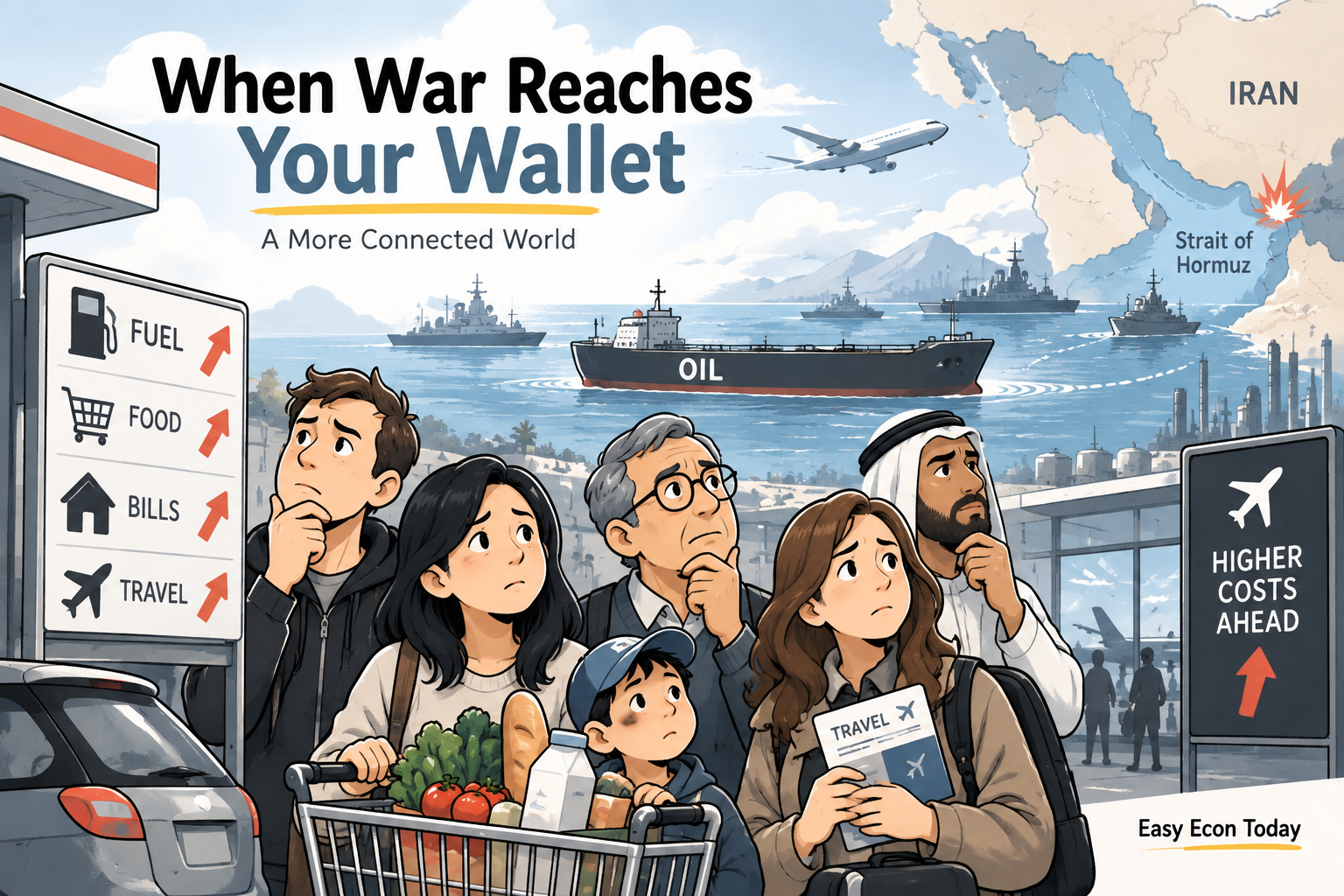
A war may begin thousands of kilometers away.
But its economic consequences can arrive much closer to home.
They can appear at a petrol station in New Zealand, in an electricity bill in Europe, in an airline ticket in Korea, or in the price of food delivered to a supermarket in America.
The continuing conflict involving the United States and Iran has therefore become much more than a Middle Eastern story.
It has become a story about energy, inflation, trade — and the cost of everyday life.
A Small Strait With an Enormous Economic Role
Look at a map of the Middle East and you will find a narrow stretch of water between Iran and Oman: the Strait of Hormuz.
It may look insignificant.
Economically, it is anything but.
Before the current conflict, roughly 20 million barrels per day of crude oil and petroleum products normally passed through the Strait — equivalent to around one-fifth of global oil consumption.
The route is also critically important for natural gas and other commodities.
The conflict has severely disrupted this traffic. Precise current flows are difficult to measure because some ships are travelling with tracking equipment switched off, while interference with navigation systems has also complicated monitoring.
That uncertainty itself has economic consequences.
Oil traders do not need to see an actual shortage before prices react.
The possibility of a shortage can be enough.
Oil Is Only the Beginning
When oil prices rise, the first thing most people notice is the petrol station.
But that is only the beginning.
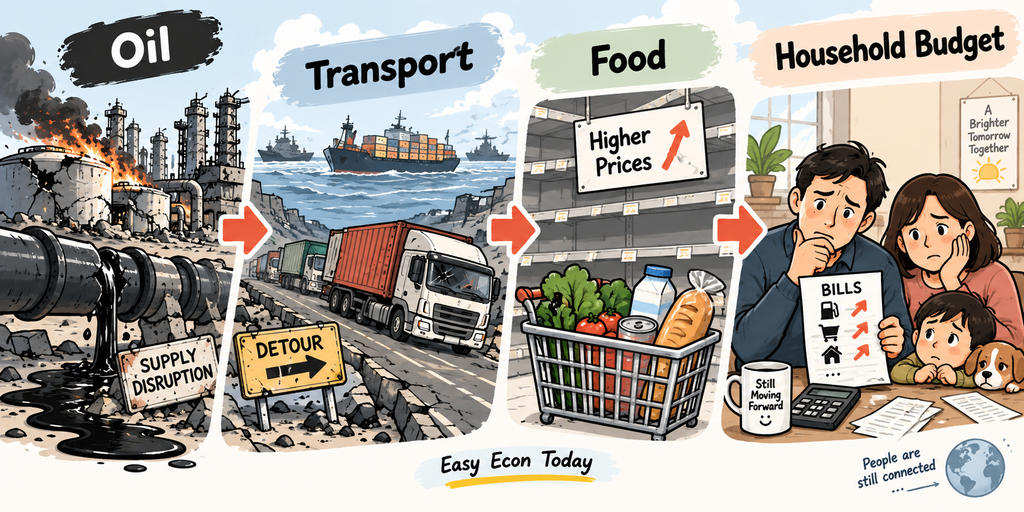
Oil moves trucks.
Trucks move food.
Ships move manufactured goods.
Aircraft move passengers and cargo.
Farmers use fuel to operate machinery. Factories need energy and transportation. Plastics, chemicals and countless everyday products depend directly or indirectly on petroleum.
So an energy shock can travel through the economy like a chain:
War → Energy disruption → Higher fuel costs → Higher transport costs → Higher business costs → Higher consumer prices
By mid-September, international oil prices were trading around or above $100 a barrel.
That matters even to someone who has never purchased a barrel of oil in their life.
When Energy Becomes Inflation
This is where the problem becomes especially important for ordinary households.
Imagine a supermarket.
The vegetables were transported by truck.
The packaging was manufactured.
The refrigeration system uses electricity.
Employees travelled to work.
The building needs heating or cooling.
If energy and transportation costs increase across this entire chain, businesses eventually face a difficult choice: absorb those costs or pass at least some of them on to customers.
That is how a geopolitical crisis thousands of kilometers away can eventually appear on a grocery receipt.
And if higher energy costs push inflation upward for long enough, central banks face another problem.
They may have less room to reduce interest rates — or may face pressure to keep monetary policy tighter than households and businesses would otherwise prefer.
For a family with a mortgage, therefore, an oil shock can potentially reach far beyond the petrol pump.
Related: Why Does Inflation Make You Feel Poorer Even When Your Salary Goes Up?
Why Asia Is Especially Important
The consequences are not distributed evenly around the world.
Asian economies have traditionally been major customers for Gulf energy supplies. China, India, Japan and South Korea are deeply connected to Middle Eastern energy routes.
This means the story is not simply about Iran and the United States.
It is also about factories in Asia, shipping companies crossing oceans, airlines buying jet fuel and consumers buying imported products.
High energy prices and disrupted supply chains can reduce consumption and economic activity, particularly in countries heavily dependent on imported energy.
This illustrates something important about today’s global economy:
Energy security is also economic security.
The World Is Trying to Adapt
Markets are not simply standing still.
Countries and companies are searching for alternative supplies and routes. Producers outside the Gulf can increase production, governments can draw on emergency reserves, and some Middle Eastern exports can be redirected through alternative pipelines and ports.
Shipping companies are adapting too.
When normal routes become dangerous or unreliable, ships may travel farther, insurance costs can increase and companies may need additional vessels.
This is a reminder that economies adjust.
But adjustment is rarely free.
A longer shipping route means more fuel, more time, more insurance and higher freight costs.
Eventually, somebody pays.
Who Feels the Pain First?
Not everyone experiences an energy shock in the same way.
A wealthy household may notice that filling the car costs more.
For a lower-income household, that increase can mean choosing between fuel, heating and food.
The same difference exists between countries.
A wealthy energy-importing nation may have strategic reserves, financial resources and alternative suppliers.
A poorer country may have far fewer options.
When fuel prices rise sharply, governments may try to subsidise petrol or electricity. But subsidies cost money, potentially increasing public debt or reducing spending available for other services.
The same increase in the price of oil can therefore mean very different things to different people.
What Can Ordinary People Do?
Most of us cannot influence the Strait of Hormuz, oil production or diplomatic negotiations.
But that does not mean households are powerless.
This is probably not the moment to make dramatic financial decisions based on predictions about the war. Geopolitical events can change suddenly, and energy prices can move in both directions very quickly.
A more practical response is much less exciting.
Watch household energy spending.
Avoid unnecessary debt where possible.
Keep some financial flexibility.
Think carefully before making large purchases that depend heavily on fuel or borrowing costs.
And perhaps most importantly:
Do not confuse uncertainty with certainty.
No one knows precisely how long the conflict will last or where oil prices will go next.
Even professional energy analysts are dealing with unusually high uncertainty.
The Hidden Geography of Everyday Life
Globalisation has made the world remarkably interconnected.
Usually we barely notice it.
Coffee appears in our kitchen.
Petrol appears at the station.
Packages arrive at our doors.
Food appears on supermarket shelves.
But a crisis can suddenly reveal the invisible network behind all of those ordinary things.
A narrow waterway thousands of kilometers away can influence a truck driver, a farmer, an airline, a factory — and eventually a family sitting around a dinner table.
That may be the most important economic lesson of the current conflict.
Wars begin with missiles and military decisions.
But for millions of ordinary people, their economic consequences arrive quietly — through the fuel pump, the grocery bill and the monthly household budget.
Easy Econ Takeaway
The U.S.–Iran conflict is not only a geopolitical story. It is an example of how deeply connected the modern global economy has become.
When a critical energy route is disrupted, the effects can travel from oil markets to transportation, inflation, interest rates and ultimately household budgets around the world.
The future of the conflict is uncertain.
But one lesson is already clear:
A war can be far away on the map — and surprisingly close to your wallet.
Sources
International Energy Agency (IEA) — Strait of Hormuz and global energy security.
International Energy Agency (IEA) — Oil markets strain to plug the gap left by Middle East supply shortfall.
Analysis of Middle East supply disruptions, alternative supplies, inventories and upward pressure on oil prices.