
The Difference Between Inflation and the Cost of Living
You go to the supermarket.
You pick up some milk, bread, eggs, fruit and a few other everyday items.
At the checkout, you look at the total and think:
“Why does everything still feel so expensive?”
Then the electricity bill arrives.
You fill the car with petrol.
Your insurance renews.
Perhaps the rent has gone up again, or the mortgage payment still takes a large part of your income.
Meanwhile, the news keeps talking about inflation.
Sometimes inflation is falling. Sometimes it rises again. Sometimes economists say that price pressures are “easing.”
For most households, however, the question is much simpler:
“Why does my money seem to buy less than it used to?”
To understand that, we need to separate two things that are often confused:
the inflation rate and the actual level of prices.
1. Inflation Is the Speed of Price Increases
Imagine that a basket of everyday goods costs $100.
After one year of 10% inflation, it costs:
$110
Now imagine inflation falls dramatically to just 3%.
That sounds like very good news.
And it is.
But the basket does not return to $100.
Instead:
$110 × 1.03 = $113.30
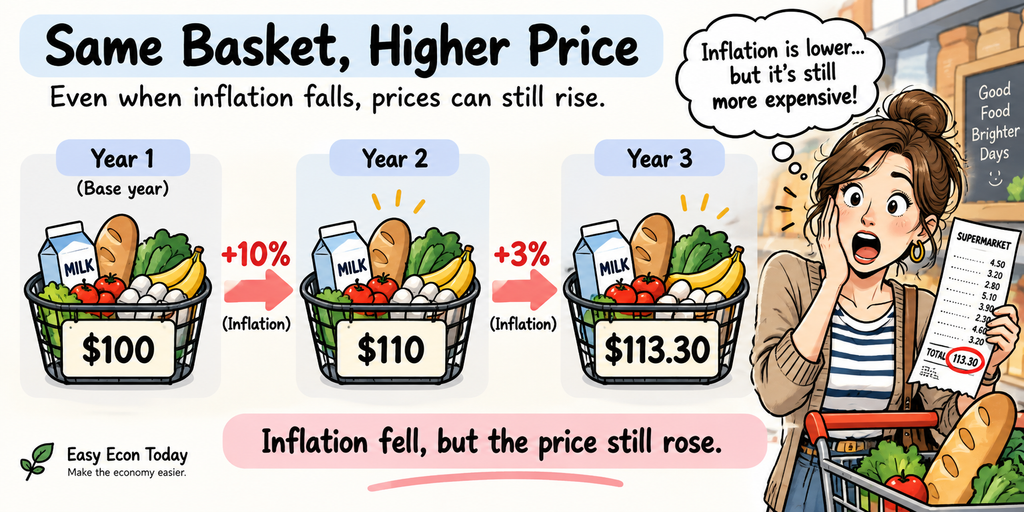
So inflation has fallen from 10% to 3%, yet the same basket has become more expensive again.
This is the key idea.
Lower inflation usually means prices are rising more slowly. It does not mean prices are falling.
Think about driving a car.
If you slow down from 100 km/h to 30 km/h, you are travelling much more slowly.
But you are still moving forward.
Inflation works in a similar way.
2. Falling Inflation and Falling Prices Are Not the Same Thing
Economists have two useful words for this distinction.
Disinflation means inflation is slowing.
Prices are still rising, but at a slower rate.
Deflation means the overall price level is actually falling.
These are very different situations.
Suppose inflation moves like this:
10% → 6% → 3% → 2%
That is disinflation.
It may be excellent news for the economy, but prices can still rise every year.
This explains one of the biggest misunderstandings surrounding inflation.
When we hear:
“Inflation is coming down,”
we may unconsciously hear:
“Things are getting cheaper.”
But what economists usually mean is:
“Things are becoming expensive more slowly.”
That sounds less dramatic, but it is much more accurate.
3. Why Do Economists and Households Sometimes Seem to Live in Different Worlds?
An economist may say:
“Inflation has moderated.”
A household may reply:
“But groceries are still expensive.”
Both can be correct.
Economists often focus on the rate of change.
Households live with the level of prices.
Consider our shopping basket again:
| Year | Cost | Inflation |
|---|---|---|
| Year 1 | $100.00 | — |
| Year 2 | $110.00 | 10% |
| Year 3 | $113.30 | 3% |
Inflation has improved dramatically by Year 3.
But the household is still paying $13.30 more than it did in Year 1.
If that were a weekly expense, the difference would add up to almost $692 over a year.
The inflation problem may therefore improve long before the cost-of-living problem feels resolved.
4. What Is Happening to Inflation Now?
The current picture is more complicated than simply saying, “inflation is falling.”
Inflation across many economies has come down substantially from the very high levels reached after the pandemic.
But that does not mean inflation is falling everywhere at the same time.
Across the OECD, annual consumer-price inflation was 4.1% in July 2026, only slightly below 4.2% in June. Energy prices were rising considerably faster, with annual energy inflation at 11.6%.
New Zealand provides a useful example of how inflation can change direction.
Annual CPI inflation increased from 3.1% in March 2026 to 4.1% in June 2026. Electricity prices, petrol and local authority rates were among the areas contributing to household price pressure.
So the current story is not:
“Inflation is falling and households simply haven’t noticed.”
A better description is:
Inflation has fallen significantly from earlier peaks in many economies, but prices remain high — and in some places inflation has recently picked up again.
That is much closer to what households are experiencing.
5. Why Does My Personal Inflation Feel Higher?
There is another complication.
There is no single household that buys exactly the same basket of goods and services as the official consumer price index.
Consider two households.
One owns a mortgage-free home, works from home and rarely drives.
Another rents, drives long distances to work, has several children and spends a large share of income on food, petrol and electricity.
Both households live under the same official inflation rate.
But they may experience it very differently.
This is why your personal cost of living can rise faster — or slower — than the headline inflation number.
And some prices are psychologically more noticeable than others.
We see the price of milk, bread, petrol and coffee frequently.
We may buy a television only once every several years.
So when frequently purchased items become more expensive, we notice the change repeatedly.
The supermarket shelf can sometimes feel more real than the inflation statistic on the evening news.
6. What Really Matters Is Whether Income Keeps Up
Prices alone do not determine whether our standard of living is improving.
Income matters too.
Suppose your salary rises by 3%.
That sounds positive.
But if your living costs rise by 5%, your purchasing power has fallen.
You have more dollars coming into your bank account, but those dollars buy less.
Now imagine the opposite.
Your income rises by 4%, while your living costs rise by 2%.
Your purchasing power has probably improved.
That is why the important question is not simply:
“Did my salary increase?”
It is:
“Did my income increase faster than the cost of the things I actually buy?”
This is the difference between nominal income and real income.
And ultimately, real income is what determines how wealthy or financially comfortable we feel.
Related: Why Does Inflation Make You Feel Poorer Even When Your Salary Goes Up?
7. Why the Cost-of-Living Problem Can Last for Years
Imagine several years of unusually high inflation.
Prices rise rapidly.
Eventually inflation returns to a more normal level.
Central bankers and economists may reasonably say that the inflation crisis is under control.
But families are still living with all the price increases accumulated during those previous years.
The price level has moved to a new, higher starting point.
For life to begin feeling easier, something else may need to happen:
incomes need time to catch up.
That can take years.
And for households whose incomes do not rise sufficiently, some of the lost purchasing power may never be fully recovered.
This is why a country can technically solve its inflation problem while many families still say:
“Life is expensive.”
Both statements can be true.
8. What Can Households Actually Do When Prices Stay High?
We cannot control inflation ourselves.
But we can pay more attention to how inflation affects our own household.
A few practical habits can help.
1. Look at the Biggest Expenses First
It is easy to focus on small purchases.
Perhaps coffee has become more expensive.
Perhaps a favourite supermarket item has gone up by $1.
Those increases matter.
But the largest savings often come from the largest recurring expenses.
Look first at:
housing, insurance, electricity, transport, subscriptions and debt interest.
Saving $30 a month on an insurance policy is worth:
$360 a year.
Reducing one large recurring bill can sometimes matter more than worrying about every small purchase.
2. Look at the Actual Price, Not Just the Discount
A sign saying:
“20% OFF!”
immediately attracts attention.
But if the original price has already risen significantly, the discounted price may still be expensive.
Instead of asking:
“How large is the discount?”
ask:
“Is this good value at the price I am actually paying?”
The percentage on the sign is marketing.
The dollars leaving your bank account are what matter.
3. Watch Out for Lifestyle Inflation
Suppose your salary rises by 5%.
It is tempting to immediately upgrade your spending.
A better car.
More restaurant meals.
More subscriptions.
A more expensive holiday.
But if prices have also risen, spending the entire pay increase can leave your financial position almost unchanged.
When income increases, keeping at least part of that increase can help rebuild purchasing power and savings.
4. Review Automatic Bills Once or Twice a Year
Some expenses quietly leave our bank accounts every month.
Insurance.
Phone plans.
Internet.
Streaming services.
Software subscriptions.
Electricity plans.
Because the payments are automatic, we stop noticing them.
Set aside an hour once or twice a year to review them.
Ask:
“Do I still need this?”
“Is there a better plan?”
“Can I negotiate or change provider?”
One hour spent reviewing recurring bills may sometimes save more money than weeks of worrying about small everyday purchases.
5. Protect a Small Emergency Buffer
High prices make unexpected expenses more difficult.
A car repair, medical bill, appliance replacement or sudden electricity bill can push a household toward expensive debt.
Even a modest emergency fund can provide some protection.
The goal does not have to be perfection.
It is simply to create a little more space between:
what comes in
and
what must go out.
9. We Cannot Control Inflation — But We Can Understand It Better
Inflation is one of those economic ideas that sounds abstract until we stand at a supermarket checkout.
Then it becomes very real.
The important thing to remember is that inflation measures the speed at which prices are changing, not whether prices feel cheap or expensive.
Inflation can fall while prices remain high.
Inflation can rise again after falling.
And your own cost of living can behave differently from the national average because your household buys a different combination of goods and services.
So the next time you hear:
“Inflation has fallen,”
you might ask one more question:
“What has happened to the actual price level — and has my income kept up?”
That question tells us much more about our real standard of living.
The Bottom Line
The inflation rate may rise and fall.
But households live with the prices that remain behind.
That is why the end of high inflation does not automatically mean the end of high living costs.
And it is why understanding inflation is not just about watching economic statistics.
It is about understanding what our money can actually buy.
We cannot control inflation.
But we can pay more attention to which prices matter most in our own lives — and make better decisions around the things we can control.
☕ A Moment to Pause
Economic numbers matter.
But they matter because behind every inflation figure are real households buying groceries, paying bills and trying to plan for the future.
So after all those prices, percentages and calculations, take a moment to slow down.
Make a cup of coffee, put the numbers aside for a few minutes, and take a moment to breathe.
Sources
U.S. Bureau of Labor Statistics — Consumer Price Index, August 2026
OECD — Consumer Prices and Inflation, July 2026
Stats NZ — Consumers Price Index: June 2026 Quarter
New Zealand CPI inflation, petrol, electricity and other household price movements.